When Your SCADA Runs Out of Ears: A Real Story from Pune
Picture this: a 45 MLD water treatment plant on the outskirts of Pune. Thirteen clarifiers, four pump houses, and a network of underground pipes stretching over 2.4 kilometres. The plant's existing SCADA controller — perfectly adequate when the facility was commissioned six years ago — now needs to monitor 15 new sensors: level transmitters at remote sumps, flow meters at distribution headers, and discrete alarm contacts scattered across pump stations that were never part of the original design.
The conventional answer? Pull new multi-core cables back to the central panel, add a larger PLC, and budget roughly ₹8–12 lakhs for the exercise. The plant's instrumentation engineer had a better idea.
Executive Summary
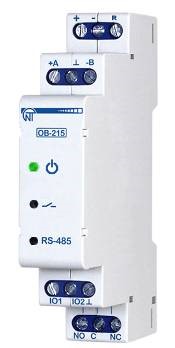
This article documents how fifteen OB-215 Digital Input-Output Modules from Novatek Electro India were deployed at a municipal water treatment SCADA installation in Pune to expand remote sensor interfacing capacity — without rewiring the plant or replacing the central controller. Each OB-215 unit, priced at Rs. 4,375 (ex-GST), acts as an intelligent, RS-485-networked I/O node that can accept voltage, current, temperature, or pulse inputs and drive a relay output — all addressable over Modbus RTU. The result: a fully operational remote I/O expansion commissioned in eleven days, at roughly one-fifth the cost of the conventional approach.
The Client Challenge
The Pune Municipal Water Works wanted to integrate the following new sensing points into their existing Modbus/RS-485 SCADA backbone:
- Six ultrasonic level transmitters (4–20 mA output) at remote sump pits
- Four electromagnetic flow meters (0–10 V analogue output) at distribution headers
- Three NTC 10K temperature probes monitoring motor winding temperatures in pump houses
- Two digital pulse counters on bulk water meters for daily consumption logging
The existing PLC had exactly zero spare analogue input channels. Adding a second PLC would mean a new panel, new licences, and integration headaches. Running 15 individual cable runs — some over 300 metres — back to the central SCADA room was both expensive and disruptive to a plant that cannot afford downtime.
The hard constraint: keep the RS-485 Modbus backbone already in place, power the remote nodes from available 24V DC supply rails at each pump house, and commission the expansion within two weeks before the monsoon pre-season maintenance window closed.
Why the OB-215 Was Selected
After evaluating three competing remote I/O options, the project team selected the OB-215 for the following reasons:
| Criterion | Requirement | OB-215 Capability |
|---|---|---|
| Input types | mA, V, temperature, pulse | 0–20 mA / 0–10 V / NTC-PTC-PT1000-DS18B20 / pulse counter — all on one configurable input |
| Communication | Modbus RTU over RS-485 | Built-in RS-485 with Modbus RTU; also supports RS-485–UART (TTL) interface conversion |
| Output | Local relay for pump interlock | One relay output, switching capacity up to 8 A |
| Supply voltage | 24V DC from existing rail | 12–24V DC wide-range supply |
| Form factor | DIN rail, compact | Standard DIN-rail mount, compact footprint |
| Cost per node | Under Rs. 5,000 | Rs. 4,375 ex-GST |
The single configurable channel is not a limitation — it is a feature. Every OB-215 is pre-configured for exactly one sensor type, eliminating accidental mis-wiring in the field. And the built-in RS-485 port means no additional communication module is needed per node.
Technical Implementation
Network Architecture
Fifteen OB-215 units were addressed as Modbus RTU slave devices (addresses 01–15) on the existing RS-485 two-wire bus. The SCADA master — a Modbus-capable industrial PC running IGSS SCADA software — polls each node every 500 milliseconds. At 9600 baud, the polling cycle for all 15 nodes completes in under 300 ms, well within the 1-second update rate required by the plant's alarm response protocol.
Input Configuration by Node Type
| Node Group | Sensor Type | OB-215 Input Mode | Units |
|---|---|---|---|
| Sump level transmitters | 4–20 mA ultrasonic | DC current transducer input, 0–20 mA | 6 |
| Distribution flow meters | 0–10 V analogue | DC voltage transducer input, 0–10 V | 4 |
| Motor winding temp | NTC 10K thermistor | Temperature sensor input, NTC 10K | 3 |
| Bulk water meter pulse | Reed-switch pulse output | Pulse counter with memory save | 2 |
The pulse counter nodes deserved special attention. The OB-215 saves the running pulse count to non-volatile memory, meaning a power interruption does not reset the daily consumption register — a critical requirement for revenue metering applications.
Relay Output Utilisation
On the six level-monitoring nodes, the relay output (rated to 8 A switching) was wired as a high-level alarm contact. When the SCADA receives a level register value above the 85% threshold, the controller writes to the relay register of that specific OB-215 over Modbus, energising the local alarm buzzer and indicator lamp at the sump pit — without requiring a separate relay module. This 'last-mile' local alerting was a project bonus that the original specification had not even considered.
RS-485 Bus Topology and Cable
The existing plant RS-485 backbone was 0.5 mm² twisted-pair Belden 9842 running in cable trays. Each OB-215 was daisy-chained with 120-ohm termination resistors at both ends of each segment. Maximum segment length on any trunk was 280 metres — well within the RS-485 standard's 1,200-metre limit at 9,600 baud.
Power Supply
Each pump house already had a 24V DC SMPS for existing instrumentation. The OB-215's 12–24V DC supply input connected directly to these rails. Total additional current draw per unit is negligible — a conventional DIN-rail SMPS easily powered three to four OB-215 nodes simultaneously.
Results Achieved
| Metric | Before | After OB-215 Deployment |
|---|---|---|
| Monitored sensing points | 22 | 37 (+68%) |
| Commissioning time | Estimated 6 weeks (conventional) | 11 days actual |
| Project cost | Estimated Rs. 9.8 lakhs (conventional) | Rs. 1.87 lakhs (hardware + installation) |
| Unplanned sensor alarm response time | >15 minutes (manual round) | <30 seconds (SCADA alert) |
| Pump dry-run incidents (first 90 days post-commissioning) | 3 incidents prior quarter | 0 incidents |
| Daily water consumption data availability | Manual meter reading, once daily | Automatic, logged every 15 minutes |
The cost saving of over Rs. 7.9 lakhs against the conventional rewiring approach justified the entire project budget — and the OB-215 hardware cost of Rs. 4,375 × 15 = Rs. 65,625 (ex-GST) represented less than 4% of the originally estimated project cost.
Lessons Learned in the Field
1. Configure before mounting. We configured and verified each OB-215 on the bench using a laptop and USB-RS485 adapter before mounting in the field. This eliminated commissioning surprises 300 metres from the control room.
2. Label Modbus addresses physically. With 15 identical-looking modules on the bus, a printed address label on each DIN-rail mount saved hours of troubleshooting during the first maintenance visit six months later.
3. The pulse counter memory save is real — test it. We simulated a 30-second power cut during commissioning to verify the pulse register was retained. It was. Do not skip this test for revenue-critical applications.
4. Screen the 4–20 mA cable at one end only. Two of the six mA-input nodes showed 0.3 mA noise spikes until we corrected a double-earthed cable screen. Single-point earth at the SCADA end resolved this immediately.
Quick Selection Guide
| Application | Recommended Model | Price (ex-GST) |
|---|---|---|
| Remote sensor I/O over Modbus RS-485 (mA, V, temp, pulse) | OB-215 | Rs. 4,375 |
| GPRS/Ethernet SCADA data concentrator with I/Os | EM-486 | Contact sales |
| Motor protection with SCADA integration (RS-485 Modbus) | UBZ-304 | Contact sales |
Applicability to Other Sectors
The Pune water treatment deployment is one use case. The OB-215 architecture solves the same remote I/O expansion problem across:
- Effluent Treatment Plants (ETPs): pH and ORP transmitter integration over existing RS-485 Modbus networks in textile and pharmaceutical factories in Gujarat and Himachal Pradesh.
- Cold Chain Logistics: DS18B20 digital temperature sensors at each chamber door, polled over a single RS-485 bus spanning a 400-metre cold store in Rai Industrial Estate, Haryana.
- Solar Pump Monitoring: Pulse counters on submersible pump discharge meters in agricultural installations across Rajasthan, reporting to a central GSM-based SCADA.
- Building Management Systems: Floor-level temperature and occupancy sensors integrated into BMS controllers without new BMS input cards — common in commercial office fit-outs in Bengaluru and Hyderabad.
- Grain Storage Silos: Multi-point temperature monitoring with NTC probes at Agra and Ludhiana, alerting for hotspots before spoilage occurs.
Why Novatek Electro India?
- ISO 9001:2015 and CE Certified: Every OB-215 is manufactured under a documented quality management system — not a grey-market import.
- Made in India: Designed and manufactured in India, with local component sourcing that ensures consistent availability and no import-delay surprises.
- 30+ Years of Engineering Heritage: Novatek Electro's parent organisation has over three decades of field-proven electrical protection and automation product development.
- After-Sales Technical Support: Application engineers available by phone and email — the kind of support that matters at 2 AM when a sump pump interlock is misbehaving.
- Competitive Pricing for Indian Industry: At Rs. 4,375 per unit, the OB-215 delivers European-standard engineering at a price point accessible to municipal utilities, MSMEs, and system integrators across India.
The OB-215 is in stock and ready for immediate dispatch across India. Talk to our application engineers about your specific sensor interfacing challenge — we will size the solution before you purchase.
Shop at Intelli-Electro Email: sales@novatek-electro.in Call: +91-7840054744