When a Solar Plant's Grid Connection Kills the Motor — Not the Inverter
Here is a fault condition that trips up even experienced electrical engineers in renewable energy installations: the solar inverter is running perfectly, the grid is energised, the three-phase supply reads 415 V line-to-line on your multimeter — and yet the compressor motor that drives your plant's HVAC system is drawing asymmetric current, running hotter than rated, and heading toward insulation failure. No alarm. No trip. The thermal overload relay is set correctly. So what is happening?
The answer is almost always voltage asymmetry or phase imbalance — not outright phase loss. A 3–4% voltage unbalance between phases, which is entirely invisible to a standard thermal overload, can translate into a 20–25% increase in negative-sequence current inside the motor windings. That negative-sequence current does not produce useful torque; it produces heat. In a solar or renewable energy facility where the grid connection is shared with inverter-based generation, harmonic loading and variable generation profiles routinely push phase voltage asymmetry beyond the 2% threshold that IS 12360 and IEC 60034-26 define as safe for continuous motor operation.
A three-phase voltage monitoring relay — specifically the Novatek Electro RNPP-302M and RNPP-301 — is the device that closes this protection gap. These relays monitor all three phases simultaneously, evaluate voltage magnitude, phase sequence, phase balance and phase presence, and trip the motor contactor within milliseconds of detecting a fault. This article explains the underlying protection physics, walks through both models in detail, and gives you a practical selection and wiring guide for solar and renewable energy applications.
The Physics of Three-Phase Motor Vulnerability
Why Thermal Overloads Are Not Enough
The thermal overload relay responds to total line current exceeding a set threshold. It does not distinguish between current caused by overload torque and current caused by voltage unbalance. Under a phase imbalance condition, current in the heaviest-loaded phase may still remain below the overload trip threshold even while the motor's thermal withstand is being exceeded. The relay remains closed. The motor fails.
Three-phase voltage monitoring operates upstream of the motor — at the supply voltage level — before asymmetric current has even entered the motor terminals. It is preventive, not reactive.
Fault Conditions That Must Be Detected
- Phase Loss / Single Phasing: One phase drops to zero. The motor attempts to run on two phases, drawing 1.73× rated current on the remaining phases. Stall torque drops to approximately 25% of rated. Windings fail within minutes.
- Phase Imbalance / Asymmetry: All three phases are present but at unequal voltages. Even 3–4% imbalance causes disproportionate negative-sequence heating in the rotor.
- Phase Sequence Reversal: The rotational direction of the motor reverses. For compressors, CNC spindles and HVAC fans, reverse rotation causes immediate mechanical damage and potential process hazard.
- Over-Voltage: Supply voltage exceeds the motor nameplate rating. Causes magnetic core saturation, increased iron losses, higher magnetising current and insulation stress.
- Under-Voltage: Supply voltage falls below rated. Motor draws higher current to maintain torque, causing resistive heating. Also increases slip and reduces efficiency.
- Phase Coincidence / Shorting: Two or more phases are electrically connected — a wiring fault condition that RNPP-302M specifically detects.
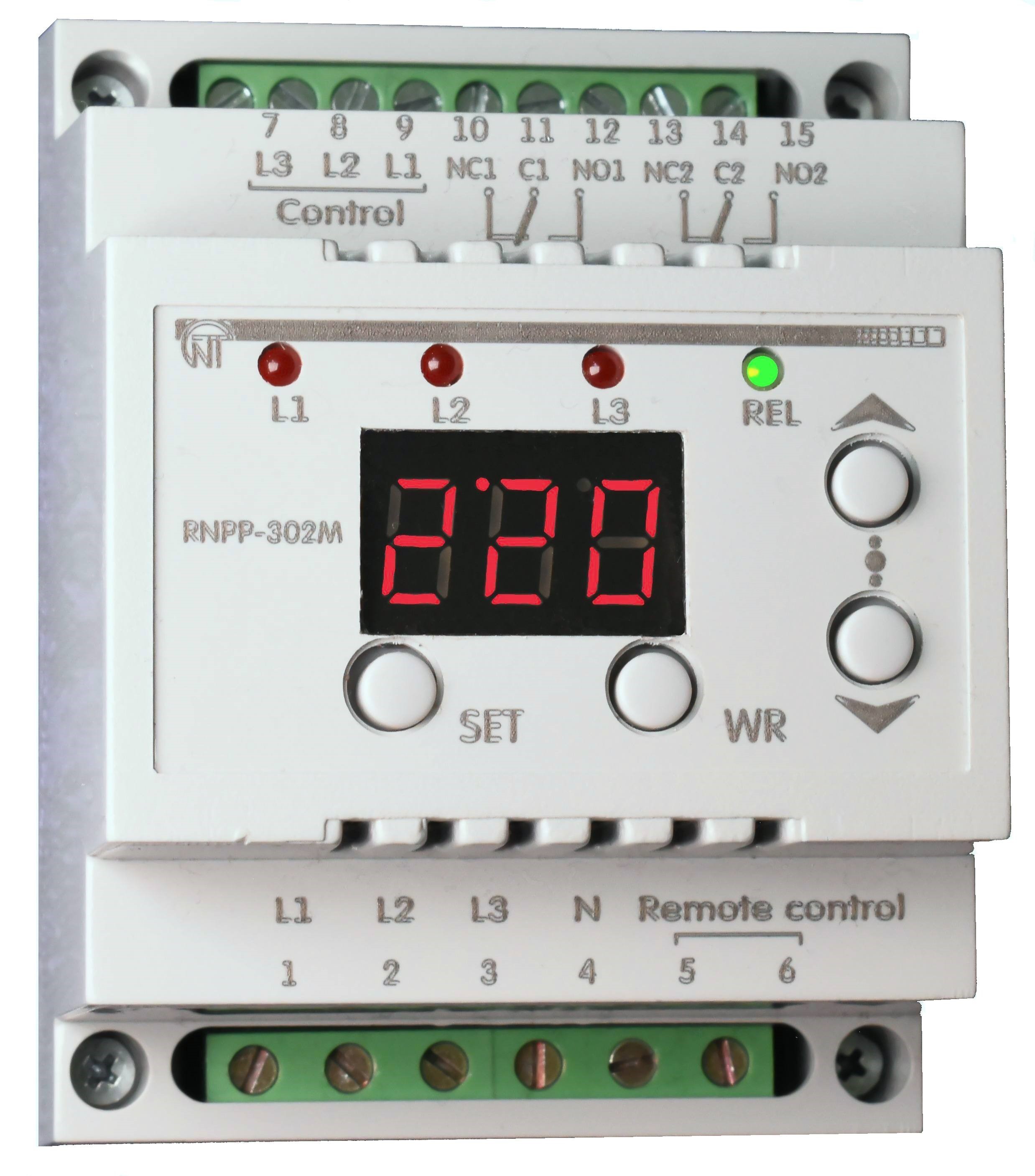
RNPP-302M — Programmable Three-Phase Voltage Monitoring Relay
Design Philosophy
The RNPP-302M is a programmable, multi-functional three-phase voltage monitoring relay designed for installations where the nominal supply voltage is not fixed — a common situation in solar plants where the grid connection point may be 220/380 V, 230/400 V or 240/415 V depending on the distribution transformer tap and the state electricity board's nominal standard. Rather than stocking separate relays for each voltage level, the RNPP-302M allows the engineer to select the operating voltage range during commissioning.
Key Technical Specifications
| Parameter | RNPP-302M Value |
|---|---|
| Voltage Type | AC |
| Operating Voltage (Selectable) | 220/380 V, 230/400 V, 240/415 V |
| Number of Poles | 3-pole and 4-pole (3-wire and 4-wire systems) |
| Output Contact Form | DPDT — 2 NO + 2 NC (Power + Signalisation output) |
| Output Contact Rating | 8 A @ 250 V AC |
| Protection Functions | Over-voltage, Under-voltage, Phase loss, Phase imbalance, Reverse phase sequence, Phase coincidence, Contactor output monitoring |
| Special Feature | Additional input for emergency button; Contactor monitoring function |
| Application | Three-phase voltage and contactor output monitoring (multi-functional) |
| Price (ex-GST) | Rs. 3,000 per piece |
The contactor monitoring function is particularly valuable in motor control centres where contact welding — a contactor failure mode caused by high inrush currents — must be detected. If the contactor contacts weld shut while the monitoring relay has tripped, the RNPP-302M detects this anomaly and signals an alarm, preventing an uncontrolled re-start when supply voltage returns to normal.
Buy RNPP-302M — Rs. 3,000 ex-GSTRNPP-301 — Standard Three-Phase Voltage Monitoring Relay
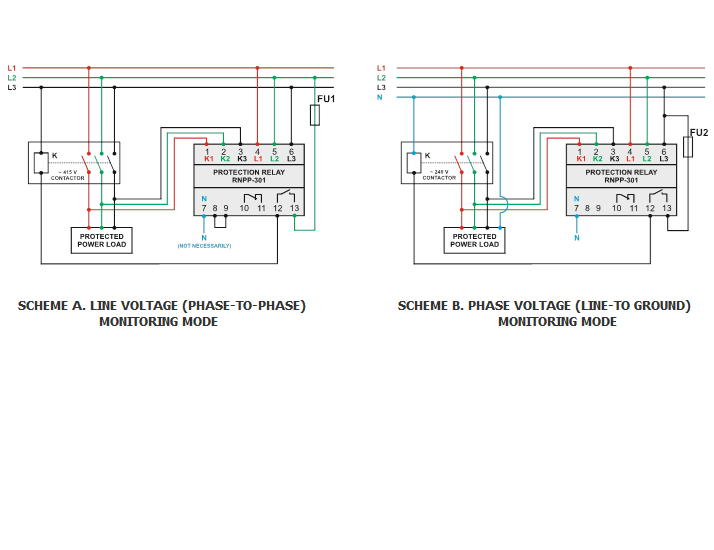
The RNPP-301 is Novatek Electro's established three-phase voltage monitoring relay, offering comprehensive protection at a price point suited to volume deployments — such as large solar plant auxiliary systems with many pump and fan motors distributed across a site. At Rs. 4,417 per piece (ex-GST), the RNPP-301 provides robust protection for standard three-phase industrial loads where the supply voltage is fixed and the application demands reliable, proven protection without the need for programmable voltage range selection.
Buy RNPP-301 — Rs. 4,417 ex-GSTModel Comparison Table
| Feature | RNPP-302M | RNPP-301 |
|---|---|---|
| Voltage Range | 220/380, 230/400, 240/415 V (selectable) | Three-phase standard range |
| Poles | 3-pole and 4-pole | 3-pole and 4-pole |
| Output Contact | DPDT (2 NO + 2 NC) | DPDT (2 NO + 2 NC) |
| Contact Rating | 8 A @ 250 V AC | Standard rating |
| Over-voltage Protection | Yes | Yes |
| Under-voltage Protection | Yes | Yes |
| Phase Loss Protection | Yes | Yes |
| Phase Imbalance Protection | Yes | Yes |
| Reverse Phase Sequence | Yes | Yes |
| Phase Coincidence Detection | Yes | Standard |
| Contactor Monitoring | Yes (unique feature) | No |
| Emergency Button Input | Yes (additional input) | No |
| Programmable Voltage Range | Yes | No |
| Price (ex-GST) | Rs. 3,000 | Rs. 4,417 |
Quick Selection Guide by Application
| Application | Key Risk | Recommended Model | Price (ex-GST) |
|---|---|---|---|
| Solar plant auxiliary motors (pumps, fans) | Variable grid voltage, imbalance from inverter-grid interaction | RNPP-302M | Rs. 3,000 |
| CNC machine spindle motors | Phase reversal causing reverse spindle rotation; phase loss | RNPP-302M | Rs. 3,000 |
| Industrial compressors | Single phasing during unloaded start; contactor welding risk | RNPP-302M | Rs. 3,000 |
| Conveyor drive motors | Phase loss under loaded condition; supply asymmetry | RNPP-301 | Rs. 4,417 |
| HVAC plant in renewable energy buildings | Over/under-voltage from grid-solar switching; imbalance | RNPP-302M | Rs. 3,000 |
| Renewable energy plant general motor MCC | Multiple motors, fixed 415 V supply, cost-sensitive volume | RNPP-301 | Rs. 4,417 |
How the Protection Circuit Works — Engineering Detail
Voltage Measurement and Symmetrical Components
Inside the RNPP-302M, a microcontroller-based measurement circuit continuously samples all three phase voltages using precision voltage dividers and an analogue-to-digital conversion stage. The firmware calculates the RMS value of each phase voltage and applies symmetrical component analysis to derive the positive-sequence and negative-sequence components. Phase loss is detected when any phase RMS voltage falls below the set under-voltage threshold. Phase imbalance is flagged when the ratio of negative-sequence to positive-sequence voltage exceeds a preset percentage threshold. Phase sequence reversal is detected by evaluating the temporal phase angle relationships between the three measured voltages.
Response Time and Trip Logic
Detection of a fault condition causes the output relay to de-energise — opening the normally-closed contact in series with the motor contactor coil and closing the normally-open contact to drive an alarm or indicator. The response time to phase loss is intentionally fast to limit thermal exposure of the motor windings. A user-configurable time delay (where supported) allows the relay to ride through momentary voltage dips that do not constitute genuine supply faults — important in grid-connected solar installations where inverter switching can cause brief transients.
Contactor Monitoring — RNPP-302M Exclusive
The contactor monitoring function in the RNPP-302M uses a feedback signal from the contactor's auxiliary contact. The relay logic continuously cross-checks its own output state against the contactor's reported state. A discrepancy — contactor closed when relay output is open, or vice versa — triggers a fault indication and prevents automatic restart. This function provides protection against contact welding, which is a serious risk in compressor starters subjected to frequent starts against back-pressure.
Wiring Best Practices for Solar and Renewable Energy Installations
- Connect voltage sensing inputs directly to the motor terminals or immediately downstream of the motor circuit breaker — not at the main incomer. This ensures the relay detects phase faults in the cable run between the panel and the motor, not just at the panel incomer.
- Use the NC output contact (normally closed) in series with the contactor coil circuit. This is a fail-safe wiring philosophy: any relay failure, wiring fault or supply loss to the relay itself will de-energise the contactor and stop the motor — the safest default state.
- For the RNPP-302M contactor monitoring function, wire the contactor's auxiliary NC contact back to the relay's designated feedback input terminal. Consult the product datasheet wiring diagram for the correct terminal numbering.
- Shield voltage sensing wiring from high-frequency noise in solar plant environments. String inverter switching at 10–20 kHz and solar charge controller PWM outputs can couple noise into unshielded measurement wiring. Use twisted-pair shielded cable for sense wiring and earth the shield at one end only.
- Install a dedicated MCB upstream of the monitoring relay's supply terminals. This allows the relay to be isolated and tested without de-energising the entire distribution board.
- Label all relay terminals clearly with phase identification (L1, L2, L3, N) at commissioning. Phase sequence errors in initial wiring are the single most common cause of phase reversal trip at first power-up — easily corrected by swapping any two of the three phase connections.
Troubleshooting Common Installation Issues
Relay Trips Immediately on Power-Up
Check phase sequence. Swap any two phase connections at the relay's voltage sensing input terminals. If the trip clears, the incoming phase sequence was reversed. Verify using a phase sequence indicator before reconnecting motors.
Relay Trips Intermittently Under Load
Log line voltage on all three phases over a 24-hour period using a power quality analyser. Intermittent trips in solar plant environments are frequently caused by voltage swell during peak solar generation — the utility grid voltage rises when local generation exceeds local load, pushing line voltage above the relay's over-voltage set point. Adjust the over-voltage threshold if the observed voltage is within the motor's rated withstand, or investigate grid export management settings on the inverter.
Contactor Monitoring Alarm on RNPP-302M Without Apparent Fault
Check the auxiliary contact wiring continuity from the contactor back to the relay's feedback input. A broken or loose connection on the auxiliary contact circuit will be interpreted by the relay as a state mismatch. Also check for contactor auxiliary contact wear — auxiliary contacts in high-cycle applications wear faster than main contacts and should be part of the preventive maintenance schedule.
Every unprotected three-phase motor in your solar plant, CNC shop or HVAC system is one phase fault away from a rewinding bill or unplanned downtime. The RNPP-302M at Rs. 3,000 ex-GST and RNPP-301 at Rs. 4,417 ex-GST are among the most cost-effective insurance policies in industrial electrical engineering.
Order Online at Intelli-Electro Email: sales@novatek-electro.inCall our technical team: +91-7840054744
Why Novatek Electro?
- ISO 9001:2015 Certified Manufacturing: Every relay is manufactured under a documented quality management system with incoming material inspection, in-process testing and final calibration records.
- CE Certified Products: Conformity to European safety and EMC directives — relevant for OEM panel builders exporting to international markets.
- Made in India: Designed and manufactured in Delhi, with locally available spare parts and a sales network across the country through authorised distributors and panel-building OEMs.
- 30+ Years of Product Development: Novatek Electro has been developing electrical protection devices for over three decades, with a product range that spans single-phase and three-phase voltage monitoring, current monitoring, time relays and multifunction protection devices.
- After-Sales Technical Support: Application engineers are available to assist with wiring queries, parameter setting and troubleshooting — reach the team at sales@novatek-electro.in or +91-7840054744.
Engineering FAQs — Three Phase Voltage Monitoring Relays
Get Technical Support and Place Your Order
For technical specifications, wiring diagrams, bulk pricing for OEM panel builders and project-specific application support, contact the Novatek Electro team:
- Online Purchase: intelli-electro.com — Three Phase Voltage Relay Category
- Email: sales@novatek-electro.in
- Phone / WhatsApp: +91-7840054744
All prices are ex-GST. GST at 18% applicable extra. Prices as per Novatek Electro India Price List 2026-27, effective 01.04.2026. Prices subject to change — confirm at time of order.