When a Microsecond Matters: Power Quality in Defense & Aerospace Electrical Systems
Imagine a test bench qualifying a mission-critical avionics module. The power supply feeding it experiences a 40-millisecond voltage sag — invisible to a standard energy meter, undetectable by a conventional data logger sampling every few seconds. The module fails its qualification test. The engineer suspects the component. The real culprit? An upstream power quality event that no instrument on-site was fast enough to catch.
This is not a theoretical scenario. Defense establishments, aerospace manufacturing facilities, maintenance-repair-overhaul (MRO) hangars, and research laboratories operate under electrical conditions where power quality is not a utility concern — it is an operational and safety-critical engineering parameter. Yet, in many such facilities across India, energy monitoring infrastructure lags decades behind the precision of the processes it supports.
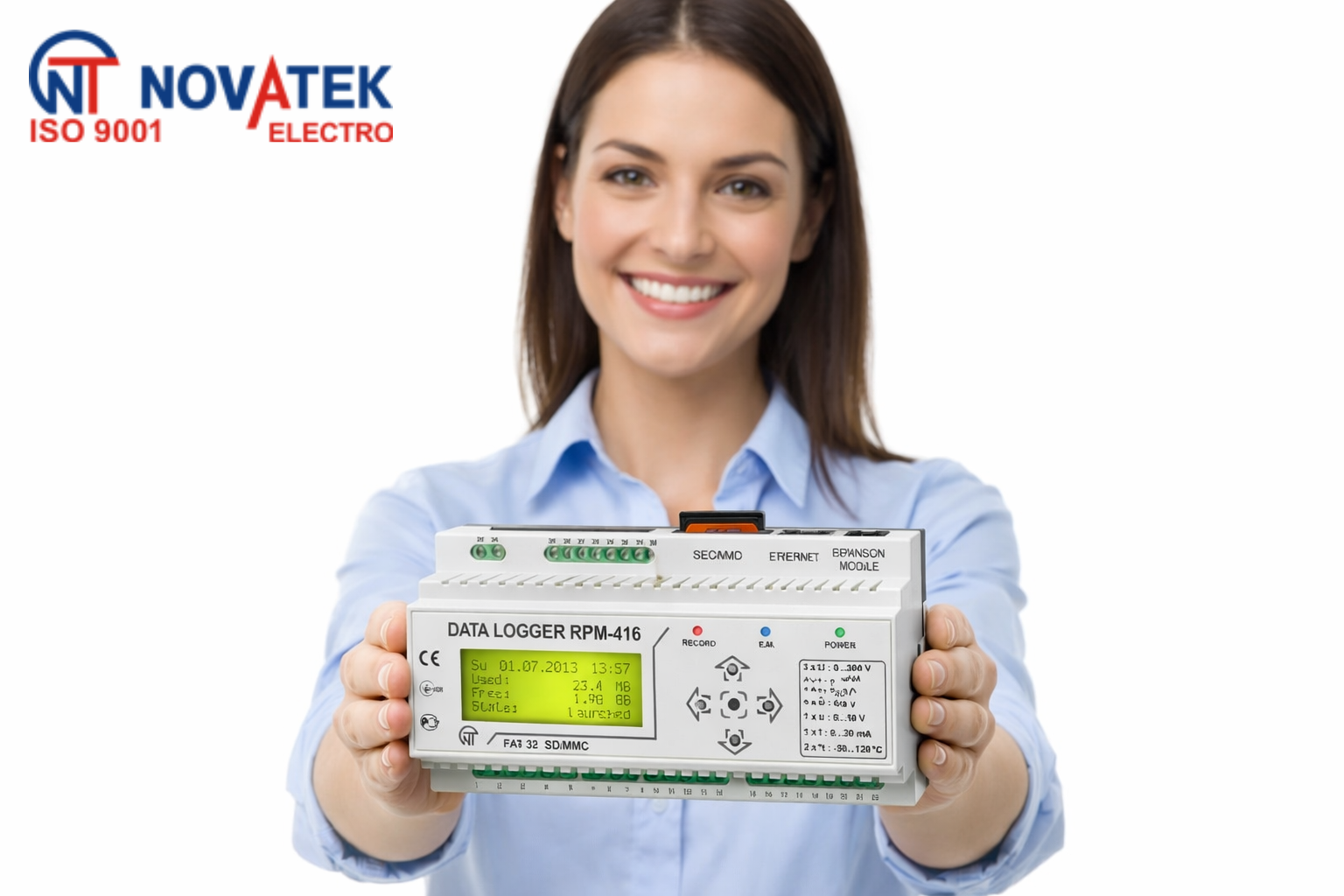
Novatek Electro India's RPM-416 Power Quality Analyser & Data Logger and RPM-16-4-3 Electrical Data Logger are engineered specifically for environments where continuous, high-resolution electrical monitoring is non-negotiable. This article maps these instruments to real application scenarios within defense and aerospace — energy audits, power factor correction, peak demand management, billing verification, and load balancing — and explains why each capability matters in this demanding industry segment.
The Power Quality Reality of Defense & Aerospace Facilities
Defense and aerospace facilities are electrically complex in ways that most industrial sites are not. Consider the range of loads present on a single campus:
- High-inertia motors driving CNC machining centers for precision airframe components
- Variable-frequency drives on environmental test chamber compressors
- Pulsed power loads from radar test equipment and electromagnetic compatibility (EMC) test chambers
- UPS-fed sensitive avionics test benches requiring near-unity power factor
- High-bay lighting and HVAC systems on separate distribution feeders
- Battery charging infrastructure for ground support equipment
Each of these load categories introduces distinct power quality signatures: harmonic distortion from drives and rectifiers, reactive power demand from motor banks, transient spikes from switching operations, and load imbalance across three-phase feeders. Managing all of these simultaneously — while also satisfying government electricity utility tariff structures that penalise poor power factor — demands instrumentation far beyond a simple energy meter.
Indian defense and aerospace facilities are additionally subject to procurement and energy audit frameworks under the Bureau of Energy Efficiency (BEE), and increasingly align with IS/IEC 61000-series power quality standards. Any facility classified as a Designated Consumer under the Energy Conservation Act, 2001 must conduct periodic energy audits — making calibrated, downloadable data logs a regulatory requirement, not merely good practice.
RPM-416: High-Resolution Power Quality Analyser for Mission-Critical Environments
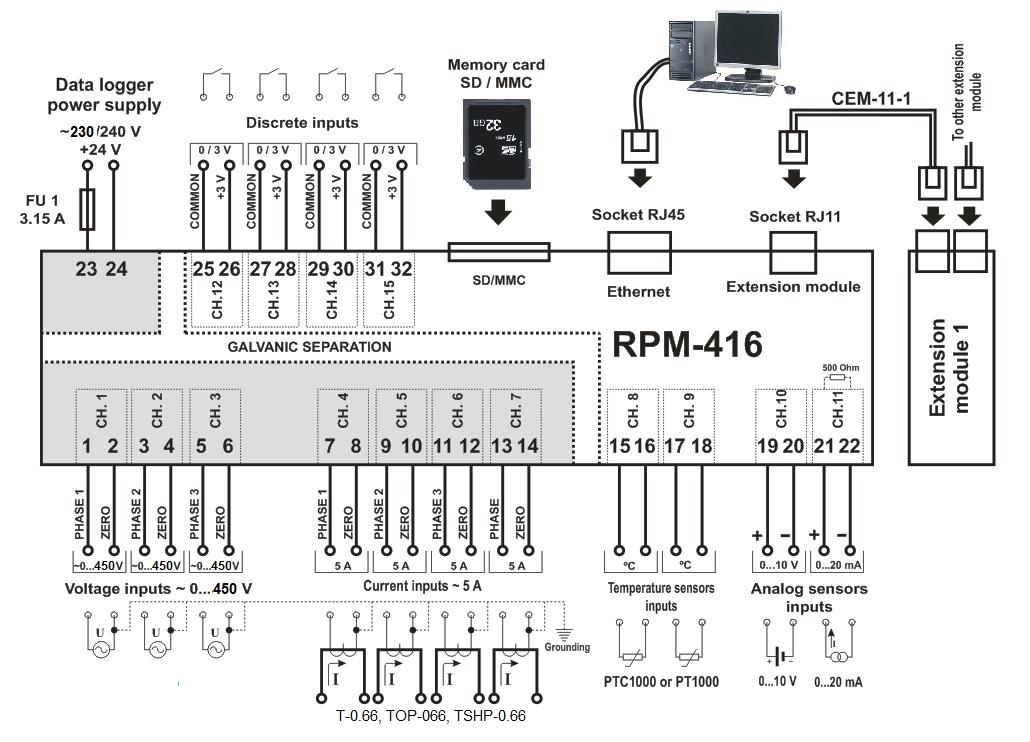
The RPM-416 is a 15-channel power quality analyser and data logger designed for continuous monitoring of three-phase electrical systems. Its defining capability for defense and aerospace applications is its 1-millisecond sampling rate — programmable from 1ms to 3600 seconds — which places it in a different category from conventional energy loggers that sample at 1-second or 5-second intervals.
Key Specifications — RPM-416
| Parameter | Specification |
|---|---|
| Input Types | AC Voltage, AC Current, Temperature, Analogue Transducer, Dry Contact |
| Voltage Range | 24–265V AC/DC |
| Total Input Channels | 15 channels |
| Channel Breakdown | 3 × Voltage, 4 × Current, 2 × Temperature, 2 × Analogue, 4 × Dry Contacts |
| Sampling Rate | 1ms to 3600 seconds (programmable) |
| Memory | 32 MB onboard |
| Communication | Modbus RTU/TCP (SCADA integration) |
| Data Export | Downloadable logs (PC software) |
| Application | Continuous Power Quality Analysis and Data Logging |
| Price (ex-GST) | Rs. 45,000 per piece |
The 4-channel current input alongside 3-channel voltage monitoring makes the RPM-416 natively suited for three-phase-plus-neutral configurations — the standard distribution architecture in defense campus substations. The dual temperature channels allow simultaneous monitoring of transformer winding temperature or switchgear compartment temperature alongside electrical parameters, which is valuable for thermal correlation in energy audits of high-load environments like test facilities and aircraft hangars.
Buy RPM-416 — Rs. 45,000 (ex-GST)RPM-16-4-3: The 'Black Box' Data Logger for Electrical Distribution Systems
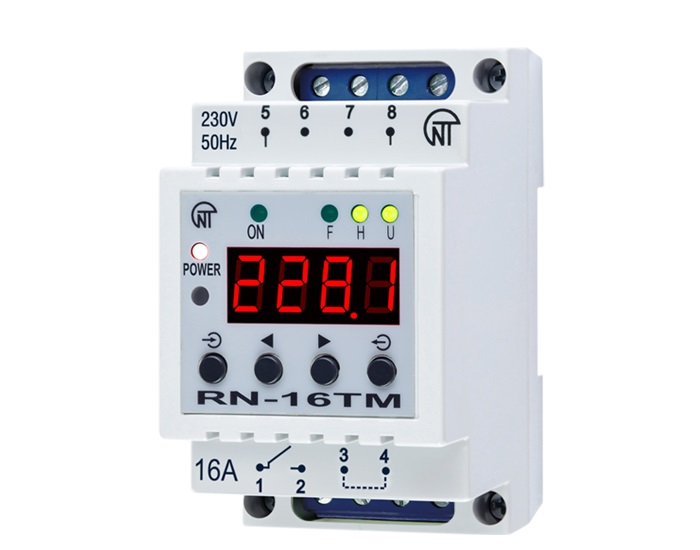
The RPM-16-4-3 is a microprocessor-based data logger designed to function as a 'black box' recorder for industrial and institutional electrical systems. Where the RPM-416 is optimised for high-resolution power quality capture at critical points, the RPM-16-4-3 is engineered to bridge the gap between long-term trend logging and real-time analysis — making it the right instrument for sustained energy audit campaigns across multiple distribution boards within a large defense or aerospace campus.
At Rs. 20,142 per piece (ex-GST), the RPM-16-4-3 offers an economical route to deploying multiple monitoring points simultaneously — a critical requirement when auditing a facility with dozens of distribution feeders serving different shop floors, test bays, administrative blocks, and utility systems.
Buy RPM-16-4-3 — Rs. 20,142 (ex-GST)Application Mapping: RPM-416 & RPM-16-4-3 in Defense & Aerospace
1. Energy Audit of Defense Campus Distribution Networks
Large defense establishments — encompassing technical training institutes, ordnance depots, airbase infrastructure, and administrative zones — often operate under a single HT tariff connection with internal distribution spanning multiple feeder panels. Deploying RPM-16-4-3 units across each major distribution board, with Modbus integration to a central SCADA or energy management system, enables feeder-level energy attribution. This is the foundational data layer for any BEE-compliant energy audit report.
2. Power Factor Analysis and Correction on Motor-Heavy Workshops
Aircraft maintenance bays, armament overhaul workshops, and engine test cells operate large three-phase motors continuously. Without active power factor correction (APFC) correctly sized to the actual reactive demand, facilities attract substantial utility penalty charges. The RPM-416's simultaneous three-phase voltage and four-channel current logging — with programmable sampling down to 1ms — enables engineers to generate precise reactive power profiles, identify the worst-performing load groups, and correctly size capacitor banks for APFC panels. This is not estimation; it is measurement-driven correction.
3. Peak Demand Management at Aerospace Manufacturing Facilities
Tariff structures for HT consumers typically include maximum demand (MD) charges based on the highest 15-minute or 30-minute demand recorded in a billing month. Aerospace manufacturing facilities with simultaneous operation of large machining centers, environmental test chambers, and compressed-air systems routinely exceed contracted MD, triggering significant penalty billing. Continuous logging via RPM-416 or RPM-16-4-3 with Modbus SCADA integration allows demand controllers or energy managers to visualise demand trends in real time and schedule non-critical loads — such as battery charging banks or HVAC pre-cooling — outside peak windows.
4. Billing Verification at Defense Utility Substations
Disagreements between facility-measured consumption and utility-billed units are not uncommon — particularly at substations with aging metering infrastructure or where CT/PT accuracy class has degraded. Installing an RPM-416 or RPM-16-4-3 at the HT metering point creates an independent, timestamped record of consumed energy that can be directly compared against utility bills. This is especially relevant for facilities under the Ministry of Defence that file periodic energy consumption returns.
5. Load Balancing Across Three-Phase Feeders in Avionics Test Bays
Avionics and electronic warfare system test bays often have highly asymmetric single-phase loads — test equipment, work-station clusters, environmental chambers — distributed unevenly across three phases. Phase imbalance causes neutral current rise, increased copper losses, and potential de-rating of distribution transformers. The RPM-416's independent three-phase voltage and four-channel current logging quantifies phase imbalance in real time, giving facility engineers the data needed to redistribute loads across phases and verify improvement after redistribution.
6. Transient Capture During Avionics and Radar Test Operations
Pulsed power loads — radar transmitters under test, high-current impulse test equipment, electromagnetic pulse (EMP) simulators — generate voltage and current transients that can propagate upstream and affect other sensitive loads on shared feeders. The RPM-416's 1ms sampling rate is specifically valuable here: it captures transient spikes and voltage disturbances that standard energy meters and slower loggers miss entirely, providing forensic data when test results are anomalous or when equipment faults are under investigation.
Quick Selection Guide
| Application | Recommended Model | Price (ex-GST) |
|---|---|---|
| Transient capture in avionics / radar test bays (1ms resolution required) | RPM-416 | Rs. 45,000 |
| Power factor profiling for APFC sizing in motor-heavy workshops | RPM-416 | Rs. 45,000 |
| Multi-feeder campus energy audit (multiple monitoring points) | RPM-16-4-3 | Rs. 20,142 |
| Billing verification at HT metering point | RPM-416 or RPM-16-4-3 | Rs. 20,142 – Rs. 45,000 |
| Peak demand management with SCADA integration | RPM-416 | Rs. 45,000 |
| Load balancing and phase imbalance analysis in test bays | RPM-416 | Rs. 45,000 |
| Long-term energy trend logging across administrative / utility blocks | RPM-16-4-3 | Rs. 20,142 |
Relevant IS/IEC Standards for Defense & Aerospace Power Quality Monitoring
- IS/IEC 61000-4-30: Testing and measurement techniques for power quality measurement methods — the reference standard for how power quality parameters must be measured and recorded.
- IS/IEC 61000-4-7: General guide on harmonics and interharmonics measurements — relevant for facilities with VFD-driven loads and rectifier-based power supplies.
- IS 16444 (Part 1 & 2): AC static transformer-operated watt-hour and var-hour meters — applicable where metering accuracy class is under review for billing verification.
- IS 15959 (Part 2) / IEC 61968-9: Data exchange for meter reading — relevant for Modbus-based integration of logger data into energy management systems.
- Energy Conservation Act, 2001 (Amended 2022): Mandates energy audits and reporting for Designated Consumers, including large defense establishments classified under the Act.
- BEE Energy Audit Guidelines: Bureau of Energy Efficiency guidelines require calibrated, traceable measurement data as the basis for mandatory energy audit reports.
- MIL-STD-704F / DEF STAN 61-5: Aircraft electrical power characteristics standards — referenced when test facilities must verify that supply quality meets airworthiness test standards.
Why Novatek Electro India?
- ISO 9001:2015 Certified: Design, manufacture, and supply of electrical protection and monitoring devices under a documented quality management system — mandatory for supply to defense and government establishments.
- CE Certified: Products meet European conformity requirements for electromagnetic compatibility and electrical safety, an indicator of design rigour that defense procurement teams value.
- Made in India — Delhi: Domestic manufacture ensures supply chain reliability, faster delivery lead times, and eligibility under the Government's preference for domestically manufactured goods in public procurement.
- 30+ Years of Manufacturing Experience: Over three decades of engineering and production in electrical protection and power monitoring devices, with deep application knowledge across Indian industrial and institutional segments.
- After-Sales Support & Technical Assistance: Dedicated technical support, configuration assistance, and application engineering guidance available through authorised distributor and direct channels across India.
Whether you are specifying instruments for a BEE energy audit, sizing APFC for a workshop feeder, or establishing a Modbus-integrated power monitoring backbone for a defense campus SCADA, Novatek Electro's RPM-416 and RPM-16-4-3 are engineered for the task.
RPM-416 — Rs. 45,000/piece (ex-GST) | RPM-16-4-3 — Rs. 20,142/piece (ex-GST)
GST @ 18% applicable extra. Prices are ex-works, Delhi.
Shop Online at Intelli-Electro Email: sales@novatek-electro.in Call: +91-7840054744