When Your Panel Runs Out of Terminals — and the Cable Tray Is Already Full
Walk any operating refinery, gas compression station or petrochemical processing unit and you will encounter the same engineering reality: the sensor count that the original panel design anticipated is rarely the sensor count that operations actually demands two years into production. Level transmitters on storage tanks, flow switches on transfer lines, pressure contacts on compressor skids, dry-contact alarms from gas detectors — every process improvement adds another field device, and every field device demands a wire path back to the central controller.
The conventional answer — run every sensor cable back to a central marshalling panel — creates its own set of problems: bulging cable trays, voltage drop over long runs, signal integrity degradation on milliamp loops, and a commissioning schedule that stretches weeks beyond the original estimate. There is a better architecture, and it is not new: bring a small, intelligent I/O node close to the field cluster, wire locally, and communicate back to the controller over a single twisted-pair RS-485 bus. That is precisely what the OB-215 Digital Input-Output Module from Novatek Electro is engineered to do.
Why Distributed Digital I/O Exists — The Engineering Need
In process industries, field devices are inherently distributed. A single tank farm may have a dozen level sensors spread across 200 metres of bunded area. Running individual 4–20 mA or 0–10 V cable runs for each sensor back to a control room is not only expensive in cable and conduit costs, it also introduces ground loop risks and makes fault isolation difficult. A distributed I/O architecture places a small module — like the OB-215 — physically adjacent to each sensor cluster. That module converts the local analog or digital signal into a digital data frame and transmits it upstream over a shared RS-485 Modbus RTU bus. The controller receives clean, noise-immune data regardless of the distance to the field.
For oil, gas and petrochemical installations specifically, this matters because:
- Field sensor clusters are often located in classified (hazardous) areas with strict cable tray segregation requirements
- Signal integrity over long cable runs is a regulatory and functional concern, particularly for safety-critical level and flow alarms
- Maintenance teams need to add or reconfigure sensors without rewiring the entire marshalling panel
- SCADA and DCS systems with finite I/O card counts need a cost-effective way to expand channel capacity without replacing the host controller
OB-215: What It Is and What It Does
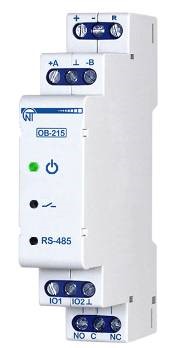
The OB-215 is a compact digital input-output module designed for IoT, remote monitoring, and modular I/O expansion applications. It provides one configurable sensor input, one relay output, and built-in RS-485 Modbus RTU communication — all powered from a 12–24 V DC supply, making it compatible with standard instrument power rails used throughout oil and gas installations.
Configurable Input Modes
One of the most practically useful features of the OB-215 is that its single input channel is not locked to one signal type. Depending on how the module is configured, it can accept:
- DC voltage transducer input: 0–10 V, for position sensors, pressure transmitters and level transducers with voltage output
- DC current transducer input: 0–20 mA, the standard industrial loop for flow transmitters, level sensors and analytical instruments
- Temperature sensors: NTC (10 kΩ), PTC 1000, PT 1000, or digital DS18B20 — covering resistance and digital temperature sensing across the full range of process and ambient monitoring requirements
- Pulse counter: with result saving in non-volatile memory — suitable for turbine flow meters, positive displacement meters and other pulse-output devices common in custody transfer and batch metering applications
- Interface converter: RS-485 to UART (TTL) — enabling integration with legacy serial devices already installed in the field
Output Capability
The OB-215 relay output switches up to 8 A, making it suitable for direct actuation of solenoid valves, small contactors, alarm hooters and indicator lamps — exactly the actuator classes encountered in tank level control, pipeline isolation and process alarm annunciation in oil and gas applications.
Communication
RS-485 Modbus RTU is the field communication standard that bridges the gap between simple sensors and supervisory controllers in process industries. The OB-215 implements this natively, allowing it to be addressed as a Modbus slave node on any RS-485 network — compatible with PLCs, RTUs, SCADA gateways and HMI systems from any major manufacturer.
Technical Specifications at a Glance
| Parameter | OB-215 Specification |
|---|---|
| Model | OB-215 |
| Supply Voltage | 12–24 V DC |
| Input Channels | 1 configurable sensor input |
| Input Signal Types | 0–10 V DC, 0–20 mA DC, NTC 10 kΩ, PTC 1000, PT 1000, DS18B20, Pulse |
| Output Channels | 1 relay output |
| Relay Switching Current | Up to 8 A |
| Communication Interface | RS-485 Modbus RTU (built-in) |
| Additional Function | RS-485 to UART (TTL) interface converter |
| Application Category | Remote monitoring/control, IoT, modular add-on channel |
| Brand / Origin | Novatek Electro / Made in India |
| Price (ex-GST) | Rs. 4,375 per piece |
All prices exclusive of GST. GST @ 18% applicable extra. Contact sales@novatek-electro.in for project and volume quotes.
Buy OB-215 OnlineQuick Selection Guide: Application vs Recommended Configuration
| Application / Requirement | Recommended Model | Input Mode to Configure | Price (ex-GST) |
|---|---|---|---|
| 4–20 mA level transmitter on storage tank | OB-215 | 0–20 mA current input | Rs. 4,375 |
| 0–10 V pressure transducer on gas compressor | OB-215 | 0–10 V voltage input | Rs. 4,375 |
| Pulse-output turbine flow meter on pipeline | OB-215 | Pulse counter mode | Rs. 4,375 |
| PT 1000 temperature sensor on heat exchanger | OB-215 | PT 1000 RTD input | Rs. 4,375 |
| DS18B20 ambient temperature in junction box | OB-215 | Digital DS18B20 input | Rs. 4,375 |
| Relay alarm output for solenoid valve or hooter | OB-215 | Relay output (up to 8 A) | Rs. 4,375 |
| RS-485 to UART bridge for legacy serial device | OB-215 | Interface converter mode | Rs. 4,375 |
Application-Based Selection: If Your Installation Requires X, Configure OB-215 as Y
If your installation requires level monitoring on a storage tank with a 4–20 mA submersible level transmitter — configure the OB-215 in 0–20 mA current input mode. The module reads the loop current proportional to level, maps it to a Modbus register, and the controller polls that register over RS-485. No long analog cable run, no signal conditioning card needed at the panel.
If your installation requires flow totalisation from a turbine or positive displacement meter with pulse output — configure the OB-215 in pulse counter mode. The accumulated count is stored in non-volatile memory, so even a power interruption does not lose the batch total. The controller reads the register via Modbus on restoration.
If your installation requires process temperature monitoring at a remote heat exchanger using an existing PT 1000 RTD — configure the OB-215 in PT 1000 mode. No separate temperature transmitter is needed; the module conditions the RTD signal directly and presents the value as a Modbus register.
If your installation requires a relay output for a small solenoid valve or alarm device rated up to 8 A — use the OB-215 relay output, controlled by the Modbus master writing to the output coil register. This eliminates the need for a separate relay module in the field junction box.
Common Selection Mistakes Engineers Make
1. Assuming One Module Can Handle Multiple Sensors Independently
The OB-215 provides one input channel and one relay output. Engineers planning a cluster of, say, five level sensors on a single tank farm need five OB-215 units, each assigned a unique Modbus address, all wired to the same RS-485 daisy chain. This is by design — each node is independently addressable, which simplifies fault isolation — but it must be accounted for in the BOM.
2. Mixing 4–20 mA and 0–10 V Without Reconfiguring
Because the input is configurable but not simultaneously multi-type, each OB-215 unit must be configured for the specific signal type of the sensor it will interface. Connecting a 0–10 V sensor to a unit configured for 0–20 mA will produce incorrect readings. Verify sensor output type before configuration and label each module accordingly at installation.
3. Ignoring RS-485 Bus Termination
On RS-485 networks longer than approximately 10–15 metres, or with more than a handful of nodes, bus termination resistors (typically 120 Ω) must be fitted at each end of the daisy chain. Omitting termination causes signal reflections that corrupt Modbus transactions — a common source of intermittent communication faults that are difficult to diagnose after the cable tray is sealed.
4. Powering from an Unregulated Supply
The OB-215 accepts 12–24 V DC. In field junction boxes where supply voltage can sag under load, ensure the supply rail is regulated and sized for all modules plus sensor excitation current. An undersized supply causes erratic behaviour that resembles a communication fault.
Installation Tips from the Field
- Assign Modbus addresses before installation: Configure each module's unique node address at the bench, label the unit, and record it in your network map. Re-addressing installed modules in a sealed junction box is avoidable extra work.
- Use shielded twisted-pair cable for the RS-485 bus: In oil and gas environments with VFDs, contactors and RF interference, unshielded RS-485 cable picks up noise. Ground the shield at one end only to avoid ground loops.
- Keep sensor input wiring short from the field device to the OB-215: The whole point of distributed I/O is to place the module close to the sensor. If the module is mounted in a field junction box adjacent to the transmitter, the analog signal path is short and noise-free.
- Document the Modbus register map: Each OB-215 exposes its input value and output state via Modbus registers. Record the register addresses and node addresses in your SCADA tag database at commissioning — not after the system is live.
- Protect the module from condensation: The OB-215 is designed for industrial use. In outdoor or uninsulated junction boxes, fit a suitable IP-rated enclosure and consider a small desiccant pack to manage humidity in coastal or high-humidity process environments.
Why Novatek Electro?
- ISO 9001:2015 certified manufacturing: Every OB-215 unit is produced under a documented quality management system — not assembled-to-order from third-party components without traceability.
- CE certified: Independently verified for electromagnetic compatibility and electrical safety to European standards — a benchmark recognised by engineering procurement teams globally.
- Made in India, designed for Indian field conditions: Wide DC supply tolerance, robust relay output, and RS-485 communication selected for the signal environment and infrastructure reality of Indian process industries.
- 30+ years of electrical protection device manufacturing: Novatek Electro's product engineering is grounded in decades of field deployment learning across industrial automation, infrastructure and process industries.
- Responsive after-sales support: Technical queries, commissioning guidance, and replacement logistics handled through a dedicated support channel — not a generic ticketing system.
The OB-215 is priced at Rs. 4,375 per unit (ex-GST) — making distributed sensor interfacing accessible even for phased expansion projects where budget is deployed one tank farm or one compressor skid at a time.
Order online via our authorised distributor portal or contact our technical sales team for project quantities, volume pricing, and application support.
Buy at Intelli-Electro Email Sales Team Call +91-7840054744Frequently Asked Questions
The OB-215 is available through Novatek Electro's authorised online distributor. Order online at intelli-electro.com, email sales@novatek-electro.in for project quotations, or call +91-7840054744 for technical and commercial enquiries. Novatek Electro is ISO 9001:2015 and CE certified, headquartered in Delhi, India.
Buy OB-215 at Intelli-Electro