Three Phase Voltage Monitoring Relays: Protecting Industrial Motors in Pharmaceutical and Healthcare Facilities
A compressor feeding a cleanroom HVAC system trips on a single-phased supply. The motor windings overheat silently. By the time the thermal overload relay responds — if it responds at all — the damage is done. Rewind cost, downtime, and a compromised controlled environment. Now multiply that risk across every three-phase motor in your facility: chillers, conveyors, CNC machines, air handling units. The question is not whether a mains fault will occur on your three-phase supply — it is whether your motor control panel is equipped to respond in time.
This article explains why three-phase voltage monitoring relays are non-negotiable in pharmaceutical and healthcare motor applications, how to select the right model from Novatek Electro's RNPP range, and what installation engineers frequently get wrong.
Why Three-Phase Voltage Monitoring Relays Exist: The Engineering Case
Three-phase induction motors are the workhorse of pharmaceutical manufacturing — driving tablet press conveyors, cleanroom HVAC units, process compressors, purified water pump sets, and CNC machining centres used in medical device fabrication. These motors are engineered to operate within tight voltage symmetry tolerances. When the supply deviates, the consequences are disproportionately severe:
- Phase loss (single phasing): With one phase absent, the remaining two phases carry the full load current. Winding temperature rises rapidly. A motor running on two phases can draw 150–200% of rated current in the healthy phases within seconds.
- Phase imbalance (voltage asymmetry): Even a 3.5% voltage imbalance can produce a 25% increase in winding temperature, according to NEMA MG-1 derating guidelines. In a pharmaceutical cold store or cleanroom, this is an unacceptable risk.
- Reverse phase sequence: A compressor or conveyor running in reverse because phases were swapped during a panel modification or after a supply changeover can destroy mechanical seals, damage product batches, and create a safety hazard.
- Over/under voltage: Sustained overvoltage accelerates insulation breakdown. Undervoltage forces motors to draw higher current to maintain torque, causing thermal stress in already loaded systems.
Standard thermal overload relays protect against sustained overcurrent — but they respond slowly and are blind to phase sequence and imbalance. A dedicated three-phase voltage monitoring relay detects all these fault modes at the supply level and trips the contactor before motor damage occurs. This is the engineering need the RNPP product family addresses.
Key Features to Look For in a Three-Phase Voltage Monitoring Relay
1. Comprehensive Fault Detection
Insist on a relay that covers all five major fault types in a single device: overvoltage, undervoltage, phase loss, phase imbalance, and phase sequence reversal. A relay that handles only phase loss leaves your motors exposed to the subtler — but equally damaging — asymmetry and reversal faults.
2. Programmable Voltage Thresholds
Indian industrial supplies vary widely. In pharmaceutical facilities served by captive DG sets or UPS bypass feeds, the nominal voltage may be 220/380V, 230/400V or 240/415V. A programmable relay that lets you select the operating voltage range at commissioning eliminates the risk of nuisance tripping on a healthy but slightly off-nominal supply.
3. DPDT Output Contacts
Two relay outputs — one for the motor contactor and one for the alarm/signalisation circuit — allow you to simultaneously trip the load and alert the SCADA or BMS without additional auxiliary relays in the panel.
4. DIN Rail Mounting and Compact Footprint
Pharmaceutical panel rooms are space-constrained. A relay that mounts directly on a standard 35mm DIN rail and occupies minimal width is a practical necessity.
5. CE Certification and Recognised Quality Standard
GMP-regulated pharmaceutical facilities are subject to equipment qualification (IQ/OQ). Using CE-marked, ISO 9001:2015-certified protection devices from a documented manufacturer simplifies vendor qualification and audit trails.
RNPP-302M vs RNPP-301: Model Comparison
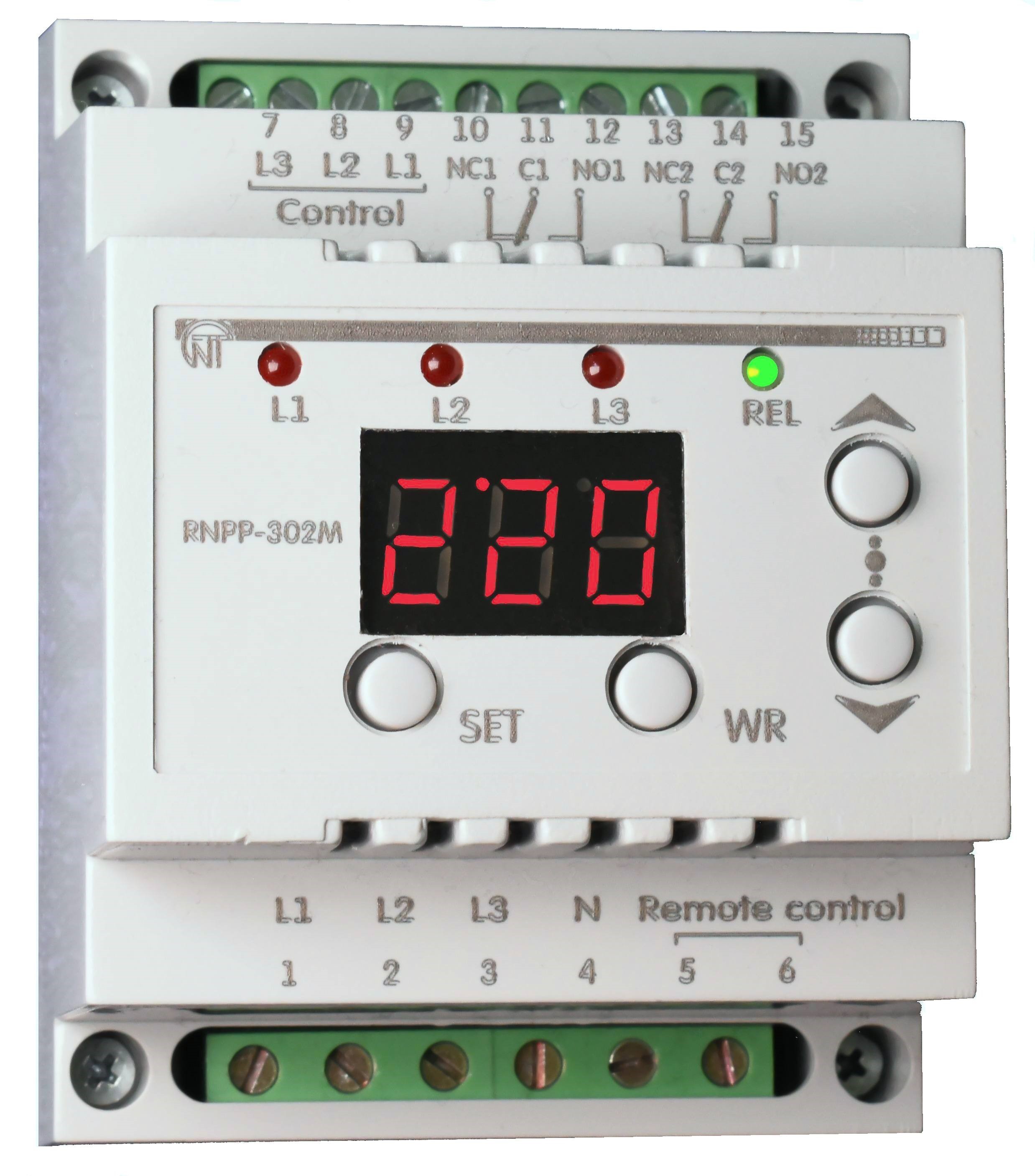
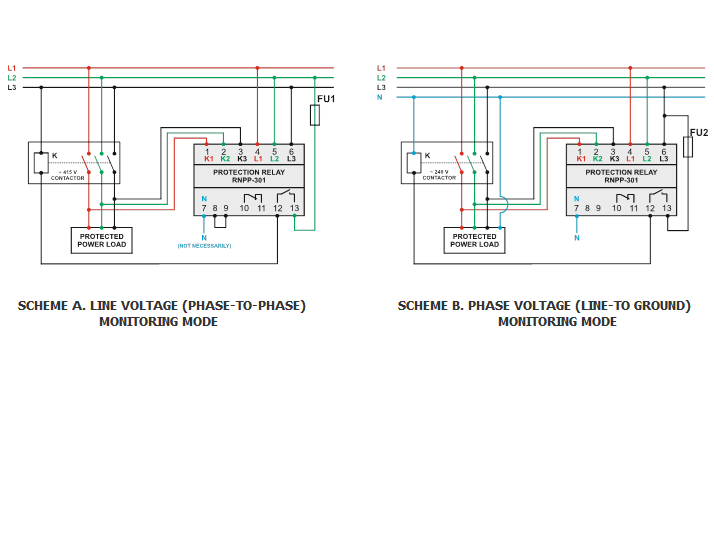
| Parameter | RNPP-302M | RNPP-301 |
|---|---|---|
| Voltage Type | AC | AC |
| Operating Voltage Range | 220/380, 230/400, 240/415 V (selectable) | 220/380 – 240/415 V |
| Pole Configuration | 3 Pole and 4 Pole | 3 Pole and 4 Pole |
| Output Contact Form | DPDT — 2 NO + 2 NC (Power and Signalisation) | DPDT — 2 NO + 2 NC |
| Output Contact Rating | 8 A @ 250 V AC | 8 A @ 250 V AC |
| Protection Functions | Overvoltage, Undervoltage, Phase loss, Phase imbalance, Reverse phase sequence, Phase coincidence, Contactor output monitoring | Overvoltage, Undervoltage, Phase loss, Phase imbalance, Reverse phase sequence |
| Contactor Monitoring | Yes — dedicated contactor feedback input | No |
| Emergency Button Input | Yes — additional input for emergency button | No |
| Phase Coincidence Protection | Yes | No |
| Voltage Threshold Programming | Programmable / Selectable voltage range | Fixed range |
| Application Type | Multi-functional — Voltage and Contactor Output Monitoring | Three-phase voltage monitoring |
| Price (ex-GST) | Rs. 3,000 per piece | Rs. 4,417 per piece |
| GST | 18% extra | 18% extra |
Prices as per Novatek Electro India Price List 2026-27, effective 01.04.2026. All prices exclusive of GST @ 18%.
Application-Based Selection Guide
| If Your Installation Requires… | Choose Model | Price (ex-GST) |
|---|---|---|
| Basic phase loss, phase sequence and voltage protection for HVAC motors and small conveyors | RNPP-301 | Rs. 4,417 |
| Contactor health monitoring in addition to voltage protection — for critical compressors or process motors where contactor welding must be detected | RNPP-302M | Rs. 3,000 |
| Emergency stop button integration directly into the protection relay circuit | RNPP-302M | Rs. 3,000 |
| Phase coincidence protection — preventing two or more phases from being shorted or bridged in a transfer switching or bus-tie scenario | RNPP-302M | Rs. 3,000 |
| CNC machine tools in medical device manufacturing where tool reversal due to phase sequence error must be prevented | RNPP-302M | Rs. 3,000 |
| Cleanroom AHU or HVAC on a DG set supply where nominal voltage may vary between 220/380 V and 240/415 V and a programmable threshold is required | RNPP-302M | Rs. 3,000 |
Reading the Selection Guide
Notice that the RNPP-302M is priced lower than the RNPP-301 while offering more protection functions, including contactor monitoring, emergency button input, phase coincidence protection, and programmable voltage ranges. For most new pharmaceutical panel installations, the RNPP-302M is the technically superior and more economical choice. The RNPP-301 remains a capable relay for straightforward voltage monitoring applications where the additional functions of the 302M are not required by the panel design.
Common Selection and Installation Mistakes
Mistake 1: Relying on the Thermal Overload Relay Alone
Thermal overload relays protect against sustained overcurrent. They are temperature-integrating devices — they respond slowly by design. A phase loss event can cause winding damage in minutes; a thermal overload relay may not trip until the bimetallic element heats up, by which time the insulation has already degraded. A voltage monitoring relay detects the phase loss condition at the supply terminals and trips the contactor within its designed response time, before the thermal overload relay has had time to react.
Mistake 2: Installing Only on the 'Most Critical' Motor
Phase faults affect the entire distribution panel, not one motor. A phase loss on the incoming feeder simultaneously endangers every motor connected downstream. Installing a voltage monitoring relay on the incomer — or on each motor starter — provides systematic protection rather than selective coverage.
Mistake 3: Not Verifying the Voltage Range Before Commissioning
The RNPP-302M supports selectable voltage ranges: 220/380 V, 230/400 V, and 240/415 V. Leaving the relay at its default setting on a 240/415 V supply that is nominally closer to 230/400 V can cause nuisance tripping or, worse, reduced sensitivity to real overvoltage events. Always confirm the supply nominal voltage with a calibrated meter and set the relay accordingly during commissioning.
Mistake 4: Overlooking Phase Coincidence Protection in DG-to-Mains Transfer Panels
In pharmaceutical facilities with captive DG sets, automatic transfer switching is common. If two phases are inadvertently bridged during a transfer event — a wiring error during panel modification, for example — standard voltage monitoring relays will not detect the fault. The RNPP-302M's phase coincidence protection detects the shorting of two or more phases and trips before downstream damage occurs. This is a function that is easily overlooked during relay specification.
Mistake 5: Connecting the Signalisation Output to the Same Circuit as the Power Output
The RNPP-302M and RNPP-301 both provide DPDT contacts — one for the power (contactor trip) circuit and one for signalisation (alarm, BMS, SCADA). A common wiring error is connecting both outputs to the same circuit, which eliminates the independent alarm function. Use the two output groups for their intended separate purposes.
Installation Tips for Pharmaceutical Motor Control Panels
- Mount on 35mm DIN rail within the motor control centre (MCC) or local motor starter panel. Ensure adequate spacing from high-heat components such as reactors and large contactors.
- Wire the relay sensing inputs directly to the motor supply terminals before the contactor, not after — so the relay monitors the incoming supply voltage and not the contactor output voltage. This is critical: if you wire after the contactor, the relay loses its voltage reference when the contactor opens.
- Use the RNPP-302M's contactor monitoring input by connecting the contactor auxiliary contact to the relay's feedback terminal. This allows the relay to detect a welded or stuck contactor and issue an alarm, which is particularly valuable for compressor starters in pharmaceutical utilities.
- Test the phase sequence at first power-on using a phase sequence indicator before the motor runs. The relay will block startup if the sequence is incorrect — confirm the intended rotation direction mechanically before bypassing or resetting the relay.
- Document relay settings (voltage range selection, trip delay if adjustable) in the panel's as-built drawing set. This is a GMP documentation requirement in pharmaceutical environments and simplifies future qualification activities.
Why Novatek Electro?
- ISO 9001:2015 Certified: Every product is manufactured and tested under a documented quality management system — essential for vendor qualification in GMP-regulated pharmaceutical facilities.
- CE Marked: Products conform to applicable European directives, providing a recognised benchmark for safety and EMC performance accepted by multinational pharmaceutical equipment standards.
- Made in India — Delhi: Domestic manufacturing means shorter lead times, local availability through a distributor network, and support under the Make in India initiative.
- 30+ Years of Engineering Depth: Novatek Electro has been designing and manufacturing electrical protection relays for over three decades, with a product range covering single-phase, three-phase, and specialised protection for industrial and commercial applications.
- After-Sales Technical Support: Technical datasheets, wiring diagrams, and application support are available directly from Novatek Electro, ensuring that panel builders and maintenance engineers have the documentation needed for commissioning and troubleshooting.
Get the Right Relay for Your Application
Contact Novatek Electro India for technical guidance, distributor pricing, or bulk project quotations:
- Email: sales@novatek-electro.in
- Phone: +91-7840054744
- Buy Online: Shop RNPP Series at Intelli-Electro