When Voltage Swings Silently Kill Your Appliances
Ask any maintenance engineer running a textile manufacturing facility and they will tell you the same story: the power quality problem is not the dramatic blackout — it is the slow, invisible damage from voltage that drifts too high or sags too low, day after day, until a compressor winding burns out or a washing machine control board gives up quietly. India's industrial power infrastructure, even in well-served areas, routinely delivers single-phase supply that swings between 170 V and 270 V during peak load hours, transformer tap changes, and feeder switching events. IS 12360 nominally specifies 230 V ±6%, but real-world distribution rarely holds that window for a full shift. For the dozens of residential-grade and consumer appliances that support a textile plant's daily operations — refrigerators in canteens, air conditioners in sampling rooms, water pumps in welfare blocks, washing machines in uniform laundries, televisions in security cabins — these swings are a slow financial drain in repair costs and asset write-offs.
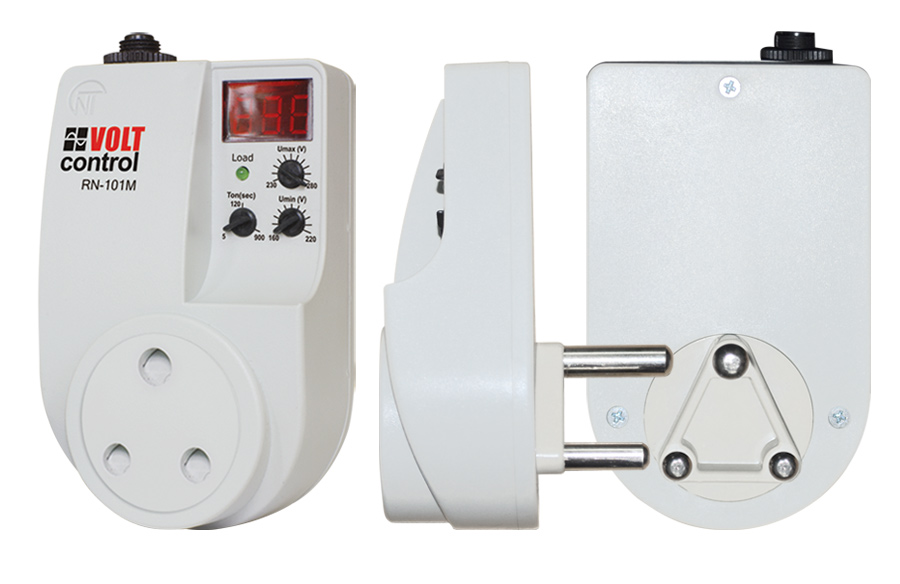
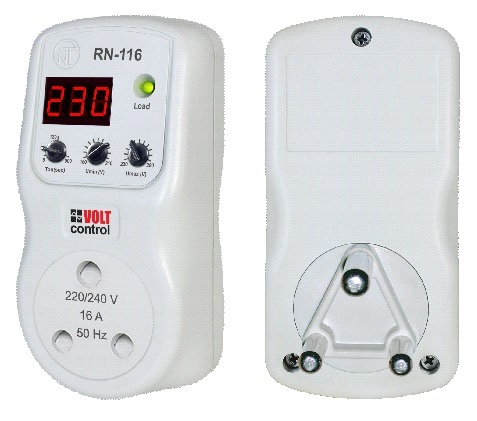
The engineering answer is straightforward: put a voltage monitoring relay in series with the load. Detect when the supply moves outside a safe window, open the contact, wait for the supply to stabilise, then reconnect — automatically, without operator intervention. Novatek Electro's RN-101M and RN-116M do exactly this, in a plug-in form factor that requires zero panel space and zero rewiring of the existing installation.
The Physics of Voltage Damage — Why Windows and Timers Both Matter
Over-voltage: The Hidden Insulation Killer
When line voltage climbs above the nameplate rating of a motor or compressor, core flux density increases beyond the linear region of the B-H curve, eddy current losses rise as the square of voltage, and winding insulation sees elevated dielectric stress. For a refrigerator compressor rated 220–240 V, sustained operation at 260 V can reduce insulation life by an order of magnitude within weeks. Power electronics inside inverter-type air conditioners and variable-speed washing machines are even less tolerant — DC bus capacitors and IGBT gate-drive circuits are designed to precise voltage margins.
Under-voltage: The Motor Burnout Trigger
Under-voltage is equally destructive and more common in Indian distribution. A motor draws current proportional to torque demand divided by flux, and flux is proportional to voltage. When voltage sags to 170 V, a motor trying to deliver rated torque must draw significantly higher current to compensate — I²R heating rises, thermal limits are exceeded, and winding insulation degrades. Single-phase water pumps are particularly vulnerable because they lack the thermal inertia of three-phase machines.
Neutral Break: The Least-Discussed but Most Dangerous Fault
A broken or high-resistance neutral in a single-phase circuit does not simply cut the supply. Depending on load configuration, it can cause the phase-to-neutral voltage seen by the load to float unpredictably — potentially reaching dangerously high values. Television power supplies, refrigerator electronic controls, and AC inverter boards can be destroyed instantly. Both RN-101M and RN-116M incorporate dedicated neutral break detection, which is a feature absent from basic voltage stabilisers and many lower-specification relays.
How the Voltage Window Circuit Works
Both relays continuously sample the incoming single-phase AC voltage through an internal measurement circuit referenced to neutral. A precision comparator evaluates the RMS value against two adjustable thresholds — an upper (over-voltage) trip point and a lower (under-voltage) trip point. The output relay contact is held closed (energised) only when voltage sits within the defined window. The moment voltage moves outside either threshold, a trip timer begins. If the fault persists beyond the set delay time, the output contact opens, disconnecting the load. Once the fault clears, a reconnect delay (return time) prevents premature re-energisation during supply oscillation — a critical feature that protects compressors from short-cycling.
Model Specifications and Comparison
| Parameter | RN-101M | RN-116M |
|---|---|---|
| Voltage Range (AC) | 220–240 V | 220–240 V |
| Number of Poles | 2 Pole | 2 Pole |
| Rated Current | 16 A (up to 3.5 kW) | 16 A |
| Contact Form | SPDT (Plug–Socket type) | SPDT (Plug–Socket type) |
| Protection Functions | Over-voltage, Under-voltage, Neutral break, Overload | Over-voltage, Under-voltage, Neutral break |
| Mounting / Form Factor | Plug–Socket (in-line) | Plug–Socket (in-line) |
| Brand | Novatek Electro | Novatek Electro |
| Price (ex-GST) | Rs. 1,830 per piece | Rs. 1,800 per piece |
| Certification | CE, ISO 9001:2015 | CE, ISO 9001:2015 |
| Primary Application | Appliances with motor/compressor overload risk | General single-phase appliance voltage protection |
Key differentiator: The RN-101M adds overload trip protection on top of the voltage window functions. This makes it the preferred choice for appliances with compressors or pump motors, where locked-rotor overload is a real failure mode. The RN-116M covers over-voltage, under-voltage, and neutral break at a marginally lower price point — suitable for loads where thermal overload protection is already handled internally (inverter ACs with built-in compressor protection, televisions, and similar electronics).
Both models are priced under Rs. 2,000 ex-GST (GST @ 18% applicable extra) — a fraction of the replacement cost of any of the appliances they protect.
Buy RN-101M Online Buy RN-116M OnlineQuick Selection Guide by Application
| Appliance / Load | Key Risk | Recommended Model | Price (ex-GST) |
|---|---|---|---|
| Refrigerator / Deep Freezer | Compressor burnout, short cycling | RN-101M | Rs. 1,830 |
| Window / Split Air Conditioner | Compressor overload, IGBT damage | RN-101M | Rs. 1,830 |
| Water Pump (single phase) | Winding burnout on sag, dry run | RN-101M | Rs. 1,830 |
| Washing Machine | Control board failure, motor damage | RN-101M or RN-116M | Rs. 1,830 / Rs. 1,800 |
| Television / Display Screen | SMPS burnout on over-voltage / neutral break | RN-116M | Rs. 1,800 |
Wiring Best Practices
In-Line Plug–Socket Installation
Both RN-101M and RN-116M are designed as in-line plug–socket devices. The relay plugs into the existing wall socket; the appliance plugs into the relay's output socket. No rewiring, no panel modification, no licensed electrician required for basic installation. Confirm that the wall socket and its upstream wiring are rated for at least 16 A before connecting loads approaching the 16 A (3.5 kW) limit of the RN-101M.
Voltage Window Setting
For most single-phase appliances rated 220–240 V, a protective window of 200 V (lower) to 250 V (upper) provides adequate margin while preventing nuisance tripping on routine supply variations. For sensitive electronics such as televisions and precision instruments, tighten the upper threshold to 245 V. For robust motor loads in areas with chronic under-voltage, setting the lower threshold to 190 V may be appropriate — but consult the motor manufacturer's minimum voltage specification before doing so.
Return (Reconnect) Delay
Always set the return delay to a minimum of 3 minutes for refrigerators and air conditioners. Compressor high-side pressure does not equalise instantly after shutdown; reconnecting too soon forces the compressor to start against high differential pressure, drawing locked-rotor current and stressing the start winding. The built-in reconnect timer in both models is specifically designed to prevent this failure mode.
Earthing and Neutral Integrity
The neutral break detection function of both relays requires a continuous, low-impedance neutral conductor to the relay's measurement circuit. Verify that the distribution board neutral bar has no loose connections or corroded terminations before commissioning. A high-impedance neutral will cause the relay to report a neutral break condition even when the phase conductor is healthy.
Troubleshooting Common Installation Issues
Relay Trips Immediately on Power-Up
Check the actual supply voltage at the socket using a calibrated RMS voltmeter. The factory default voltage window may be tighter than your local supply. Readjust the lower threshold downward or the upper threshold upward by 5–10 V increments and observe. If the relay trips within seconds consistently, suspect a neutral break — check neutral continuity with the supply isolated.
Relay Reconnects and Trips in a Short Cycle
This indicates the supply is oscillating near one of the threshold limits — a common symptom when a large motor on the same feeder starts and stops. Increase the trip delay setting slightly to filter out transient dips that resolve within a few cycles. Alternatively, widen the voltage window by 5 V on the affected threshold.
Appliance Does Not Power On After Relay Reset
Verify that the appliance itself has not latched into a fault state due to the power interruption. Many inverter ACs and modern washing machines require a manual reset or a complete power cycle. Disconnect the appliance from the relay output, wait 30 seconds, and reconnect. If the relay output contact has failed (check with a continuity tester between output pins in the energised state), contact the Novatek service network.
RN-101M Overload Trip on Normal Load
The RN-101M's overload function monitors actual load current. If the relay trips on a load rated well within 16 A / 3.5 kW, verify that start-up inrush current (especially refrigerator and AC compressor start) is within the relay's overload trip curve. If inrush is causing nuisance trips, check whether the compressor's start capacitor is degraded — a weak start capacitor dramatically increases compressor start current.
Order the RN-101M (Rs. 1,830 ex-GST) or RN-116M (Rs. 1,800 ex-GST) online through our authorised e-commerce partner, or contact our technical sales team for bulk pricing and application support.
Shop on Intelli-Electro Email: sales@novatek-electro.in Call: +91-78400 54744Why Novatek Electro?
- ISO 9001:2015 Certified Manufacturer: Every product is designed and manufactured under a documented quality management system — not assembled from generic components.
- CE Certified: Products meet European electromagnetic compatibility and safety directives, independently verified — relevant to any facility supplying export markets.
- Made in India, Designed for Indian Power Conditions: Our products are engineered for the voltage and frequency variations typical of Indian distribution networks, not simply re-labelled imports calibrated for stable European grids.
- 30+ Years of Electrical Protection Expertise: Novatek Electro's product range spans single-phase relays through three-phase monitoring, motor protection, and power quality instruments — deep application knowledge behind every datasheet.
- Pan-India Distributor and After-Sales Network: Technical support, replacement units, and application guidance available through authorised distributors across India and directly from our Delhi headquarters.
Engineering FAQs
Available online at intelli-electro.com. For technical queries, bulk orders, or distributor partnerships, reach our team directly:
Email: sales@novatek-electro.in | Phone: +91-78400 54744
Order Now