When the Grid Lies to Your Appliances — And They Pay the Price
Picture a site office at a cement plant or a building materials depot: a refrigerator humming in the break room, an air conditioner running through a dusty afternoon shift, a water pump feeding the overhead tank, a washing machine in the welfare block. None of these loads are exotic. All of them are expensive to replace. And every single one of them is silently vulnerable to the one hazard that the Indian grid delivers with clockwork regularity — voltage outside the safe operating window.
The Central Electricity Authority's own data confirms that voltage fluctuation is among the leading causes of residential and light-commercial appliance failure in India. In heavy-industry environments — cement grinding units, brick kilns, stone crushing yards, prefabricated building materials plants — the power quality challenge is compounded by large inductive loads switching on and off the same feeder, capacitor bank hunting, and notoriously weak distribution transformers at the tail end of rural feeders. The result: voltage spikes that routinely touch 280 V or sag to 160 V, sometimes in the same hour.
A single phase voltage monitoring relay installed ahead of a sensitive appliance acts as an electronic sentinel. It watches the supply voltage in real time, compares it against user-configurable upper and lower thresholds, and disconnects the load the moment voltage strays outside the safe band — then reconnects automatically after a programmable time delay once supply normalises. This article explains how that protection physics works, and how Novatek Electro's RN-101M and RN-116M translate it into rugged, affordable, field-proven hardware.
The Protection Physics — How a Voltage Relay Actually Works
Continuous RMS Voltage Sensing
Modern microcontroller-based voltage relays sample the AC waveform many times per cycle — typically at 1–5 ms resolution — and compute a running true-RMS value. This is important: a relay that merely measures peak voltage and divides by √2 will be fooled by distorted waveforms common in cement plant environments where large VFD-driven mills create significant harmonic content. True-RMS sensing means the relay responds to the actual heating effect of the voltage, not a mathematical approximation.
Comparator Logic and Trip Decision
The sensed RMS value is continuously compared against two thresholds stored in non-volatile memory: V_max (overvoltage setpoint) and V_min (undervoltage setpoint). The moment the measured value breaches either threshold, the relay starts an internal timer — the trip delay. If the fault persists beyond this delay, the output relay de-energises, disconnecting the load. If the fault clears before the timer expires, the trip is suppressed and the output stays closed. This intentional delay prevents nuisance tripping on momentary transients (a motor starting nearby, a capacitor switching event).
Neutral Break Detection
A floating neutral in a single-phase system is arguably more dangerous than a simple over/undervoltage event. When the neutral conductor opens — due to a corroded joint, a loose lug, or a broken neutral at the distribution transformer — the line-to-neutral voltage measured at any socket can swing wildly, sometimes reaching near full line-to-line voltage (415 V in a 3-phase system). Both RN-101M and RN-116M incorporate dedicated neutral break detection circuitry that trips the output independently of the voltage window comparators.
Reconnection Delay (Restart Timer)
After a trip — whether caused by overvoltage, undervoltage, or neutral break — the relay waits for a user-programmable restart delay before re-closing the output. This delay serves a mechanical purpose: compressors in refrigerators and air conditioners require equalisation time before restarting. Attempting to restart a compressor against high head pressure immediately after a power interruption stresses the motor and can trip the thermal overload. A 3–5 minute restart delay is standard engineering practice for compressor loads.
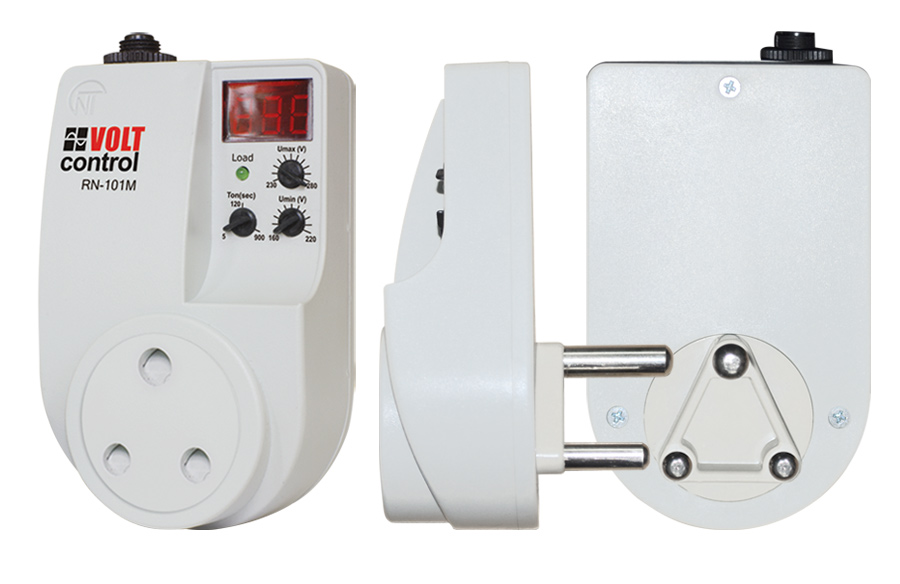
RN-101M — Plug-in Protection with Overload Sensing
The RN-101M is Novatek Electro's most feature-complete plug-in single phase relay. It combines voltage window monitoring with overload trip capability — a significant differentiator for appliances with induction motors.
- Rated voltage: 220–240 V AC, single phase
- Current rating: 16 A (up to 3.5 kW load)
- Contact form: SPDT, plug-socket type
- Protection functions: Overvoltage, undervoltage, neutral break, and overload
- Mounting: Plug-in (inline between socket and appliance)
- Price: Rs. 1,830 per piece (ex-GST)
The overload function makes the RN-101M particularly relevant for water pumps and washing machines — loads where a blocked impeller or a seized drum bearing causes a sustained overcurrent that a simple voltage relay would not detect. The relay monitors current through the connected load and trips if sustained overcurrent is detected, providing a layer of protection analogous to a thermal overload relay, in a plug-in form factor.
Buy RN-101M Online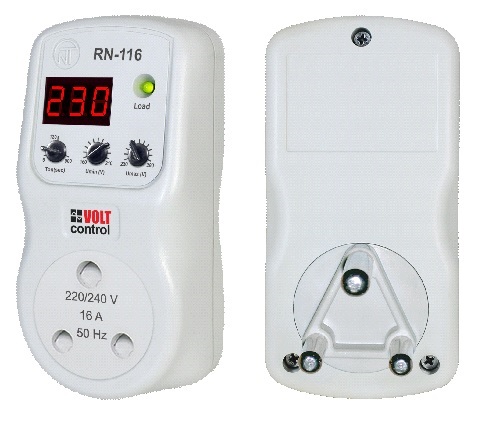
RN-116M — 16 A Plug-in Voltage Monitoring for General Appliances
The RN-116M is the streamlined voltage-only variant — overvoltage, undervoltage, and neutral break protection in the same plug-socket form factor, without the overload function. At Rs. 1,800 per piece (ex-GST), it is the right choice when you need pure voltage protection for loads like televisions, refrigerators, and air conditioners where the appliance already incorporates its own motor protection.
- Rated voltage: 220–240 V AC, single phase
- Current rating: 16 A
- Contact form: SPDT, plug-socket type
- Protection functions: Overvoltage, undervoltage, neutral break
- Mounting: Plug-in (inline between socket and appliance)
- Price: Rs. 1,800 per piece (ex-GST)
Model Comparison Table
| Parameter | RN-116M | RN-101M |
|---|---|---|
| Rated Voltage | 220–240 V AC | 220–240 V AC |
| Current Rating | 16 A | 16 A (up to 3.5 kW) |
| Poles | 2 Pole | 2 Pole |
| Contact Form | SPDT (Plug-Socket) | SPDT (Plug-Socket) |
| Overvoltage Protection | ✓ Yes | ✓ Yes |
| Undervoltage Protection | ✓ Yes | ✓ Yes |
| Neutral Break Protection | ✓ Yes | ✓ Yes |
| Overload Protection | ✗ No | ✓ Yes |
| Mounting | Plug-in (inline) | Plug-in (inline) |
| Price (ex-GST) | Rs. 1,800 | Rs. 1,830 |
| Best For | Refrigerators, TVs, ACs | Water pumps, washing machines, motor loads |
Quick Selection Guide by Application
| Appliance / Load | Key Risk | Recommended Model | Price (ex-GST) |
|---|---|---|---|
| Refrigerator | Compressor burnout from overvoltage / neutral break | RN-116M | Rs. 1,800 |
| Air Conditioner | PCB damage from voltage spikes, compressor stress | RN-116M | Rs. 1,800 |
| Washing Machine | Motor overload + voltage fluctuation | RN-101M | Rs. 1,830 |
| Water Pump (up to 3.5 kW) | Dry run / blocked impeller overload + undervoltage | RN-101M | Rs. 1,830 |
| Television / Home Theatre | SMPS and panel damage from voltage spikes | RN-116M | Rs. 1,800 |
Wiring Best Practices for Cement and Building Materials Site Installations
1. Load Current Verification Before Installation
Both models are rated 16 A continuous. Before plugging in, calculate the full-load current of the connected appliance from its nameplate: I = P / (V × PF). A 1.5-tonne split AC draws approximately 8–9 A; a 0.5 HP domestic pump draws approximately 4–5 A. Never connect loads whose starting current surge exceeds the relay's interrupt capacity. For loads above 3.5 kW, consider the DIN-rail mounted RN-113 (32 A) or RN-102 (32 A) variants.
2. Earth Connection Integrity
The plug-socket form factor of RN-101M and RN-116M means earth continuity passes through the relay body. Inspect the relay socket's earth pin engagement and verify earth continuity with a loop impedance tester. In construction-site environments, earth conductors are frequently damaged. A relay cannot protect against electric shock if the earth path is broken.
3. Voltage Setpoint Configuration
Set the overvoltage threshold at no more than 10% above nominal (i.e., ≤ 253 V for a 230 V system, per IS 12360 / IEC 60038). Set the undervoltage threshold at no less than the appliance manufacturer's minimum rated voltage — typically 180–190 V for most Indian-market appliances. For compressor-based loads (refrigerators, ACs), set the restart delay to at least 3 minutes.
4. Avoid Daisy-Chaining Multiple High-Current Loads
The 16 A rating applies to a single relay — do not use a multi-socket adapter downstream of the relay to connect multiple appliances whose combined current could exceed 16 A. This is a common site-office wiring error that causes relay contact overheating and premature failure.
5. Environment and Ingress Protection
Plug-in relays are rated for indoor use. In dusty cement plant environments, install the relay inside a covered socket box or an IP54-rated enclosure with a socket outlet. Cement dust ingress into the relay body or socket contacts is a leading cause of contact resistance increase and arcing damage.
Troubleshooting Common Installation Issues
Relay Trips Immediately on Power-On
Check whether the supply voltage is outside the configured window before assuming relay fault. Use a true-RMS voltmeter at the supply socket. If voltage is within window, verify that the overvoltage/undervoltage setpoints have not been inadvertently set to a very narrow band. Also check for a neutral break condition — the relay will trip instantly if neutral is open.
Relay Does Not Reconnect After Trip
The restart delay timer must complete before reconnection. If the supply fault has not cleared, the relay will re-trip immediately after the restart delay expires and repeat cycling. Check supply voltage stability. If the relay never reconnects even after confirmed stable supply, the relay may have failed in the tripped state — inspect the output contact with a continuity tester.
Load Runs Hot / Contact Smells of Burning
Almost always caused by a connected load exceeding the 16 A relay rating, or by a high-resistance contact caused by dust contamination or arcing from repeated inrush current. Replace the relay and verify that the load current is within rating.
RN-101M and RN-116M are available for immediate despatch through Novatek Electro's authorised distributor network across India. Order online or speak to our applications team for quantity requirements, panel-builder pricing, and OEM support.
Shop Online at Intelli-Electro Email: sales@novatek-electro.inCall: +91-7840054744
Why Novatek Electro?
- ISO 9001:2015 Certified: Quality management systems audited and certified — every relay leaving our Delhi facility is tested against defined acceptance criteria.
- CE Certified: Products comply with applicable European directives, reflecting design rigour that goes beyond minimum Indian market requirements.
- Made in India — 30+ Years of Manufacturing: Novatek Electro has designed and manufactured electrical protection relays in India for over three decades, with deep application knowledge of Indian grid conditions.
- Wide Product Range: From 16 A plug-in relays to 32 A DIN-rail units, from single-phase to three-phase monitoring — a complete protection relay portfolio under one brand.
- After-Sales Technical Support: Dedicated applications engineering support for panel builders, OEMs and electrical contractors — reach us at sales@novatek-electro.in or +91-7840054744.
Frequently Asked Questions
For technical queries, project specifications, OEM enquiries, or to place an order:
Website: intelli-electro.com
Email: sales@novatek-electro.in
Phone: +91-7840054744
Browse All Single Phase Voltage Relays