When the Lights Flicker at 2 AM — Your Hotel Pump Does Not Have to Die With Them
Picture this: peak irrigation season in rural India, 2 AM, and every farmer on the same 11 kV feeder has switched on his borewell simultaneously. The single-phase supply voltage at your hotel property collapses from 230 V to 168 V. Your submersible pump — supplying water to guest bathrooms, the kitchen, and the cold-chain storage unit — keeps running on that starved voltage. The motor draws 40–60 % more current than its nameplate rating. Within minutes, winding insulation that was designed to last 15 years begins to break down irreversibly. By the time housekeeping notices low water pressure at 6 AM, the motor is already damaged.
This is not a hypothetical. Rural and peri-urban hospitality properties — resorts, eco-lodges, agri-tourism farms, mid-market highway hotels — routinely operate on single-phase supplies that swing from 160 V to 270 V within the same 24-hour period. A Rs. 200 thermal relay will not save a Rs. 25,000 submersible pump winding from low-voltage burnout. A properly specified single-phase voltage monitoring relay will.
This article explains exactly how the Novatek Electro RN-119 and RN-102 single-phase voltage monitoring relays work, how to select between them, and how to wire them correctly into a hotel pump-control panel.
The Physics of Voltage-Related Motor Failure
Why Under-Voltage Is the Biggest Killer
An induction motor is fundamentally a constant-flux machine. When supply voltage drops, the motor attempts to maintain the same flux by drawing proportionally more magnetising current. The relationship is non-linear: a 20 % under-voltage can cause winding current to rise by 30–50 %, depending on load torque and motor design. The heating effect scales as I², so a 40 % current increase translates to nearly double the copper loss. The Arrhenius rule-of-thumb for motor insulation states that every 10 °C rise above rated temperature halves insulation life. A sustained 10-minute under-voltage event during peak irrigation hours can therefore consume years of a motor's designed lifespan.
Over-Voltage and Neutral Break
Over-voltage — typically seen when large inductive loads on the same feeder trip suddenly — causes increased core losses and magnetic saturation. More critically, a neutral-break condition (loose neutral connection at the distribution transformer or meter box) can expose a single-phase motor to full line-to-line voltage: 380–415 V on a nominally 230 V system. Winding insulation fails within seconds. This failure mode is particularly common on rural distribution networks where overhead neutral conductors are mechanically stressed by monsoon winds and corroded at splice joints.
What a Voltage Monitoring Relay Does
A single-phase voltage monitoring relay continuously samples the AC supply voltage using an internal measurement circuit — typically a precision rectifier and comparator or a microcontroller-based ADC — and compares it against pre-set upper and lower threshold voltages. When the measured voltage exits the safe operating window, the relay de-energizes its output contact after a programmable or fixed response delay, disconnecting the load. When voltage returns to normal and remains there for a reconnection delay period, the relay re-energizes the output and restores the load. This simple but reliable mechanism is what separates a protected pump from an unprotected one.
Novatek Electro RN-119 — DIN-Rail Single Phase Voltage Relay
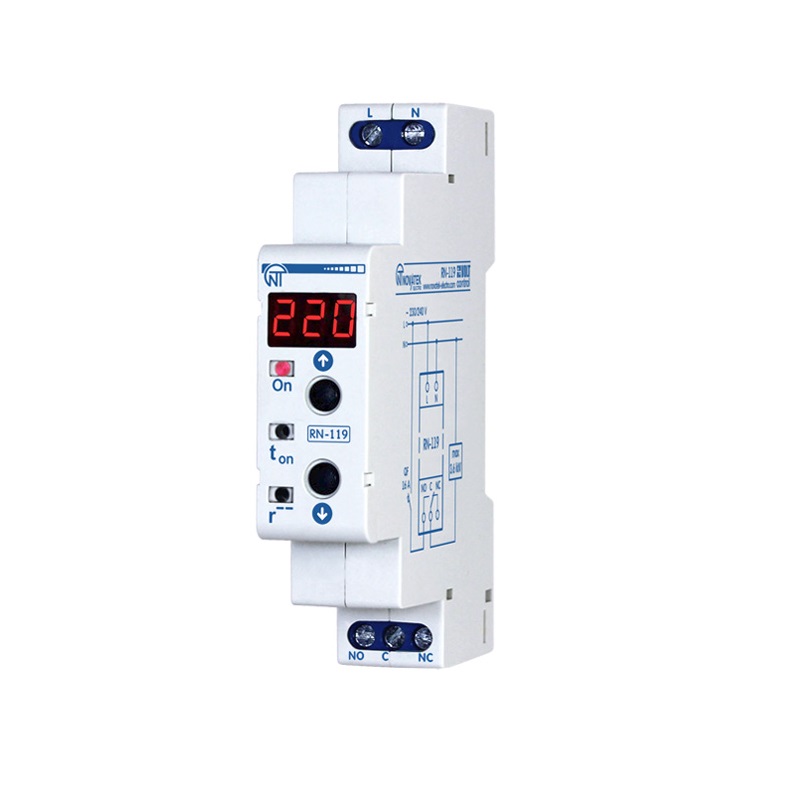
The RN-119 is a compact DIN-rail-mount single-phase voltage monitoring relay designed for panel-board integration. It monitors AC supplies in the 220–240 V range and provides simultaneous protection against under-voltage, over-voltage, and neutral-break conditions. Its SPDT (1 NO + 1 NC) output contact at 10–16 A makes it directly compatible with standard IEC contactors used in pump starter panels.
- Voltage range: 220–240 V AC
- Contact form: SPDT — 1 NO + 1 NC
- Output current: 10–16 A
- Poles: 2-pole
- Protection functions: Under-voltage, Over-voltage, Neutral-break
- Mounting: DIN-rail
- Price: Rs. 1,950 per piece (ex-GST)
The RN-119's NO contact is wired in series with the pump contactor coil. Under normal voltage, the NO is closed and the pump runs. On any fault — under-voltage, over-voltage, or neutral break — the NO opens, the contactor drops out, and the pump stops instantly. The NC contact simultaneously closes, which can be wired to an alarm indicator or building management system (BMS) digital input.
Buy RN-119 Online — Rs. 1,950Novatek Electro RN-102 — Wall-Mount Single Phase Voltage Relay
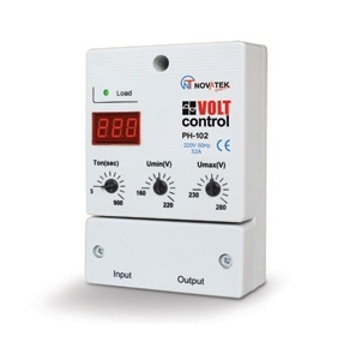
The RN-102 is the field-deployment companion to the RN-119. It is a wall-mounting-type single-phase voltage monitoring relay, rated at a robust 32 A, and designed to be installed in outdoor pump-house enclosures close to the load — eliminating the need for a separate panel-board in remote pump locations on hotel or agri-tourism properties.
- Voltage range: 220–240 V AC
- Contact form: SPDT
- Output current: 32 A
- Poles: 2-pole
- Protection functions: Under-voltage, Over-voltage, Neutral-break
- Mounting: Wall-mount (for enclosure installation)
- Price: Rs. 4,570 per piece (ex-GST)
With a 32 A output rating, the RN-102 can directly switch loads up to approximately 7 kW on a single-phase 230 V supply — covering most submersible pumps up to 3 HP used for hotel water supply and drip-irrigation systems. For larger pumps, its SPDT output drives the coil of a suitably rated contactor.
Buy RN-102 Online — Rs. 4,570Model Comparison Table
| Parameter | RN-119 | RN-102 |
|---|---|---|
| Voltage (V AC) | 220–240 | 220–240 |
| Output Current Rating | 10–16 A | 32 A |
| Contact Form | SPDT (1 NO + 1 NC) | SPDT |
| Mounting Style | DIN-rail | Wall-mount |
| Poles | 2-Pole | 2-Pole |
| Protection Functions | Under-V, Over-V, Neutral Break | Under-V, Over-V, Neutral Break |
| Best For | Panel-board integration, contactor-driven starters | Field pump houses, direct load switching up to 32 A |
| Price (ex-GST) | Rs. 1,950 | Rs. 4,570 |
All prices exclusive of GST. GST @ 18% applicable extra.
Quick Selection Guide — By Application
| Application | Recommended Model | Reason | Price (ex-GST) |
|---|---|---|---|
| Submersible pump (up to 2 HP) — field pump house, no MCC panel | RN-102 | Wall-mount form factor, 32 A direct switching, no separate panel needed | Rs. 4,570 |
| Submersible pump (3 HP+) — starter panel with contactor | RN-119 | DIN-rail mounts inside panel, SPDT output drives contactor coil, NC drives alarm | Rs. 1,950 |
| Drip-irrigation controller and solenoid bank | RN-102 | Wall-mount at outdoor irrigation panel, 32 A handles controller + valve actuators | Rs. 4,570 |
| Grain-processing equipment (single-phase mill, winnower) | RN-119 | Panel integration, contactor switching, NC contact to alarm/SCADA | Rs. 1,950 |
| Rural cold-chain storage (single-phase compressor unit) | RN-102 | 32 A handles compressor loads directly; wall-mount suits cold-room plant rooms | Rs. 4,570 |
Wiring Best Practices
RN-119 in a Pump Starter Panel
- Mount the RN-119 on the DIN rail adjacent to the pump contactor and MCB. Maintain a minimum 10 mm clearance from heat-generating components.
- Connect the relay's Phase and Neutral sensing terminals directly to the supply side of the MCB — before the contactor — so the relay measures actual incoming supply voltage, not the post-contactor voltage which drops to zero when the pump is off.
- Wire the NO output contact in series with the contactor coil and the manual ON pushbutton circuit. This ensures the contactor cannot energize when the relay detects a fault.
- Connect the NC output contact to a 230 V panel lamp (red) or a BMS/SCADA digital input for remote fault annunciation.
- Use minimum 2.5 mm² copper for control wiring and minimum 4 mm² for the load-side conductors at 16 A.
RN-102 in a Field Pump House
- Install the RN-102 inside an IP54 or better rated GRP or sheet-steel enclosure. Never expose it directly to monsoon rain, direct sunlight, or chemical spray from fertilizer mixing areas.
- Use minimum 6 mm² copper conductors for the 32 A load terminals. Apply anti-oxidant compound on terminals in high-humidity environments near water bodies.
- Bond the enclosure to the site earth electrode using a 4 mm² green-yellow conductor. Single-phase pump systems in rural areas are particularly vulnerable to earth faults during monsoon; a well-bonded enclosure protects operating personnel.
- Install a suitably rated MCB or MCCB upstream of the RN-102 for short-circuit protection — the voltage relay protects against voltage faults, not short circuits.
- Label the relay's LED status indicators at the enclosure door window so maintenance personnel can diagnose faults without opening the enclosure under live conditions.
Troubleshooting Common Installation Issues
| Symptom | Likely Cause | Corrective Action |
|---|---|---|
| Relay trips immediately on power-up even though supply appears normal | Sensing terminals connected to load side of contactor — relay sees 0 V when contactor is open | Move sensing wires to supply side (upstream) of the main contactor |
| Relay trips repeatedly during pump start even though voltage is adequate | Motor starting current causes a brief supply voltage dip that crosses the under-voltage threshold | Verify that the relay response delay is set to ride through the motor starting transient (typically 3–5 seconds); check supply impedance and cable sizing |
| Pump does not restart after voltage returns to normal | Reconnection delay timer still running, or manual-reset feature engaged | Wait for reconnection delay to elapse; check relay LED status and datasheet for reset procedure |
| Relay energizes but contactor does not pull in | NO contact wiring open, contactor coil open-circuit, or relay output overloaded by coil inrush | Check continuity of NO contact wiring; verify contactor coil rating matches relay output; use a suppression diode or RC snubber across the coil |
| Relay output contact burns or pits after a few months | Relay switching contactor coil without arc suppression — inductive kick damages contacts | Fit an RC snubber (0.1 µF / 100 Ω for AC coils) or a varistor (MOV) across the contactor coil terminals |
Why Novatek Electro?
- ISO 9001:2015 Certified Manufacturing: Every relay is manufactured under a documented quality management system. Calibration records, traceability, and incoming material inspection are embedded in the production process — not bolt-on activities.
- CE Marked Products: CE certification confirms that RN-series relays meet European electromagnetic compatibility (EMC) and low-voltage directive requirements — a standard that exceeds the minimum compliance demanded by most Indian project specifications.
- Made in India — Delhi: Novatek Electro India Private Limited designs and manufactures all relays at its Delhi facility. Spare parts, technical support, and replacement units are accessible through a pan-India distributor network — not shipped from overseas on 8-week lead times.
- 30+ Years of Protection Device Expertise: Novatek Electro has been engineering voltage and current monitoring relays since the early 1990s. The product range spans single-phase to three-phase, current monitoring, motor protection, and power-quality relays — all from a single manufacturer.
- Accessible After-Sales Support: Technical documentation, wiring diagrams, and datasheet downloads are available. Pre-sales application engineering support is available to help panel-builders and contractors select the right relay for their load profile and supply conditions.
The RN-119 (Rs. 1,950 ex-GST) and RN-102 (Rs. 4,570 ex-GST) are available for immediate dispatch through our authorized online channel. For bulk project quantities, OEM pricing, or technical application support, contact our sales team directly.
Shop Online at Intelli-Electro Email: sales@novatek-electro.in
Call / WhatsApp: +91-7840054744