When Your Electricity Bill Is Bigger Than Your Maintenance Budget — A Petrochemical Reality Check
Walk into any refinery substation, gas compressor station or petrochemical plant and you will find the same engineering paradox: multi-crore process equipment operating on electrical systems whose power quality has never been formally audited. Harmonic distortion from variable-frequency drives on compressor trains, low power factor from motor banks driving centrifugal pumps, peak demand spikes during simultaneous equipment start-ups — all of these translate directly into penalty charges on electricity bills, accelerated insulation degradation and unplanned downtime. Yet the instruments needed to measure, log and diagnose these issues are still treated as optional rather than essential.
This article is a practical engineering guide for electrical engineers, energy managers and instrumentation teams working in oil, gas and petrochemical facilities — covering what to measure, why it matters, and how the Novatek Electro RPM-416 and RPM-16-4-3 power analyzers and data loggers map to real-world applications in this sector.
Why Power Quality Is a Process Safety and Profitability Issue in Oil, Gas & Petrochemical
The electrical environment in hydrocarbon processing is uniquely hostile. Consider the load profile: large induction motors on crude transfer pumps and gas compressors draw high reactive current and depress power factor; pulse-width-modulated VFDs inject 5th and 7th harmonic currents into the distribution system; emergency shutdown system (ESD) relay panels and UPS banks create non-linear loading; and process heaters with thyristor controls generate voltage notching that propagates upstream to utility metering points.
From a regulatory and commercial standpoint, DISCOMS across India impose power factor penalties when the average monthly PF falls below 0.90 or 0.95 depending on the tariff category. For high-tension industrial consumers — which virtually every refinery, CGD (City Gas Distribution) compressor station or petrochemical complex qualifies as — these penalties can represent a significant recurring cost. Additionally, maximum demand (MD) tariff structures mean that a single equipment start-up sequence that coincides with peak grid demand can elevate the MD register for the entire billing month.
Beyond billing, low power factor and harmonics cause: transformer derating and overheating, nuisance tripping of sensitive process control systems, motor winding stress and premature bearing failure, and inaccurate energy metering that makes internal cost allocation unreliable across plant departments.
What Needs to Be Measured — and How Often
A meaningful energy audit in an oil and gas facility is not a one-day snapshot exercise. It requires continuous, time-stamped recording of:
- Three-phase voltage (line-to-line and line-to-neutral) with waveform capture capability
- Three-phase current including neutral current
- Active power (kW), reactive power (kVAR), apparent power (kVA) per phase and totals
- Power factor — per phase and displacement PF
- Energy consumption (kWh, kVARh) with time-of-day segmentation
- Peak demand — 15-minute and 30-minute integrated demand windows matching DISCOM billing cycles
- Voltage and current harmonics (THD)
- Temperature at cable terminations and busbar joints (process correlation)
The sampling rate matters enormously. A 15-minute average obscures a 200-millisecond voltage sag that trips a DCS controller. For root-cause analysis, millisecond-resolution logging is required.
Novatek Electro RPM-416 — The Multi-Channel Power Quality Analyzer for Complex Plant Electrical Systems
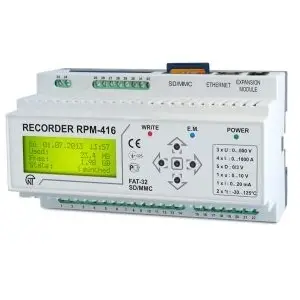
The RPM-416 is designed for exactly the kind of multi-parameter, continuous-monitoring requirement described above. It is not a handheld instrument — it is a panel-mounted, 24/7 recording device that functions as the electrical system's 'black box.'
Key Specifications
| Parameter | RPM-416 Specification |
|---|---|
| Input Voltage Range | 24 – 265 V AC/DC |
| Input Types | AC Voltage, AC Current, Temperature, Analogue Transducer, Dry Contact |
| Number of Input Channels | 15 total |
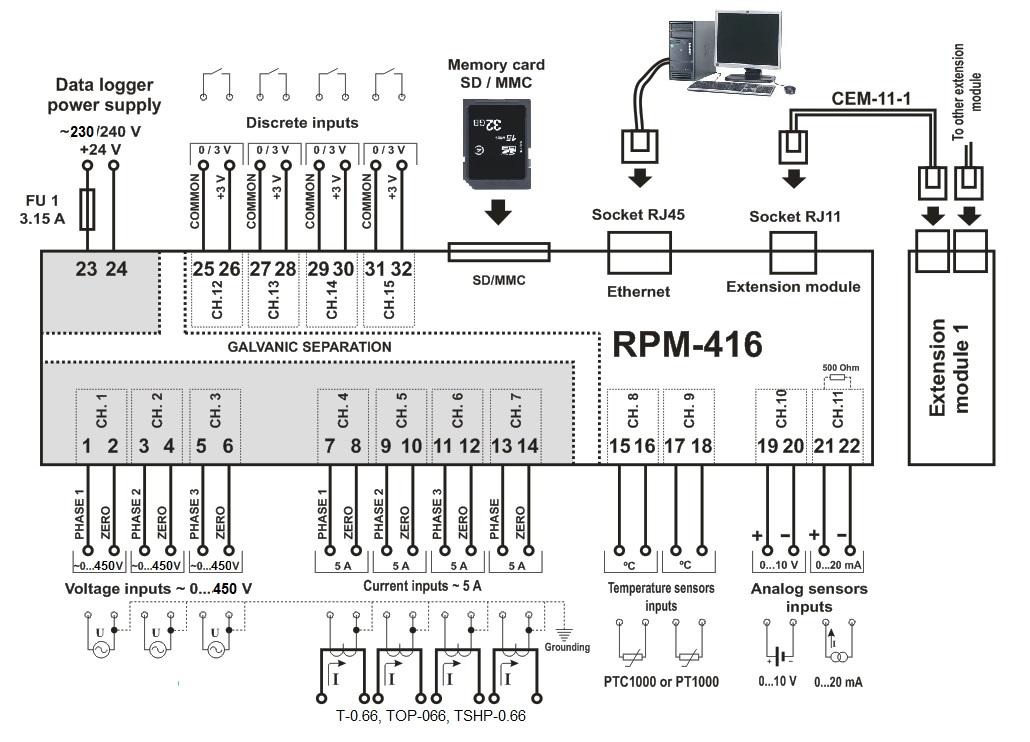
| Channel Breakdown | 3 × Voltage, 4 × Current, 2 × Temperature, 2 × Analogue, 4 × Dry Contacts |
| Data Sampling Rate | 1 millisecond to 3,600 seconds (programmable) |
| Data Storage | 32 GB external SD/MMC card |
| Communication | Built-in Ethernet port; Modbus for SCADA integration |
| Software | Free PC software for analysis and report generation |
| Certifications | CE Certified; ISO 9001:2015 manufactured |
| MRP (ex-GST) | Rs. 45,000 per piece |
The 15-channel architecture is what sets the RPM-416 apart for petrochemical applications. On a single instrument you can simultaneously log all three phase voltages, current on four circuits (three phases plus neutral — or three phases on two separate feeders), temperature at two measurement points (useful for correlating cable heating with load cycles), two analogue transducer inputs (4–20 mA from a gas flow meter or pressure transmitter, for example) and four dry-contact status inputs (circuit breaker open/close, motor run/stop). This is not just energy monitoring — it is process-correlated energy monitoring.
The 1-millisecond sampling capability means transient events — voltage sags caused by large motor starts, current inrush during compressor kick-in, momentary supply dips during utility switching — are captured with the temporal resolution needed for root-cause analysis. The 32 GB SD card stores months of such data without overwriting. The built-in Ethernet port means logged data integrates directly with plant SCADA or historian systems via Modbus, eliminating the need for manual data retrieval at the device.
Buy RPM-416 — Rs. 45,000 (ex-GST)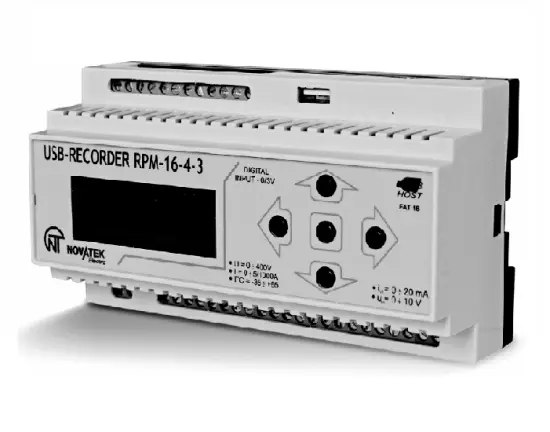
Novatek Electro RPM-16-4-3 — The 'Black Box' Recorder for Industrial Electrical Systems
The RPM-16-4-3 is a microprocessor-based electrical data logger positioned to bridge the gap between real-time power analysis and long-term trend recording. Think of it as the flight data recorder equivalent for your electrical distribution system — always recording, always time-stamping, ready to tell you exactly what happened before a trip or a penalty event.
For oil and gas applications where the primary requirement is continuous trend logging of electrical parameters across a three-phase system — rather than deep waveform analysis — the RPM-16-4-3 provides the right capability at a price point that makes it practical to deploy multiple units across a facility: at the incomer, at individual MCC feeders serving process pumps, at the compressor motor control panel, and at utility metering points for billing verification.
Buy RPM-16-4-3 — Rs. 20,142 (ex-GST)Application Mapping: RPM-416 & RPM-16-4-3 in Oil, Gas & Petrochemical
| Application Type | What to Measure | Recommended Model | Why This Model |
|---|---|---|---|
| Main HT/LT incomer energy audit in refineries and petrochemical complexes | All three-phase V, I, kW, kVAR, kWh, PF, MD, THD | RPM-416 | 15-channel capacity, Ethernet/Modbus for DCS integration, 1 ms sampling for transient capture |
| Gas compressor motor starter panels — power factor and demand analysis | Per-phase current, PF, kVAR demand, inrush profiling | RPM-416 | 4-current-channel input captures all phases plus neutral; temperature channels for motor cable monitoring |
| Crude transfer and pipeline pump station MCC feeder logging | Running current, kWh per batch, PF trend, load factor | RPM-16-4-3 | Cost-effective for multi-point deployment across pump stations; continuous trend logging |
| Flare system and ESD panel electrical parameter monitoring | Voltage stability, current draw, dry-contact status of ESD relays | RPM-416 | 4 dry-contact inputs correlate electrical events with ESD status signals |
| Billing verification at utility metering points in CGD / LPG bottling plants | kWh, kVARh, MD 15-min demand, PF for cross-checking DISCOM invoices | RPM-16-4-3 | Independent logging for dispute resolution; downloadable logs as evidence |
| Load balancing across three-phase distribution in process plant sub-stations | Per-phase current imbalance, neutral current, load profile by shift | RPM-416 or RPM-16-4-3 | RPM-416 for detailed analysis; RPM-16-4-3 for ongoing monitoring post-correction |
| Power factor correction (APFC panel) performance verification | PF before/after capacitor switching, kVAR injection vs demand | RPM-416 | Analogue transducer inputs accept signals from capacitor switching controllers |
Quick Selection Guide
| Application | Recommended Model | Price (ex-GST) |
|---|---|---|
| Deep power quality analysis, waveform capture, SCADA integration, multi-parameter logging | RPM-416 | Rs. 45,000 |
| Continuous trend logging, billing verification, multi-point feeder monitoring | RPM-16-4-3 | Rs. 20,142 |
All prices exclusive of GST. GST @ 18% applicable extra. Contact distributor for volume pricing on multi-unit deployments.
Relevant IS/IEC Standards for Energy Audit and Power Quality in Petrochemical Applications
- IS 15958 / IEC 61000-4-30: Power quality measurement methods — Class A and Class S measurement requirements for energy audit instrumentation
- IS 14697 / IEC 61557-12: Performance measuring and monitoring devices (PMD) for electrical energy systems
- IEC 61326-1: EMC requirements for measurement, control and laboratory equipment — relevant for instruments in industrial process environments
- BEE (Bureau of Energy Efficiency) Energy Audit Guidelines: Mandate continuous electrical parameter logging as part of detailed energy audit under the Energy Conservation Act, 2001
- CEA Regulations on Installation and Operation of Meters, 2006 (amended): Govern metering accuracy and data retention requirements at HT consumer premises
- IS 13234: Power factor improvement and reactive power compensation guidelines for industrial consumers
- IEC 60034-30: Energy efficiency classification for AC motors — referenced during audit of motor-driven systems in process plants
The RPM-416 (Rs. 45,000 ex-GST) and RPM-16-4-3 (Rs. 20,142 ex-GST) are available through Novatek Electro's authorised distribution network across India. For technical specifications, application assistance or a quotation, contact the team below.
Online: intelli-electro.com
Email: sales@novatek-electro.in
Phone: +91-7840054744
Why Novatek Electro?
- ISO 9001:2015 Certified Manufacturer: Quality management systems audited and certified — not a trading company but a design-and-manufacture operation.
- CE Certified Products: RPM-416 and RPM-16-4-3 carry CE certification, confirming compliance with European EMC and safety directives — accepted as a quality benchmark by EPC contractors and plant engineers.
- Made in India: Products designed and manufactured in India, offering supply chain reliability, faster delivery and compatibility with Indian grid conditions (voltage, frequency, wiring practices).
- 30+ Years of Engineering Experience: Novatek Electro has been developing electrical protection and measurement devices for over three decades, with products installed across process industries, utilities and infrastructure.
- Genuine After-Sales Support: Technical documentation, free PC analysis software (RPM-416), and a responsive support team — not just a product box.
Frequently Asked Questions
For application-specific advice, bulk pricing or to place an order for the RPM-416 or RPM-16-4-3, reach the Novatek Electro team through any of the following channels:
Online Store: intelli-electro.com — Power Analyzers & Data Loggers
Email: sales@novatek-electro.in
Phone / WhatsApp: +91-7840054744
Shop RPM-416 — Rs. 45,000 Shop RPM-16-4-3 — Rs. 20,142