When Your Data Center PUE Looks Fine on Paper But Your Electricity Bill Tells a Different Story
Every data center facility manager knows the drill: the UPS dashboard shows stable voltages, the cooling system reports nominal loads, and yet the monthly electricity bill keeps climbing — faster than your server rack count. The uncomfortable truth is that standard metering at the utility incomer tells you what you consumed, not why, when, or on which circuit. Power factor penalties, peak demand charges, load imbalances across three-phase feeders, and invisible harmonic distortion silently inflate operational costs in virtually every IT facility that has not deployed dedicated power quality monitoring.
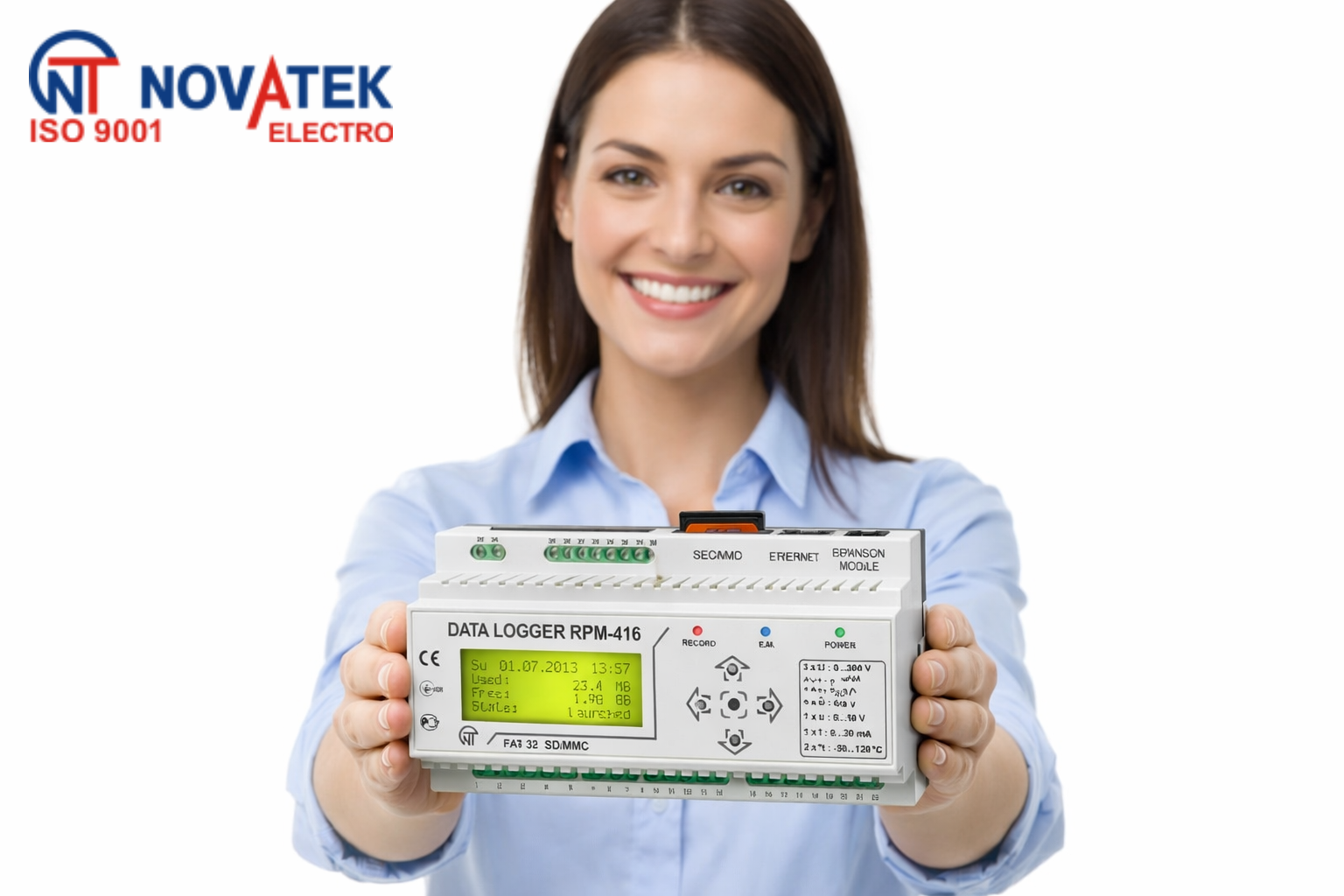
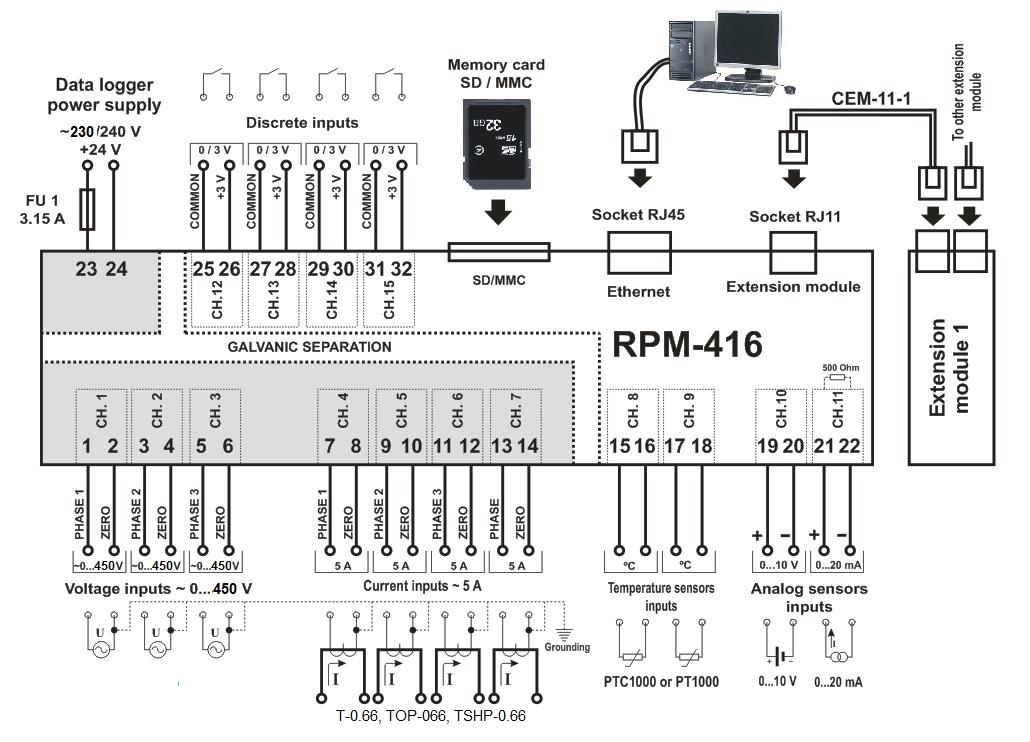
This is precisely the engineering problem that the Novatek Electro RPM-416 and RPM-16-4-3 power analyzers and data loggers are built to solve — not as passive meters, but as continuous, high-resolution recorders that give facility engineers the evidentiary data needed to act.
Why Data Centers Need Dedicated Power Analyzers — Not Just Panel Meters
A data center electrical system is among the most demanding environments for power quality instrumentation. You have high-density UPS systems injecting harmonics, variable-speed drives on CRAC units pulling non-linear currents, unequal rack loading creating phase imbalance across PDUs, and diesel generators with reactive power characteristics that differ from the grid. Standard panel meters sample at intervals too coarse to capture transient events, and they store nothing — meaning that by the time you notice a problem, the evidence is gone.
What a facility engineer actually needs is a device that:
- Samples voltage and current at sub-second intervals — ideally down to 1 millisecond
- Logs data continuously to removable memory with a timestamp trail
- Measures all three phases simultaneously with individual current channels
- Computes active power (kW), reactive power (kVAR), apparent power (kVA), power factor and energy (kWh) in real time
- Communicates over Modbus RTU/TCP so SCADA and BMS systems can pull live data
- Accepts analogue transducer inputs for temperature or process signals from server rooms or cooling plants
Both the RPM-416 and RPM-16-4-3 are engineered to meet these requirements, but they serve different installation scales and budget profiles. Understanding which one fits your scenario saves both money and commissioning time.
Feature-by-Feature: What to Look for in a Data Center Power Analyzer
Sampling Rate
For billing verification and energy audit work, one-minute averages are often sufficient. For capturing transient events — voltage sags during generator changeover, current inrush on server startup — you need millisecond-level resolution. The RPM-416 offers a programmable sampling rate from 1 millisecond to 3,600 seconds, giving you flexibility across both use cases on a single instrument.
Channel Count and Input Diversity
A three-phase feeder needs three voltage channels and at least three current channels. Add neutral current monitoring, cooling plant temperature, and a dry-contact input from a generator status relay, and your channel count climbs quickly. The RPM-416 provides 15 input channels: 3 × voltage, 4 × current, 2 × temperature, 2 × analogue transducer, and 4 × dry contact — all on one device.
Memory and Data Export
Continuous logging is only useful if you can retrieve and analyse the data. The RPM-416 stores logs on an external SD/MMC card (32 GB), allowing months of high-resolution data to be physically retrieved or downloaded over its built-in Ethernet port. Free PC software for analysis and report generation is included — directly relevant for preparing energy audit reports or disputing utility billing.
Communication and Integration
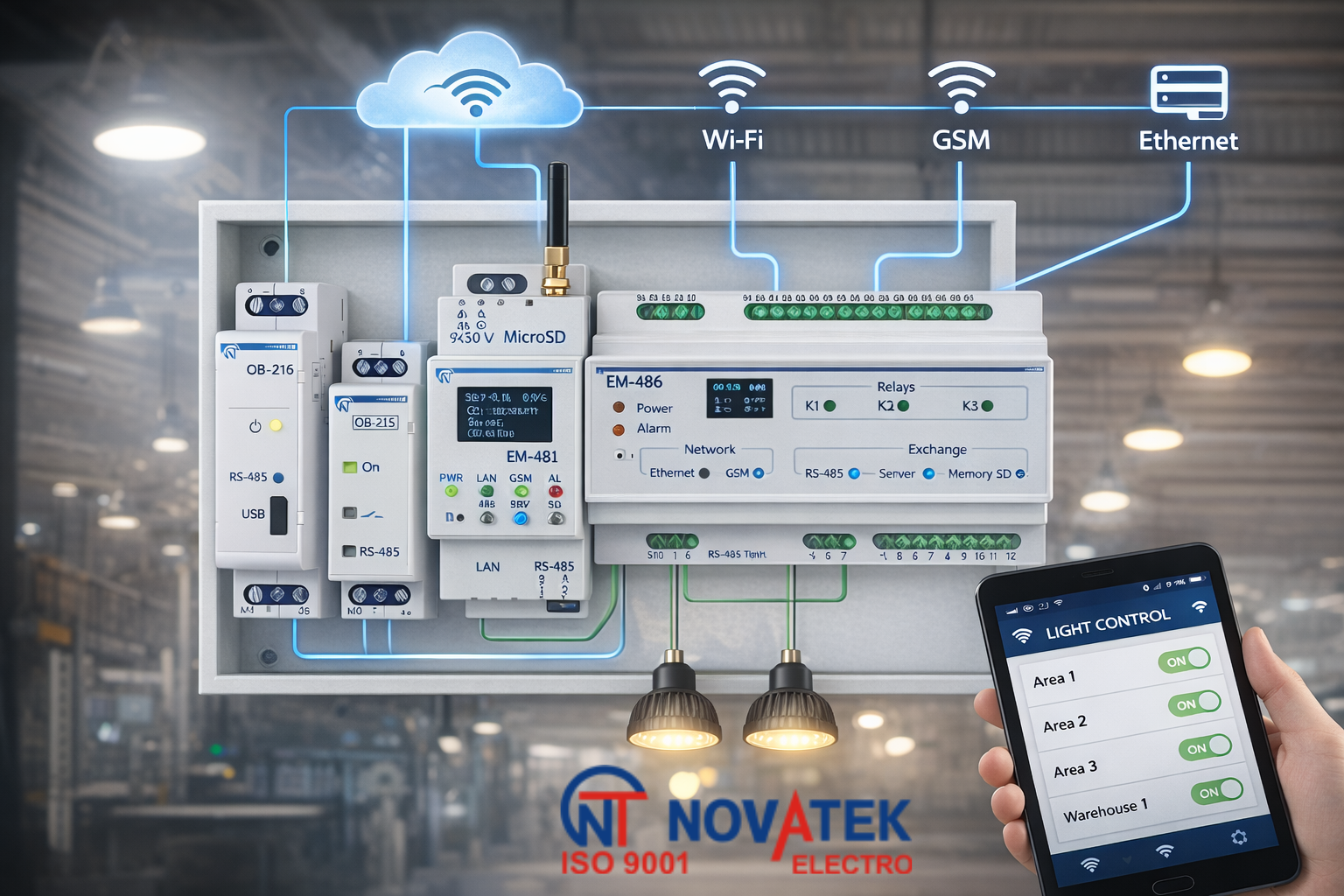
Both models support Modbus communication, which is the lingua franca of industrial SCADA, BMS, and DCIM (Data Center Infrastructure Management) platforms. This means logged parameters can feed live into your centralised monitoring dashboard without custom protocol conversion.
Voltage Input Range
Indian data center feeders operate at 415 V line-to-line (240 V phase-to-neutral) nominally, but voltage can range considerably — especially during utility fluctuations or generator operation. Both the RPM-416 and RPM-16-4-3 accept 24–265 V AC/DC on voltage input channels, which comfortably covers standard LV distribution without external potential transformers on most feeder configurations.
Model Comparison: RPM-416 vs RPM-16-4-3
| Parameter | RPM-416 | RPM-16-4-3 |
|---|---|---|
| Device Type | Power Quality Analyser & Data Logger | Microprocessor-based Electrical Data Logger |
| Input Voltage Range | 24–265 V AC/DC | 24–265 V AC/DC |
| Total Input Channels | 15 (3V + 4I + 2 Temp + 2 Analogue + 4 Dry Contact) | 16 (refer datasheet for channel breakdown) |
| Sampling Rate | 1 ms – 3,600 sec (programmable) | Programmable (refer datasheet) |
| Memory | 32 GB external SD/MMC | Internal (refer datasheet) |
| Communication | Modbus + Built-in Ethernet | Modbus |
| PC Software | Free (analysis & report generation) | Refer datasheet |
| Temperature Inputs | 2 channels | Refer datasheet |
| Price (ex-GST) | Rs. 45,000 | Rs. 20,142 |
| Best Suited For | Comprehensive power quality audit, multi-parameter logging, SCADA-integrated facilities | Continuous electrical data logging, cost-effective multi-feeder monitoring |
All prices effective 01 April 2026. GST @ 18% applicable extra. Prices subject to revision — confirm with distributor at time of order.
Application-Based Selection Guide
| Application Scenario | Recommended Model | Price (ex-GST) |
|---|---|---|
| Full power quality audit with SCADA/BMS/DCIM integration, temperature monitoring of server rooms and UPS rooms, millisecond-level transient capture | RPM-416 | Rs. 45,000 |
| Continuous electrical data logging across multiple sub-feeders, billing verification, load balancing between PDU branches | RPM-16-4-3 | Rs. 20,142 |
| Power factor correction project: establishing baseline PF across three-phase incomer before APFC installation | RPM-416 | Rs. 45,000 |
| Peak demand management: 30-day demand profiling to identify demand peaks and schedule non-critical loads | RPM-16-4-3 | Rs. 20,142 |
| Generator-to-grid changeover monitoring with dry-contact status inputs and voltage/current logging during transition | RPM-416 (dry contact inputs essential) | Rs. 45,000 |
| Budget-conscious multi-point sub-metering across rack PDUs in a colocation facility | RPM-16-4-3 | Rs. 20,142 |
The Quick Decision Rule
If your installation requires millisecond sampling, SD card archiving, built-in Ethernet, temperature channel inputs, dry-contact status logging, and a full suite of power quality analysis with PC report generation — choose the RPM-416 (Rs. 45,000 ex-GST).
If your installation requires reliable, cost-effective continuous electrical data logging across multiple sub-feeders with Modbus output for integration, and your primary need is demand profiling, billing verification and load balancing rather than deep power quality analysis — choose the RPM-16-4-3 (Rs. 20,142 ex-GST).
Buy RPM-416 — Rs. 45,000 Buy RPM-16-4-3 — Rs. 20,142Common Selection Mistakes (and How to Avoid Them)
Mistake 1: Buying a Logger Without Modbus When You Have a BMS
Many procurement teams evaluate power analyzers in isolation and only realise post-installation that their Building Management System or DCIM platform cannot pull data from the device. Both the RPM-416 and RPM-16-4-3 support Modbus, but always confirm your BMS master supports Modbus RTU or TCP and obtain the register map before commissioning.
Mistake 2: Under-specifying the Current Input Range
Data center feeders carrying UPS output currents can be substantially higher than nameplate assumptions, especially during N+1 failover events. Verify that external current transformers (CTs) are sized for maximum fault-ride current, not just nominal load. The power analyzer measures what the CT presents — an undersized CT saturates and gives false readings.
Mistake 3: Ignoring the Sampling Rate vs Storage Trade-off
On the RPM-416, logging at 1 ms fills storage faster than logging at 1-minute intervals. For a 30-day energy audit, 1-minute sampling is typically adequate and extends SD card life significantly. Reserve 1 ms sampling for specific transient capture sessions — generator changeover tests, UPS bypass switching — not continuous background logging.
Mistake 4: Installing at the Incomer Only
A single analyzer at the utility incomer gives you total facility consumption but nothing about distribution inside the data hall. For load balancing and billing verification across tenants in a colocation environment, you need analyzers or sub-meters at each PDU or feeder breakout. The RPM-16-4-3 at Rs. 20,142 makes multi-point deployment economically practical.
Mistake 5: Not Planning for CT Polarity and Phase Sequence Before Installation
Reversed CT polarity causes negative power readings. Wrong phase sequence assignment causes incorrect power factor calculation. These are purely wiring errors, but they are the most common cause of 'instrument malfunction' calls to technical support. Always verify phase sequence with a phase sequence indicator before energising CT secondaries.
Installation Tips from the Field
- Use shielded twisted-pair cable for Modbus RS-485: Data center environments have significant electromagnetic interference from server switching supplies and UPS inverters. Unshielded Modbus wiring introduces communication errors that look like instrument faults but are purely a cabling issue. Ground the shield at one end only.
- Mount the RPM-416 in a ventilated panel: The SD card slot must remain accessible for periodic data retrieval if you are not using the Ethernet download path. Plan panel layout accordingly — do not position the card slot behind busbars or cable bundles.
- Set the RTC (Real Time Clock) before first logging session: All log timestamps depend on an accurate internal clock. For SCADA correlation, synchronise the device clock to your network time server via the commissioning software before the first logging session begins.
- Document your CT ratios in the device configuration: Both models compute engineering-unit values (kW, kWh, power factor) based on programmed CT and PT ratios. Incorrect ratio entry is the most common source of wrong energy readings. Cross-check computed values against a portable clamp meter on day one.
- Label each Modbus register map channel clearly: In a data center with multiple analysers on the same Modbus network, mixed-up device addresses cause supervisory software to display wrong feeder data on wrong dashboards. Assign and tape-label device addresses during installation, not retrospectively.
Why Novatek Electro?
- ISO 9001:2015 Certified Manufacturing: Every RPM-416 and RPM-16-4-3 unit is manufactured under a documented quality management system — critical when instruments are used for billing verification and regulatory compliance reporting.
- CE Certified Products: CE marking confirms conformity with applicable European directives on electromagnetic compatibility and low-voltage safety — a useful reference standard even for India-deployed equipment.
- Made in India — 30+ Years of Manufacturing Experience: Novatek Electro India has been manufacturing electrical protection and monitoring devices from Delhi for over three decades, with a product range specifically developed for Indian grid conditions including voltage fluctuations, harmonic-rich environments and high ambient temperatures.
- Genuine After-Sales Technical Support: Technical documentation, connection diagrams, PC software and application guidance are available through authorized distributors and the Novatek Electro technical team — not outsourced to generic call centres.
- Distributor and Panel-Builder Network: Products are available through a network of authorised distributors and system integrators who can provide local commissioning support, making it practical for data center fit-out contractors to source and deploy at scale.
Whether you are planning a comprehensive energy audit with the RPM-416 or deploying distributed logging with the RPM-16-4-3, Novatek Electro authorised distributors can assist with product selection, CT sizing guidance and Modbus integration support.
Shop Online: Buy at Intelli-Electro.com
Email: sales@novatek-electro.in
Phone/WhatsApp: +91-7840054744