The Hidden Wiring Problem That Slows Down Data Center Automation
Every electrical engineer who has walked a cable tray in a mature data center or IT facility knows the feeling: the tray is already 80% full, the controller’s I/O card is out of spare terminals, and the project scope just expanded by another twelve sensors. The instinct is to order a new I/O card, run more cables to the central panel, and absorb the cost. But there is a better engineering answer — and it has been available in Indian industrial automation for decades under the name distributed remote I/O.
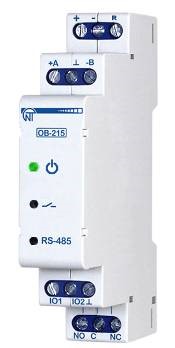
The Novatek Electro OB-215 is a compact digital input-output module built precisely for this problem. One configurable sensor input. One relay output. Built-in RS-485 Modbus communication. Powered from 12–24V DC. At Rs.4,375 per unit ex-GST, it changes the economics of sensor network expansion fundamentally.
Why This Product Category Exists: The Engineering Need
Traditional panel-centric automation wires every sensor — level float, flow switch, door contact, thermal alarm — back to a central controller with individual cables. In a data center environment, this means running signal cables from precision cooling units, UPS rooms, diesel generator bays, containment doors and water-leak detection strips, all the way back to one panel. The results are predictable: cable tray congestion, high EMI pickup on long unshielded runs, signal degradation on resistive loops, and a commissioning nightmare when a tag is mislabelled 40 metres from the panel.
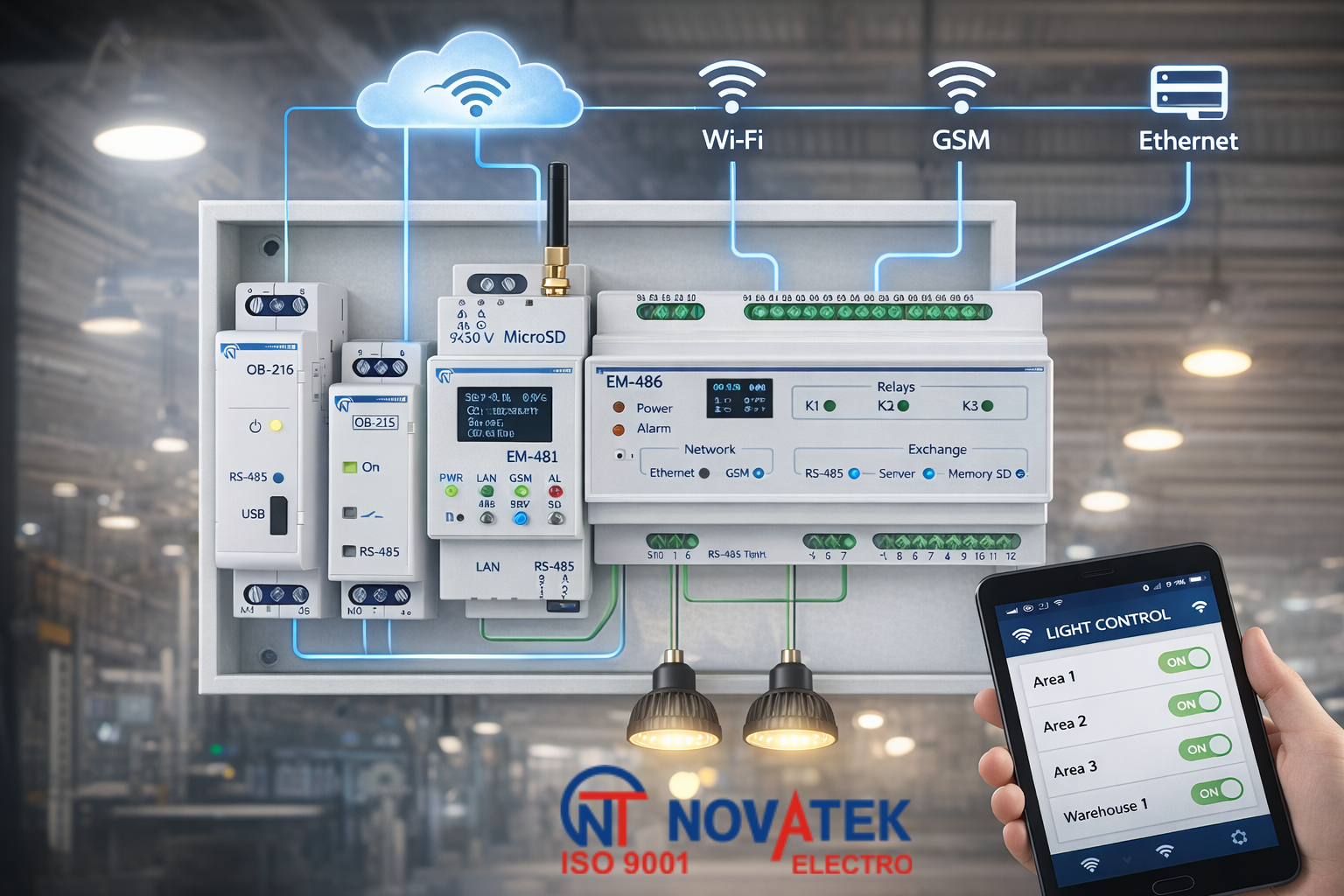
Distributed remote I/O solves this by mounting a small module close to the field device — on a DIN rail inside a local junction enclosure — and returning only a Modbus RS-485 signal over a single twisted-pair cable to the master controller. One RS-485 bus can carry data from many OB-215 slave nodes. The result is fewer cables in the tray, shorter individual field runs, and a single, screenable communication cable between zones and the main panel.
For data centers specifically, where physical infrastructure — power, cooling, access control, leak detection — must be monitored continuously and alarm states must reach a BMS or DCIM platform in near real-time, the OB-215’s Modbus slave architecture fits directly into existing SCADA and BMS master controllers without bespoke driver development.
Key Features to Look For in a Digital I/O Module
1. Communication Protocol and Bus Compatibility
RS-485 with Modbus RTU is the de facto standard for industrial serial networks in India. Any module that does not speak Modbus will require custom protocol mapping. The OB-215 implements Modbus RTU as a slave with individual addressing, error detection, and standardised function code responses — including error message generation when a query cannot be executed — meaning it integrates with virtually any PLC, industrial PC, or IoT gateway on the market today.
2. Configurable Input Flexibility
Data center sensor networks are not homogeneous. You may have dry contact outputs from a flow switch, DC voltage signals from a level transmitter, and digital status outputs from a precision cooling unit — all on the same segment. The OB-215’s configurable sensor input accommodates the standard industrial signal types used across level, flow and contact monitoring applications, avoiding the need for separate signal conditioning modules for each sensor type.
3. Local Relay Output for Edge Action
Not every actuation decision needs to travel back to the master controller. The OB-215’s relay output enables local edge action — closing a valve, energising an alarm sounder, or tripping an auxiliary circuit — based on the local input state, even while simultaneously reporting over Modbus. This edge-compute behaviour reduces response latency for critical alarm conditions.
4. Wide DC Supply Range
Data center auxiliary power rails vary. A module that accepts only 24V DC creates supply compatibility constraints at sites where 12V DC is the dominant auxiliary rail. The OB-215’s 12–24V DC supply range eliminates this constraint and allows the same module to be powered from UPS-backed 12V or 24V DC distribution without additional DC-DC conversion.
5. Modular, Scalable Architecture
The OB-215 is designed as a modular add-on channel. You deploy exactly as many units as the application demands — one per sensor point — and scale by adding units to the bus. There is no need to replace or reprogram an existing controller; you simply add another addressed slave and extend the polling list at the master.
OB-215 Specifications at a Glance
| Parameter | OB-215 Specification |
|---|---|
| Model | OB-215 |
| Sensor Input | One configurable sensor input (level, flow, contact monitoring signal types) |
| Output | One relay output |
| Communication | RS-485 (EIA/TIA-485), Modbus RTU, slave mode |
| Supply Voltage | 12–24V DC |
| Application | Remote monitoring/control, IoT, modular add-on channel, I/O expansion |
| Network Role | Modbus slave (master is PLC or industrial PC) |
| Error Handling | Generates error response message on invalid query or unexecutable command |
| Brand | Novatek Electro (Made in India) |
| Price (ex-GST) | Rs.4,375 per unit |
| Port of Dispatch | New Delhi, India |
Quick Selection Guide: Application vs Recommended Module
| Application Requirement | Recommended Model | Price (ex-GST) |
|---|---|---|
| Single remote sensor point with local relay actuation + Modbus reporting | OB-215 | Rs.4,375 |
| Level monitoring at remote sump or tank with BMS integration | OB-215 | Rs.4,375 |
| Flow switch status reporting over RS-485 to SCADA | OB-215 | Rs.4,375 |
| Distributed alarm aggregation: multiple contact inputs across a large floor | OB-215 (one per alarm point) | Rs.4,375 per point |
| IoT-ready modular I/O expansion for existing controller with free RS-485 port | OB-215 | Rs.4,375 |
Application-Based Selection Guide
If your data center needs distributed water-leak or sump-level monitoring…
Deploy one OB-215 per monitoring point, wired to the level sensor at the local junction box. The relay output can locally activate a sounder or indicator lamp while the Modbus slave interface reports the level state to your BMS master over a shared RS-485 bus. The 12–24V DC supply rail is typically available from the same UPS-backed distribution that feeds network switches and sensors in the sub-floor or raised-floor zone.
If your installation requires remote flow monitoring for precision cooling circuits…
Cooling distribution units and in-row coolers often have flow switch outputs as dry contacts. An OB-215 mounted at the equipment, accepting the flow switch contact on its sensor input and reporting state changes to the central DCIM or SCADA via Modbus, eliminates the need to run individual alarm cables back to the main panel — a particularly valuable saving in high-density row deployments.
If your engineering team needs to expand I/O on an existing PLC without changing the controller…
The OB-215 is a modular add-on channel by design. Provided your controller has an available RS-485 master port — or a Modbus RTU gateway — each OB-215 added to the bus extends the effective I/O count by one input and one relay output. No new I/O card, no controller reprogramming, no panel-board modification beyond adding a terminal block and a 12–24V DC supply tap.
If your project involves alarm aggregation across multiple server rooms or zones…
Place one OB-215 per monitored alarm contact — door contacts, thermal breaker trip signals, smoke detector relay outputs, generator room signals — and address each uniquely on the Modbus bus. A single RS-485 cable run connects all nodes back to your SCADA gateway. At Rs.4,375 per point, this is one of the most cost-effective alarm aggregation architectures available in the Indian market for sub-100-point networks.
Common Selection Mistakes to Avoid
Mistake 1: Treating OB-215 as a Multi-Channel Block
The OB-215 is a single-channel module — one sensor input, one relay output. Engineers accustomed to 8- or 16-channel I/O cards sometimes try to replace a multi-channel card with one OB-215, expecting equivalent density. The correct approach is to deploy one OB-215 per field point and use the RS-485 bus to aggregate them logically, not physically.
Mistake 2: Ignoring RS-485 Bus Termination
RS-485 buses longer than approximately 10 metres require proper termination resistors at both ends of the cable to prevent reflections that corrupt Modbus frames. Omitting termination on a 50-metre run through a data center floor will produce intermittent communication errors that are notoriously difficult to diagnose post-installation.
Mistake 3: Powering Multiple OB-215 Units from an Unregulated Supply
The 12–24V DC supply range assumes a reasonably regulated source. Using an unregulated transformer-rectifier supply with high ripple can cause erratic behaviour, particularly at the lower end of the supply range. Use a dedicated SMPS or UPS-backed regulated DC rail.
Mistake 4: Not Pre-Assigning Modbus Device Addresses Before Field Mounting
Configure each OB-215’s Modbus slave address before mounting it in the field enclosure. Accessing address configuration on a unit already installed in a tight junction box, 3 metres above a raised floor, is avoidable rework.
Installation Tips from the Field
- Use shielded twisted-pair (STP) cable for the RS-485 bus in data center environments. Shield should be grounded at one end only (master end) to avoid ground loop currents.
- Keep the 12–24V DC power supply local to the cluster of OB-215 units where possible. Running both power and RS-485 communication in the same cable reduces the cable count but verify that the power cable voltage drop over long runs keeps supply voltage within 12–24V at the most remote unit.
- Label each OB-215 with its Modbus device address using a permanent adhesive label on the enclosure door. Future maintenance technicians will thank you.
- Test communication to each slave node individually during commissioning before connecting the full bus. This isolates wiring faults early before they become multi-node debugging exercises.
- Document the Modbus register map for each deployed OB-215 in your SCADA tag database at commissioning time. Retroactively identifying which register corresponds to which physical sensor is time-consuming.
Why Novatek Electro?
- ISO 9001:2015 certified — quality management system audited and certified, ensuring consistent manufacturing standards for every OB-215 unit shipped.
- CE marked — products meet European conformity standards, a relevant reference point for data center and IT industry procurement teams with global compliance requirements.
- Made in India, dispatched from New Delhi — domestic manufacturing reduces lead times compared to imported modules and supports supply chain resilience for Indian infrastructure projects.
- 30+ years of engineering experience in electrical protection and monitoring devices, with a product portfolio that spans relay protection, energy measurement, and remote I/O — enabling coordinated system selection from a single manufacturer.
- Dedicated after-sales technical support — reachable at sales@novatek-electro.in and +91-7840054744 for pre-commissioning queries, wiring guidance and replacement part coordination.
The OB-215 is available now at Rs.4,375 per unit, ex-GST through Novatek Electro’s authorised online channel. For multi-unit project pricing, technical pre-sales consultation, or bulk order quotations, contact our engineering sales team directly.
Buy OB-215 Online Email for Project Quote Call +91-7840054744