When Your Cable Tray Is Full — And Your Sensor Count Is Still Growing
Picture this: a cement grinding unit has grown from a single production line to three. The original panel design anticipated 40 field signals. Today, the operations team wants to monitor 110 points — silo levels, bag-filter differential pressures, bucket-elevator motion detectors, clinker conveyor belt-slip switches, and emergency pull-cords. The panel builder's quote for running individual shielded signal cables back to the central PLC? Three weeks of shutdown and a cable-tray expansion that cannot physically fit through the existing conduit runs.
This is not an edge case. It is one of the most common infrastructure bottlenecks in cement and building-materials manufacturing across India. Distributed-sensor sprawl outpaces the original panel architecture, and the conventional fix — more cable cores, bigger marshalling panels, longer runs — brings its own cascade of problems: ground-loop noise on 4–20 mA signals over 200-metre runs, voltage drop on dry-contact sense circuits, sheer installation labour cost, and the ongoing nightmare of tracing a fault through hundreds of identical-looking cores in a crowded tray.
Why Long Field-Cable Runs Create Real Engineering Problems
From a pure electrical engineering standpoint, running low-level signal cables over long distances in an industrial environment exposes every signal to three classes of interference:
- Common-mode noise induced by VFD switching transients and high-tension conductors running in adjacent trays — a particular problem in cement plants where large ID-fan drives and kiln drives generate substantial EMI.
- Resistive voltage drop on 24 V DC dry-contact sense circuits. A 100-metre run of 0.75 mm² cable adds roughly 4.8 Ω round-trip; at 5 mA sense current that is a 24 mV drop — manageable in isolation, but compound that across a marshalling panel with twenty such loops sharing an imperfect common and you invite nuisance alarms.
- Ground loops created when field instruments and the panel reference different earth potentials — a structural inevitability in multi-building cement complexes where buildings have independent earthing systems.
The engineering answer is to move signal conditioning intelligence to the field, digitise the data there, and transmit it back over a two-wire differential RS-485 serial bus. A single twisted-pair carrying Modbus RTU can span 1,200 metres, carry 32 nodes, and is inherently immune to the common-mode noise that destroys analogue signals. That is the architectural shift that the OB-215 Digital Input-Output Module from Novatek Electro enables.
Introducing the OB-215 — Modular Remote I/O for Industrial Automation
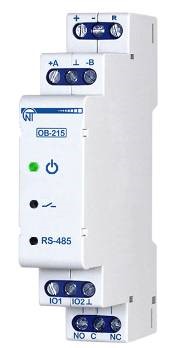
The OB-215 is a compact, DIN-rail-mountable digital input-output module designed for remote sensor interfacing, I/O expansion, and IoT edge applications. It provides one configurable sensor input, one relay output, and a built-in RS-485 Modbus communication port — all in a single, low-cost module powered from 12–24 V DC. At Rs. 4,375 per piece (ex-GST), it is priced to deploy in multiples, which is precisely how it is intended to be used.
Buy OB-215 on Intelli-ElectroCore Technical Specifications
| Parameter | Specification |
|---|---|
| Model | OB-215 |
| Input Channels | One configurable sensor input |
| Output Channels | One relay output |
| Communication | Built-in RS-485 (Modbus RTU) |
| Supply Voltage | 12–24 V DC |
| Mounting | DIN rail (standard 35 mm) |
| Typical Applications | Remote monitoring, IoT edge node, modular I/O expansion |
| Price (ex-GST) | Rs. 4,375 per piece |
| Manufacturer | Novatek Electro India Private Limited, Delhi |
| Certifications | ISO 9001:2015, CE |
What Makes OB-215 Specifically Suited to Cement and Building-Materials Plants
1. Configurable Input — One Module, Multiple Signal Types
Cement-plant sensor inventories are heterogeneous. A single production zone might need to monitor a vibrating-fork level switch (dry contact), a proximity sensor (NPN or PNP transistor output), and a belt-motion detector (pulse output). The OB-215's configurable input accommodates the standard industrial signal types used in level, flow, and contact monitoring without requiring separate module variants for each sensor type. This dramatically simplifies spares inventory.
2. RS-485 Modbus RTU — The Industrial Bus Standard
RS-485 differential signalling maintains valid logic levels at the receiver even with 7 V of common-mode offset, which is typical in multi-building cement complexes. Modbus RTU is natively supported by virtually every SCADA platform and PLC brand operating in India — Siemens, Allen-Bradley, Schneider, Delta, Mitsubishi — so the OB-215 drops into an existing control architecture without a protocol gateway. Up to 32 OB-215 nodes can share a single RS-485 segment, reducing the communication infrastructure cost per monitored point substantially.
3. Relay Output for Local Actuation
Remote I/O modules that are read-only force all actuation decisions back through the serial bus and the central controller, adding latency. The OB-215's onboard relay output enables local control logic — for example, energising a solenoid to isolate a high-level silo, or tripping a feeder conveyor on belt-slip detection — with the central SCADA receiving the status via Modbus concurrently. This is the correct architecture for safety-critical interlock loops where communication-link delay cannot be accepted.
4. 12–24 V DC Power Supply Compatibility
Modern cement-plant distributed control panels universally carry a 24 V DC bus for field instruments. The OB-215's 12–24 V DC supply range means it can be powered directly from the local instrument power supply, eliminating the need for a dedicated supply unit at each remote junction box.
Application Categories in Cement and Building Materials
- Silo and bin level monitoring — aggregating high/low level switch outputs from multiple material storage silos via a single RS-485 run to the central DCS or SCADA
- Bag-filter and dust-collector status monitoring — collecting differential-pressure switch contacts and pulse-jet timer feedback from distributed filter units across the plant
- Conveyor and bucket-elevator supervision — belt-slip, belt-misalignment, and pull-cord emergency stop status from remote conveyor galleries
- Raw-material flow detection — interfacing paddle-type, vibrating-fork, or rotary-vane flow switches on raw-meal and cement transport lines
- Clinker cooler and kiln auxiliary monitoring — temperature limit switch contacts and motion-detector outputs from equipment distributed around the kiln line
- Quarry and crushing-plant remote I/O — extending the I/O reach of a central PLC to crusher feed hoppers and primary screen decks without running multi-core cables over long distances
- Building-materials manufacturing (AAC blocks, fly-ash bricks, RMC plants) — aggregate-bin level monitoring, slurry-tank overflow detection, and batching-plant alarm aggregation
- Alarm aggregation for remote sub-stations — collecting status contacts from MCC and MV switchgear located away from the main control room and transmitting consolidated status over RS-485
Quick Selection Guide
| Application Requirement | Recommended Model | Price (ex-GST) |
|---|---|---|
| Single remote sensor node with relay output and Modbus RS-485 | OB-215 | Rs. 4,375 |
| Multi-node distributed sensor network (level, flow, contact monitoring) | OB-215 (multiple units on one RS-485 bus) | Rs. 4,375 per node |
| IoT edge I/O expansion for existing PLC with RS-485 port | OB-215 | Rs. 4,375 |
| Remote alarm aggregation from distributed field contacts | OB-215 (one per alarm source zone) | Rs. 4,375 per unit |
All prices exclusive of GST. GST @ 18% applicable extra. Prices effective 01.04.2026 per Novatek Electro price list 2026–27. Contact sales@novatek-electro.in for project and volume pricing.
Why Novatek Electro?
- 30+ years of manufacturing experience — Novatek Electro has been designing and manufacturing electrical protection and monitoring devices in India since the early 1990s, with deep application knowledge across process industries.
- ISO 9001:2015 certified — quality management systems covering design, manufacture, and final inspection, ensuring consistent product performance batch to batch.
- CE certified — products meet European EMC and safety directives, confirming electromagnetic compatibility in industrial environments — a meaningful credential in high-noise cement-plant settings.
- Made in India — domestic manufacturing means shorter lead times, rupee-denominated pricing without import-cost volatility, and accessible after-sales support.
- Panel-builder and OEM friendly — products are available through authorised distributors and through the Intelli-Electro online platform with technical documentation, connection diagrams, and datasheet support for engineering teams.
Frequently Asked Questions
Ready to Expand Your Sensor Network with OB-215?
The OB-215 digital input-output module is available now at Rs. 4,375 per unit (ex-GST) through India's authorised Novatek Electro distribution network.
Buy on Intelli-ElectroFor project pricing, volume orders, or technical pre-sales support:
- 📧 sales@novatek-electro.in
- 📞 +91-7840054744
- 🌐 intelli-electro.com
Manufactured by Novatek Electro India Private Limited, Delhi — ISO 9001:2015 and CE certified. Made in India.