When a Mis-Sequenced Motor Start Shuts Down the Rolling Mill
Picture a cold-rolling mill conveyor system: three drive motors, each drawing 15–22 A at start-up, all commanded to energise simultaneously because the panel timer drifted or the wrong mode was selected. The busbar voltage collapses, the VFDs trip on under-voltage, and a downstream coiler jams a 6-tonne coil mid-process. Downtime is measured in hours, not minutes. The root cause — an inadequate or incorrectly configured time delay relay — costs orders of magnitude more than the relay itself ever would have.
This is not a hypothetical. Sequential motor starting, conveyor staging, star-delta transition, and process interlocking are everyday realities in steel and metals facilities. The timing relay sitting inside your panel is the silent orchestrator of all of it. Get the relay right and the sequence runs like clockwork. Get it wrong and the consequences cascade.
This article is written for panel-builders, automation engineers, and plant electricians who need to select the correct multifunction time delay relay — and configure it correctly the first time.
Why Multifunction Time Delay Relays Exist: The Engineering Need
A single-function timer — say, a fixed on-delay — handles one scenario. But a steel or metals facility demands far more from the same DIN rail slot. Consider what a single panel section may need to handle across a shift:
- Conveyor staging: Motor A must reach full speed before Motor B starts — on-delay sequencing.
- Star-delta motor starting: Contactor transition from star to delta must happen at the right moment — typically 5–15 seconds — to limit inrush without stalling.
- HVAC fan control: Damper actuator must open fully before the fan motor energises — on-delay; fan must coast down before damper closes — off-delay.
- Cyclic operations: Lubrication pumps, mist coolant systems, or spray quench systems that must run for a set period, pause, then repeat — cyclic/interval timing.
- Process interlocks: After a furnace door opens, a gas purge must run for a defined interval before re-ignition is permitted — pulse or interval mode.
A multifunction relay handles all of these with a single hardware SKU, configurable at commissioning. That is the engineering value proposition: one relay, multiple modes, field-programmable without rewiring.
Features to Look for in an Industrial Time Delay Relay
Operating Mode Coverage
Specify a relay that covers, at minimum: on-delay, off-delay, pulse (on-trigger and off-trigger variants), interval/cyclic, and star-delta. A relay with fewer modes forces you to stock multiple SKUs — or worse, use the wrong mode in a pinch.
Time Range Granularity
A broad range (0.1 second to 10 days) with multiple selectable sub-ranges is essential. Star-delta transitions need sub-second to 15-second resolution. Cyclic lubrication cycles may need hours. One relay must span both extremes.
Digital Display and Pushbutton Programming
Analogue pot-set timers drift with temperature and vibration — a known failure mode in steel environments where ambient temperatures can reach 45–55 °C near furnaces. A microprocessor-based relay with digital display and pushbutton programming eliminates pot-drift entirely and lets technicians verify the set time visually at the panel door.
External Control Input
Many sequences are triggered by PLC output signals, proximity sensors, or manual pushbuttons — not just by power-on. An external control input (potential-free) on the relay means it can operate in both self-powered and externally triggered modes without additional interface relays.
Contact Rating and Form
For contactor coil switching in star-delta circuits, 6 A SPDT contacts rated to 240 V AC are standard. Verify the contact form — SPDT with both NO and NC available — so one relay can handle both the 'start' and 'interlock' contacts in a sequence without a separate auxiliary relay.
Dual-Channel Capability
Star-delta starting, by definition, requires two timed output events — star contactor drop-out and delta contactor pick-up — with a transition gap. A dual-channel relay handles this natively; a single-channel relay requires external logic.
The Models: REV-120, REV-114, and REV-201M
REV-120 — The Versatile Single-Channel Workhorse
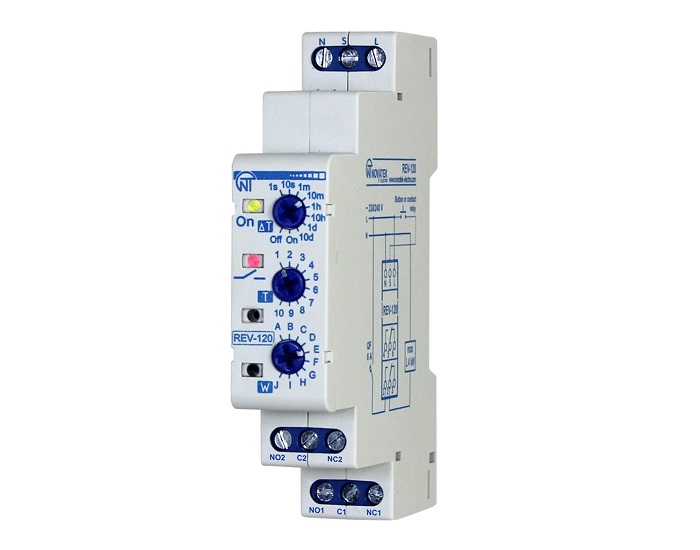
The REV-120 is a microprocessor-based multifunction time delay relay offering ten operating modes: on-delay, time delay when energising, periodic with on-delay, periodic with time delay when energising, off-delay (on control contact opening), pulse I (on contact closing), pulse II (on contact opening), on/off delay according to control contact, pitch of load relay, and star-delta. The inclusion of a dedicated star-delta mode makes it the go-to choice for motor starting applications without adding a second timer.
It operates on 220–240 V AC 50/60 Hz, provides a 1-pole SPDT output rated at 6 A, and covers 10 selectable time ranges from 0.1 second to 10 days. The external control input accepts potential-free signals, enabling PLC or sensor-triggered operation.
Price: ₹1,900 per piece (ex-GST)
Buy REV-120 OnlineREV-114 — The High-Mode-Count Programmable Timer with Display
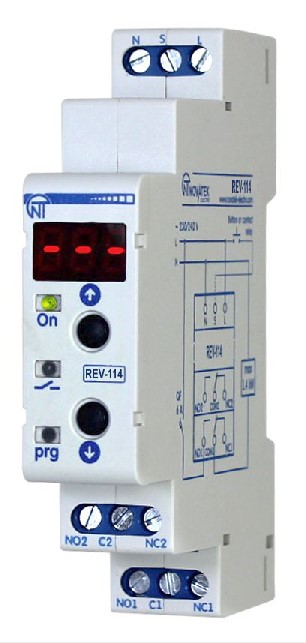
Where the REV-120 covers ten modes, the REV-114 steps up to seventeen operating algorithms — the broadest mode coverage in this family. These include all standard modes (on-delay, off-delay, cyclic, pulse) plus extended variants such as periodic with on-delay, periodic with time delay when energising, and additional sequencing logic suited to complex interlocking scenarios in steel process lines.
Like the REV-120, it runs on 220–240 V AC 50/60 Hz, delivers a 6 A SPDT (2NO+2NC) output, and spans 0.1 second to 10 days across 10 selectable ranges. The front-panel digital display and control buttons are particularly valuable in steel environments — engineers can read and adjust the set time directly at the panel without opening a laptop or fetching a datasheet.
Price: ₹2,050 per piece (ex-GST)
Buy REV-114 OnlineREV-201M — The Dual-Channel Relay for Star-Delta and Two-Stage Sequences
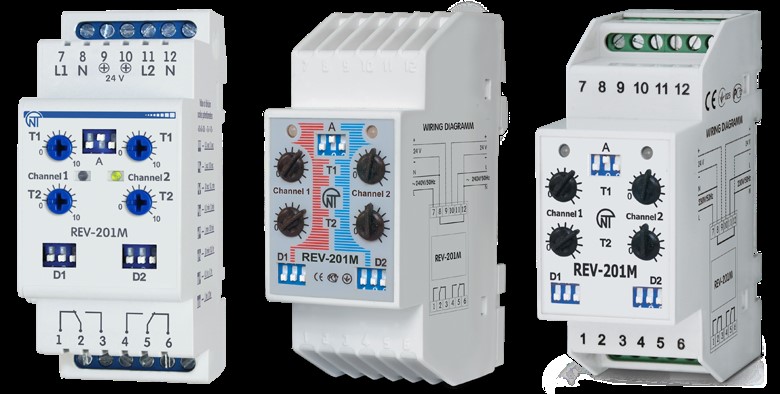
The REV-201M is the dual-channel member of the family. It is designed for commutation of electrical circuits up to 240 V AC 50 Hz and 24 V DC, with adjustable time delay settings across seven operating algorithms: turn-on time delay, pulse relay 1, intermittent (cyclic) relay 1, star-delta operation, pulse relay 2, intermittent relay 2, and off-delay. The star-delta algorithm is native to the hardware — the two channels handle star contactor timing and delta contactor timing independently, with built-in transition management.
The dual-channel architecture also makes it ideal for two-stage conveyor sequences (Stage 1 delay → Stage 2 delay) and HVAC sequences (damper open delay → fan start delay) within a single relay body, reducing panel space and wiring complexity.
Price: ₹2,833 per piece (ex-GST)
Buy REV-201M OnlineFull Specification Comparison Table
| Parameter | REV-120 | REV-114 | REV-201M |
|---|---|---|---|
| Supply Voltage | 220–240 V AC 50/60 Hz | 220–240 V AC 50/60 Hz | 240 V AC 50 Hz / 24 V DC |
| Output Channels | 1 | 1 | 2 |
| Contact Form | SPDT (1NO+1NC) | SPDT (2NO+2NC) | Dual SPDT |
| Contact Current | 6 A | 6 A | 6 A per channel |
| Time Range | 0.1 sec – 10 days (10 ranges) | 0.1 sec – 10 days (10 ranges) | Adjustable (see datasheet) |
| Operating Modes | 10 modes incl. star-delta | 17 algorithms | 7 algorithms incl. star-delta |
| External Control Input | Yes, potential-free | Yes, potential-free | Yes |
| Digital Display | Yes | Yes | Yes |
| Star-Delta Mode | Yes (native) | No (not listed) | Yes (native, dual-channel) |
| DC Supply Option | No | No | Yes (24 V DC) |
| Price (ex-GST) | ₹1,900 | ₹2,050 | ₹2,833 |
| Best For | Star-delta, conveyor, cyclic | Complex multi-mode sequences | Star-delta, two-stage sequences, DC panels |
*All prices ex-GST. GST @ 18% applicable extra. Prices as per Novatek Electro Price List 2026–27, effective 01.04.2026.
Quick Selection Guide
| Application | Recommended Model | Key Reason | Price (ex-GST) |
|---|---|---|---|
| Motor star-delta starting (single relay solution) | REV-120 | Native star-delta mode, lowest cost | ₹1,900 |
| Complex conveyor interlocking (many sequence variants) | REV-114 | 17 algorithms, digital display for field adjustment | ₹2,050 |
| Star-delta with precise transition gap (two-channel) | REV-201M | Dual channel — star and delta managed independently | ₹2,833 |
| HVAC damper + fan two-stage control | REV-201M | Two independent timed outputs in one relay body | ₹2,833 |
| Cyclic lubrication / mist coolant pump | REV-120 or REV-114 | Cyclic/interval mode, wide time range | ₹1,900 / ₹2,050 |
| Process purge interlock (fixed interval) | REV-114 | Pulse and interval modes, 17 algorithms for complex logic | ₹2,050 |
| 24 V DC panel (PLC-integrated cabinet) | REV-201M | 24 V DC supply option | ₹2,833 |
| Irrigation timing / water treatment sequencing | REV-120 | Up to 10-day time range, cyclic mode, cost-effective | ₹1,900 |
Application-Based Selection Guide
If your installation requires motor star-delta starting on a budget...
Choose the REV-120 at ₹1,900. Its native star-delta mode handles the star-contactor hold time and delta-contactor energisation within a single relay. Wire it in series with your star and delta contactors per the connection diagram; set the transition time (typically 5–10 seconds for motors up to 30 kW in rolling mill auxiliary drives), and the relay manages the rest. One relay, two contactors, clean sequence.
If your installation requires star-delta starting with a defined transition gap and independent channel control...
Choose the REV-201M at ₹2,833. The dual-channel architecture gives you one channel for star-contactor timing and a second channel for delta-contactor pick-up, with an independently adjustable transition gap. This eliminates the risk of simultaneous energisation — a wiring error that destroys contactors. The 24 V DC supply option also means the REV-201M integrates cleanly into PLC-powered control cabinets without a separate 240 V auxiliary supply.
If your installation requires conveyor staging across multiple modes, or the sequence changes seasonally...
Choose the REV-114 at ₹2,050. With seventeen programmable algorithms, panel-builders can configure the relay for on-delay staging during commissioning, switch to cyclic mode for a periodic purge function on the same production line, and adjust timing directly from the digital display without revisiting the wiring. This is particularly valuable in steel service centres where the panel may serve different product lines across shifts.
If your installation requires HVAC sequencing in a rolling mill or continuous casting bay...
Choose the REV-201M. HVAC control in high-heat industrial environments typically requires: damper open → wait for actuator travel → start fan motor. The two-channel output handles both events natively. Set Channel 1 for the damper open delay (typically 30–120 seconds depending on actuator speed); Channel 2 energises the fan contactor after Channel 1 completes. On shutdown, the off-delay algorithm ensures the fan runs on for a set purge period before the damper closes — all within one relay body.
Common Selection Mistakes — and How to Avoid Them
Mistake 1: Using a Single-Channel Relay for Star-Delta Without Checking the Mode
Not every single-channel relay has a star-delta mode. If you specify REV-114 for a star-delta application, check the datasheet carefully — REV-120 and REV-201M carry native star-delta algorithms; REV-114's seventeen modes serve complex sequence logic rather than star-delta transition. Specify the right model from the outset.
Mistake 2: Setting the Wrong Time Range Sub-Scale
With 10 selectable time ranges spanning 0.1 second to 10 days, it is easy to commission a relay on the wrong range — for example, setting '5' on a range where the unit is minutes rather than seconds, resulting in a 5-minute star-delta delay instead of 5 seconds. Always verify the range indicator on the display before energising. Document the range setting in your panel schedule, not just the set value.
Mistake 3: Ignoring the External Control Input When PLC Control Is Required
If the timing sequence is initiated by a PLC digital output rather than by power-on, the relay must be wired to its external control input terminal — not simply powered. Powering the relay without connecting the control input in externally-triggered modes means the relay either runs immediately on power-up or never triggers. Review the connection diagram for your selected mode before wiring.
Mistake 4: Overlooking DC Supply Requirements in PLC Panels
Many modern automation panels in steel facilities run 24 V DC control voltage throughout. Only the REV-201M supports 24 V DC supply. Specifying REV-120 or REV-114 in a DC-only cabinet requires an additional 240 V AC auxiliary supply — adding cost, space, and a potential single point of failure. If the panel is DC-powered, specify REV-201M.
Installation Tips from the Field
- DIN rail mounting: All three models are DIN rail mount. In steel plant panels where vibration from rolling mill drives is transmitted through the structure, use clip-on DIN rail end stops on both sides of the relay to prevent lateral migration over time.
- Ambient temperature: Panel ambient in steel environments can exceed 40 °C during summer. Ensure panel ventilation or cooling keeps internal temperature within the relay's rated operating range. Verify this against the product datasheet before finalising panel layout.
- Contact protection: When switching inductive loads (contactor coils), fit a snubber RC circuit or varistor (MOV) across the load — not across the relay contacts — to suppress inductive kickback. At 6 A rated contacts, unprotected inductive switching accelerates contact wear.
- Label the time range: After commissioning, affix a small label inside the panel door recording the model number, operating mode selected, time range sub-scale, and set value. Technicians doing fault-finding at 2 AM will thank you.
- Commissioning sequence: Always test the timing sequence with the motor disconnected (contactors only, no motor load) before first energisation. Verify star contactor drops before delta contactor picks up — even 20–30 ms of overlap can weld contactor tips on larger motors.
Why Novatek Electro?
- ISO 9001:2015 certified manufacturer — quality management system covers design, production, and testing of all relays.
- CE certified products — conformance to European electromagnetic compatibility and low-voltage directive standards, accepted by export-oriented OEMs and panel-builders.
- Made in India, Delhi-based — domestic manufacturing means shorter lead times, rupee-denominated pricing without import duty exposure, and accessible after-sales support.
- 30+ years of engineering heritage in electrical protection and control devices — the product range reflects real-world application feedback, not theoretical specifications.
- Dedicated after-sales and technical support — application engineers available to assist with mode selection, connection diagrams, and commissioning queries before and after purchase.
Browse the REV-120 (₹1,900), REV-114 (₹2,050), and REV-201M (₹2,833) with full datasheets, connection diagrams, and programming guides at intelli-electro.com.
For bulk orders, OEM pricing, or application-specific queries, reach our technical team:
📧 sales@novatek-electro.in | 📞 +91-7840054744