When a Mistimed Sequence Trips Your Entire Solar Array Offline
Imagine a grid-tied solar plant where the inverter contactors, cooling fans, and tracker motors must energise in a strict sequence — each step separated by a defined delay — to prevent inrush current spikes from tripping the upstream protection. Now imagine that sequence is controlled by nothing more than a fixed mechanical timer from the 1990s. One cold morning, thermal drift shifts the timing by 800 milliseconds. The star-delta transition on a 15 kW tracker motor fires too early. The overcurrent relay trips. The entire string goes offline during peak generation hours. The cause? A timing device that cost less than a cup of tea but was never engineered for the job.
This is not a hypothetical. In renewable energy and solar installations — where automation panels control everything from conveyor-fed module assembly lines to irrigation pump sequencing for agri-solar projects — timing precision is not a convenience, it is a system-level requirement. The REV-120, REV-114, and REV-201M multifunction time delay relays from Novatek Electro are microprocessor-based devices engineered for exactly these demands.
The Engineering Behind Programmable Time Delay Relays
Why Microprocessor Control Matters
A conventional RC (resistor-capacitor) timing circuit drifts with temperature and supply voltage variation. In a solar plant environment — where panel-room temperatures can swing from 10°C on a winter morning to 55°C on a summer afternoon — an RC-based timer can drift by several percent across that range. Microprocessor-based timing, by contrast, uses a crystal-controlled oscillator as its time base. The oscillator frequency is stable across the operating temperature range, so the programmed delay is repeatable within tight tolerances regardless of ambient conditions.
The REV-series relays use this microprocessor architecture. The user-defined time set-point is stored in non-volatile memory, so a power interruption — common during grid fluctuations at renewable energy sites — does not reset the programmed mode. The output is a potential-free SPDT (Single Pole Double Throw) contact rated at 6 A, which can directly drive contactor coils, solenoid valves, or PLC digital inputs.
Operating Modes — What They Mean in Practice
The term multifunction is overused. In the REV series, it means something specific: each relay can be field-configured to operate in fundamentally different logical modes without any hardware change. Understanding these modes is the starting point for correct application selection.
- On-Delay (TON): Output energises after a set delay following input energisation. Used for motor sequencing — start Motor A, wait T seconds, start Motor B.
- Off-Delay (TOFF): Output remains energised for a set period after input de-energises. Used for fan run-on after an inverter shuts down, or conveyor coast-down sequences.
- Interval / Pulse Timer: Output energises for a fixed duration regardless of how long the input stays active. Used for dosing pumps and solenoid valve actuation in solar-powered irrigation systems.
- Cyclic / Intermittent Timer: Output cycles on and off repeatedly with user-defined on-time and off-time. Used for sequential conveyor staging, borewell pump cycling, and HVAC compressor duty cycling.
- Star-Delta Timer (REV-120 and REV-201M): Dedicated mode that controls the star-to-delta transition in reduced-voltage motor starting. This is the most common cause of motor damage in pump-driven solar irrigation — incorrect transition timing causes a current transient that the winding insulation sees as a voltage stress event.
Model-by-Model Technical Breakdown
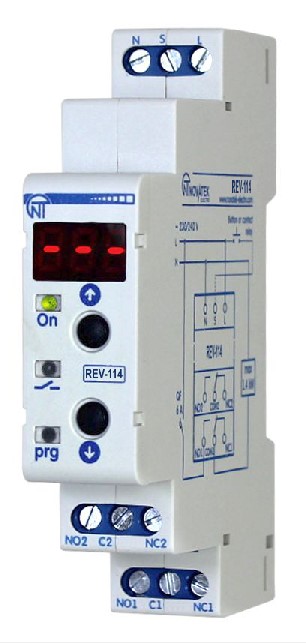
REV-114 — Seventeen Modes, Digital Display, External Input
The REV-114 is the most feature-rich single-channel relay in this family. It offers seventeen operation logics — including on-delay, time delay when energising, periodic with on-delay, periodic with time delay when energising, off-delay, pulse modes I and II, and on/off delay modes. A front-panel digital display allows real-time visual verification of the countdown, which is invaluable during commissioning of a solar plant automation panel when you need to confirm that each sequence step is executing correctly. The external input allows a PLC or a manual pushbutton to trigger the timing cycle without cycling panel supply voltage. Time range spans 0.1 seconds to 10 days across 10 selectable ranges — meaning the same device can control a 200 ms star-delta pause and a 24-hour irrigation cycle interval. Output contact: SPDT, 6 A, potential-free. Supply: 220–240V AC, 50/60 Hz. Price: Rs. 2,050 per piece (ex-GST).
Buy REV-114 OnlineREV-120 — Ten Modes Including Dedicated Star-Delta
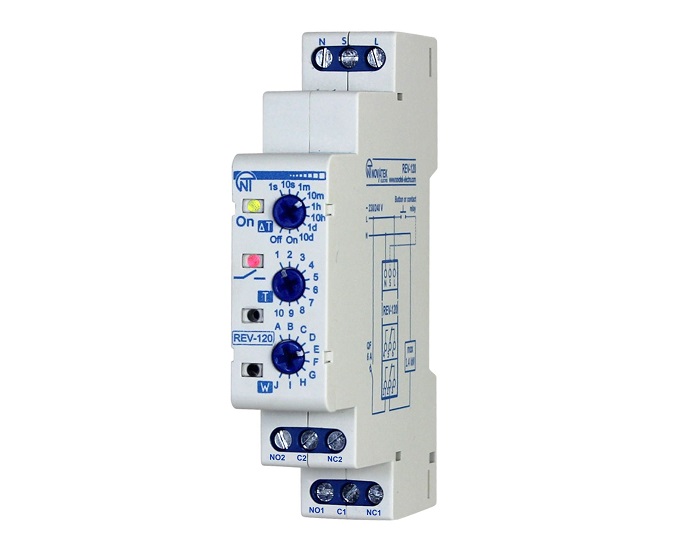
The REV-120 operates in ten modes: on-delay, time delay when energising, periodic with on-delay, periodic with time delay when energising, off-delay, pulse I, pulse II, on/off delay, pitch of load relay, and — critically — a dedicated star-delta timer mode. This last mode makes REV-120 the natural choice for solar irrigation pump panels and wind turbine auxiliary motor panels where reduced-voltage starting is mandatory. The external input pin allows the timing cycle to be triggered by a PLC signal, a float switch, or a pressure sensor output — useful in agri-solar pump automation where the start command comes from a soil-moisture controller. Supply: 220–240V AC, 50/60 Hz. Contact: SPDT, 6 A, potential-free. Time range: 0.1 sec to 10 days, 10 selectable ranges. Price: Rs. 1,900 per piece (ex-GST).
Buy REV-120 OnlineREV-201M — Two Channels, Seven Algorithms, DC-Compatible
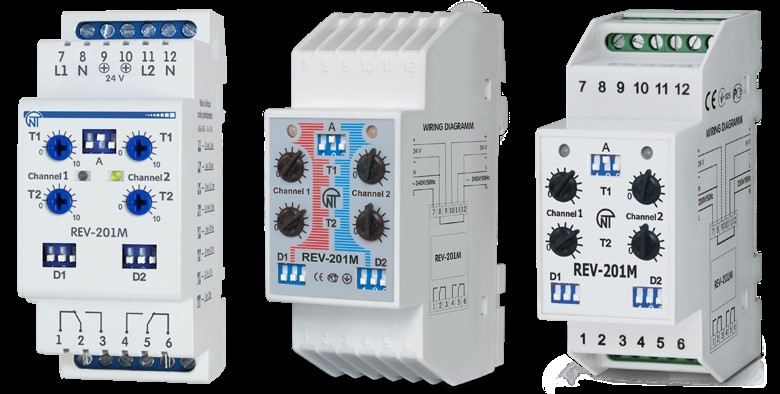
The REV-201M is a two-channel device designed for commutation of 240V AC 50 Hz as well as 24V DC electrical circuits with adjustable time delay. This dual-voltage capability is significant for solar applications: the DC side of a solar panel control system (MPPT signals, battery management outputs, DC bus switching) operates at 24V DC, while the AC load side operates at 240V. The REV-201M can interface both within a single device. It operates across seven algorithms: Turn ON time delay, Pulse relay 1, Intermittent (cyclic) relay 1, Star-delta operation, Pulse relay 2, Intermittent relay 2, and OFF delay. Two independent channels mean you can sequence two separate loads — for example, a conveyor drive and a suction fan — from a single timing device, reducing panel component count. Price: Rs. 2,833 per piece (ex-GST).
Buy REV-201M OnlineFull Specification Comparison Table
| Parameter | REV-120 | REV-114 | REV-201M |
|---|---|---|---|
| Supply Voltage | 220–240V AC, 50/60 Hz | 220–240V AC, 50/60 Hz | 240V AC 50 Hz / 24V DC |
| Channels | 1 | 1 | 2 |
| Output Contact | SPDT, 6A, potential-free | SPDT, 6A, potential-free | SPDT per channel |
| Time Range | 0.1 sec – 10 days, 10 ranges | 0.1 sec – 10 days, 10 ranges | Adjustable per channel |
| Number of Modes | 10 | 17 | 7 |
| Star-Delta Mode | Yes | No | Yes |
| Digital Display | No | Yes | No |
| External Input | Yes | Yes | Yes |
| DC Circuit Support | No | No | Yes (24V DC) |
| Price (ex-GST) | Rs. 1,900 | Rs. 2,050 | Rs. 2,833 |
| Certifications | CE, ISO 9001:2015 | CE, ISO 9001:2015 | CE, ISO 9001:2015 |
Quick Selection Guide — Application vs Model vs Price
| Application | Recommended Model | Key Mode Used | Price (ex-GST) |
|---|---|---|---|
| Motor Star-Delta Starting (pumps, blowers) | REV-120 | Star-Delta Timer | Rs. 1,900 |
| Conveyor Sequential Start-Stop Staging | REV-114 | On-Delay / Periodic | Rs. 2,050 |
| HVAC Fan Run-On / Compressor Duty Cycle | REV-114 | Off-Delay / Cyclic | Rs. 2,050 |
| Solar Irrigation Pump Timing | REV-120 | Cyclic / Interval | Rs. 1,900 |
| Two-Load Sequencing (AC + DC circuits) | REV-201M | Dual-Channel Intermittent | Rs. 2,833 |
| Process Delay — Dosing / Solenoid Valves | REV-114 | Pulse Timer | Rs. 2,050 |
| Solar Panel Tracker Motor Starting | REV-201M | Star-Delta + ON Delay | Rs. 2,833 |
Wiring Best Practices for Renewable Energy Panels
Earthing and Shielding
Solar plant automation panels are often located in outdoor enclosures or skid-mounted structures where ground potential differences exist. Always connect the relay supply common to the panel earth bar. Where the external input wire runs more than 2 metres to a remote sensor or PLC output, use shielded twisted-pair cable and connect the shield at one end only (relay end) to avoid ground loops that can cause false triggering.
Contact Load Matching
The 6 A output contact on each relay is rated for resistive loads. When switching inductive loads — contactor coils, solenoid valves — always fit a snubber (RC network, typically 100 Ω + 100 nF for AC) or a freewheeling diode (for DC coils) across the load. Without suppression, the inductive kick at contact opening can produce voltage transients exceeding 1,000V, eroding the silver-alloy contact surface and causing premature relay failure.
Star-Delta Interlock Wiring
When using REV-120 or REV-201M in star-delta mode, always include a mechanical and electrical interlock between the star and delta contactors. The relay manages the timing transition, but the interlock prevents simultaneous energisation of both contactors — a condition that would short two phases of the supply. This is a panel-building requirement under IS 13947 / IEC 60947, not merely a best practice.
Troubleshooting Common Installation Issues
Relay Energises But Output Does Not Switch
Verify that the programmed mode matches the intended logic. In on-delay mode, the output switches after the programmed time — if the time range selector is set to ×100s and the dial reads 1.0, the delay is 100 seconds, not 1 second. Confirm the time range multiplier before assuming a fault.
Timing Is Inconsistent Across Power Cycles
This typically indicates supply voltage outside the 220–240V AC rated band. At solar sites where a local inverter feeds the panel, check inverter output voltage regulation under varying irradiance conditions. Severe undervoltage can cause the relay microprocessor to reset mid-cycle.
External Input Does Not Trigger the Timer
Confirm that the external input signal level meets the relay input specification. A dry contact closure from a float switch or pressure switch is acceptable. A PLC transistor output must be verified for compatible voltage level — check the datasheet external input requirements before connecting open-collector PLC outputs.
Contact Novatek Electro India for technical support, bulk pricing, and distributor referrals.
Shop REV Series Online Email: sales@novatek-electro.in Call: +91-7840054744
Why Novatek Electro?
- ISO 9001:2015 Certified: Quality management systems audited and certified — every relay that leaves the factory meets documented process and test standards.
- CE Certified: Products comply with European electromagnetic compatibility and low-voltage directive requirements — accepted by EPC contractors specifying internationally compliant components.
- Made in India — 30+ Years of Manufacturing: Novatek Electro India Private Limited has been manufacturing electrical protection and timing devices in Delhi for over three decades, with deep application knowledge across Indian grid conditions.
- Full Application Support: Technical datasheets, wiring diagrams, connection guides, and programming multiplier charts available for every model — not just a product page.
- Distributor and Panel-Builder Network: Available through authorised distributors and online at intelli-electro.com with GST-compliant invoicing and after-sales support.
Engineering FAQs
Available at intelli-electro.com with GST invoicing and technical support.
Email: sales@novatek-electro.in | Phone: +91-7840054744