When a Compressor Fails at 2 AM in a Cold Store, Who Gets the Alert First — You or the Spoilage?
Cold chain integrity is not a quality assurance checkbox. It is a legal obligation under FSSAI regulations and a direct financial liability. A single refrigeration compressor failure in an unmonitored cold store can compromise an entire batch of perishables before the morning shift arrives. Across multi-site food processing operations — from pre-cooling chambers at agricultural aggregation points to blast freezers in logistics hubs — the inability to stream real-time operational data from field equipment to a centralised analytics platform is no longer an engineering inconvenience. It is a compliance and commercial risk.
This is precisely the engineering problem that the EM-481, EM-486, and OB-215 from Novatek Electro India Private Limited are designed to solve. Together, they form the protocol-conversion and I/O-expansion layer that makes existing electrical equipment — PLCs, drives, protection relays, energy meters — visible to modern cloud SCADA, predictive maintenance engines, and energy dashboards, without ripping out a single panel.
Why This Product Category Exists: The Engineering Need
Most food processing and cold chain facilities were commissioned with capable electrical equipment — Modbus RTU-capable motor protection relays, VFDs with RS-485 ports, energy meters with serial outputs. The engineering investment is real. But that investment was made when 'connectivity' meant running a twisted-pair cable to a local HMI. Industry 4.0 demands something different: every sensor reading, every relay event, every energy parameter streamed to a cloud platform with timestamps, accessible from any browser, triggerable for SMS or email alarms, and archivable for regulatory audit trails.
The gap between the RS-485 world on your MCC door and the Ethernet/GPRS world on your analytics dashboard is exactly what IoT interface controllers and remote I/O expanders bridge. No new PLC. No ripped-out wiring. No six-month integration project. Three devices, a SIM card, and a switch.
Features to Look for in an Industrial IoT Gateway for Food & Cold Chain
1. Multi-Protocol Bridging
Your field devices speak Modbus RTU over RS-485. Your cloud platform speaks TCP/IP. The gateway must translate — not just pass-through — both directions: read Modbus registers from a slave device and publish them via GPRS or Ethernet to a SCADA server, and conversely, push control commands from the cloud down to field actuators over Modbus.
2. Dual-Path Connectivity (Ethernet + GSM/GPRS)
A cold store in an industrial estate may have reliable Ethernet. A pre-cooling facility at an agricultural cluster may only have GSM coverage. Your gateway must support both, with automatic failover so that a LAN outage does not silence your monitoring. A built-in GSM modem with SIM card slot — not an external dongle — is the correct engineering choice for panel-mount installations.
3. Local Data Buffering
Communication links fail. A gateway without local storage loses data during outages. For FSSAI temperature logging and HACCP compliance, data gaps are not acceptable. Look for onboard flash memory or Micro SD card support with automatic resync on reconnection.
4. Built-in I/O for Direct Sensor Integration
Not every field signal is Modbus-readable. Thermostat dry contacts, door interlock switches, manual alarm push-buttons, and 4–20 mA temperature transmitters often need direct wiring into the gateway. A gateway with programmable relay outputs and analogue/digital sensor inputs eliminates the need for a separate remote I/O module at smaller sites.
5. Programmable Alarms and SMS Notifications
A dashboard that shows a high-temperature alarm is useful. A device that sends an SMS to the duty engineer the moment a condenser pressure exceeds its setpoint — without requiring a cloud subscription to be active — is what actually prevents spoilage.
6. DIN-Rail Form Factor and Wide Power Supply Compatibility
Panel space in MCCs and distribution boards is always at a premium. DIN-rail mounting, compact footprint, and a 12V DC supply (compatible with standard panel PSUs) are not nice-to-haves. They are installation necessities.
The Novatek Electro IoT Stack: EM-481, EM-486, OB-215
EM-481 — Interface Controller for IoT Solutions
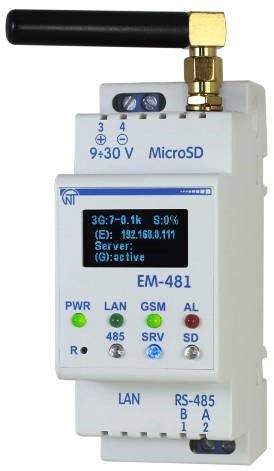
The EM-481 is Novatek Electro's core IoT gateway — an interface controller that converts RS-485 Modbus RTU/ASCII communications to Ethernet or GSM/GPRS, enabling any Modbus-capable field device to publish its data to a remote SCADA server or cloud platform. It is the right choice when your primary need is protocol conversion and remote data logging from existing communicable devices, and your site already has adequate sensor wiring infrastructure.
- Network Types: RS-485 Modbus RTU/ASCII, Ethernet, GSM-GPRS (SIM Card)
- Power Supply: 12V DC
- Local Storage: Micro SD card for offline data buffering and recovery on reconnection
- Application: Remote monitoring/control, IoT, data logging
- Brand: Novatek Electro | Compatible: Any Modbus RS-485 device
- Price: Rs.†18,873 per piece (ex-GST; GST @ 18% applicable extra)
EM-486 — Interface Controller for IoT with Built-in I/Os
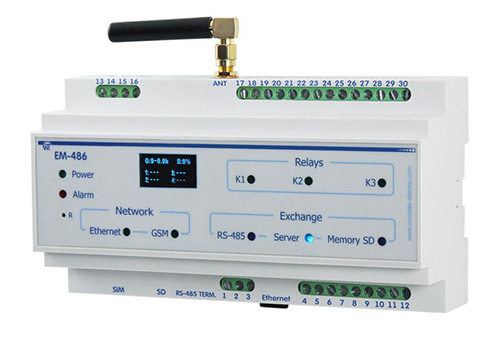
The EM-486 is the enhanced version of the EM-481, adding programmable relay outputs and direct sensor inputs to the same RS-485 Modbus to Ethernet/GPRS gateway core. Where the EM-481 is a pure protocol bridge, the EM-486 is a protocol bridge plus a local controller — it can receive an alarm condition from a Modbus device, evaluate it against a programmed threshold, and simultaneously trigger a local relay (to energise a hooter or isolate a circuit) while transmitting an SMS alert and pushing the event to the cloud server. This is the correct device for cold store installations where direct hardwired alarm outputs and sensor inputs must coexist with cloud connectivity in the same compact DIN-rail module.
- Network Types: RS-485 Modbus RTU/ASCII, Ethernet, GSM-GPRS (SIM Card)
- Power Supply: 12V DC
- Local Storage: Micro SD card with flash memory; automatic data resync on reconnection
- Built-in I/Os: 3 programmable relay outputs + 4 sensor inputs (programmable)
- Power Output for Sensors: Yes — powers connected sensors directly
- Reserve Power Supply Input: Yes — for backup supply continuity
- SMS Alarms: Automatic SMS transmission on selected device state changes
- Connectivity: Supports Ethernet-primary with automatic GPRS failover
- Standards Compliance: IEC 60950-1:2001 (Data processing devices)
- Application: Remote monitoring/control, IoT, data logging, 3 relay outputs & 4 sensor inputs
- Price: Rs.†35,260 per piece (ex-GST; GST @ 18% applicable extra)
OB-215 — Remote I/O Expander
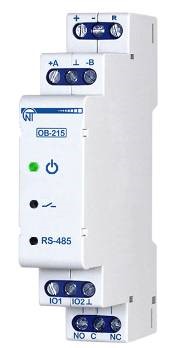
The OB-215 is a Modbus-addressable remote I/O expander. When your site has more discrete sensor signals and relay outputs than any single gateway can accommodate — think a large cold storage complex with dozens of temperature zones, door alarm contacts, compressor run-feedback signals, and solenoid valve control outputs — the OB-215 adds I/O capacity on the same RS-485 Modbus bus that the EM-481 or EM-486 is already polling. It is the correct device to deploy as a field-level I/O node in a multi-zone monitoring architecture, keeping the IoT gateway at the panel and running I/O nodes to the equipment.
- Function: Remote I/O expansion via Modbus RS-485
- Application: Multi-zone sensor aggregation, distributed I/O for cloud SCADA
- Price: Rs.•4,375 per piece (ex-GST; GST @ 18% applicable extra)
Model Comparison Table
| Feature / Parameter | EM-481 | EM-486 | OB-215 |
|---|---|---|---|
| Primary Function | RS-485 Modbus to Ethernet/GSM gateway | RS-485 Modbus to Ethernet/GSM gateway + built-in I/Os | Remote I/O expander (Modbus RS-485 slave) |
| RS-485 Modbus RTU/ASCII | Yes | Yes | Yes (slave) |
| Ethernet Connectivity | Yes | Yes | No (via master gateway) |
| GSM/GPRS (SIM Card) | Yes | Yes (with auto-failover from Ethernet) | No (via master gateway) |
| Relay Outputs | No | 3 programmable | Yes (expandable) |
| Sensor Inputs | No | 4 programmable | Yes (expandable) |
| Sensor Power Output | No | Yes | No |
| SMS Alarm Notifications | No (via SCADA platform) | Yes (direct, programmable) | No |
| Local Data Storage | Micro SD card | Micro SD card + flash memory | — |
| Reserve Power Supply Input | No | Yes | — |
| Power Supply | 12V DC | 12V DC | — |
| Standards | CE certified | CE certified; IEC 60950-1:2001 | CE certified |
| Price (ex-GST) | Rs.†18,873 | Rs.†35,260 | Rs.•4,375 |
All prices are ex-GST as per Novatek Electro Price List 2026-27, effective 01.04.2026. GST @ 18% applicable extra. Prices subject to change without notice.
Quick Selection Guide
| Application Requirement | Recommended Model(s) | Indicative Price (ex-GST) |
|---|---|---|
| Stream Modbus data from energy meters / motor protection relays to cloud SCADA — no new I/O needed | EM-481 | Rs.†18,873 / unit |
| Cloud connectivity + direct temperature sensor wiring + local hooter/alarm relay output + SMS alerts | EM-486 | Rs.†35,260 / unit |
| Add more sensor inputs and relay outputs to an existing EM-481 or EM-486 deployment | OB-215 (one or more units) | Rs.•4,375 / unit |
| Multi-zone cold store: central panel gateway + distributed I/O nodes across refrigeration zones | EM-486 + multiple OB-215 | Rs.†35,260 + Rs.•4,375 × n |
| Multi-site food processing: each site has its own MCC, needs individual cloud node, no local alarm | EM-481 per site | Rs.†18,873 / site |
| Site with GSM-only coverage (no LAN), needs direct sensor wiring and hardwired alarm output | EM-486 | Rs.†35,260 / unit |
Application-Based Selection Guide
If your installation requires cloud data logging from existing Modbus energy meters and motor protection relays — choose EM-481
Food processing facilities with Modbus-capable MCCs and existing RS-485 wiring simply need a gateway to push register data to a cloud historian. The EM-481 at Rs.†18,873 (ex-GST) is the correct, cost-effective choice. It reads any Modbus RTU/ASCII slave on the RS-485 bus and transmits collected data via Ethernet or GPRS to your SCADA server. The Micro SD card ensures no data loss during connectivity interruptions — critical for HACCP audit trails.
If your installation requires direct temperature sensor wiring, local relay alarm outputs, and cloud connectivity in a single DIN-rail device — choose EM-486
Cold storage chambers, blast freezers, and chilled dispatch areas often lack a separate Modbus temperature transmitter. A PT-100 or 4–20 mA sensor is wired directly to the controller. The EM-486 accommodates four such sensor inputs and provides three programmable relay outputs to drive local alarms, ventilation dampers, or standby compressor switchover logic — all while simultaneously pushing data to the cloud and sending SMS alerts to duty personnel. The reserve power supply input ensures the gateway stays live even during panel power fluctuations — a common occurrence near large compressor starts.
If your installation has more I/O points than a single gateway can handle — add OB-215 units
A multi-zone cold store with 16 temperature zones, 32 door alarm contacts, and 8 compressor run-feedback signals requires far more I/O than any compact gateway provides. The OB-215, priced at Rs.•4,375 (ex-GST), sits on the same RS-485 Modbus bus as the EM-481 or EM-486 and presents its I/O points as Modbus registers — transparently readable by the gateway. Deploy multiple OB-215 units across the facility, address each uniquely on the bus, and the gateway polls them all as part of a single network scan cycle.
Common Selection Mistakes — and How to Avoid Them
Mistake 1: Choosing EM-481 when direct sensor wiring is needed
The EM-481 has no physical sensor inputs. If your field sensors are not already connected to a Modbus slave device, you cannot wire them to the EM-481. Use EM-486 or pair EM-481 with OB-215 nodes for physical I/O.
Mistake 2: Expecting SMS alarms from EM-481
The EM-481 does not generate direct SMS notifications. Alarm SMS capability is native to the EM-486. If SMS-based alerting without cloud platform dependency is a requirement, specify EM-486.
Mistake 3: Under-sizing the RS-485 bus for multi-drop deployments
RS-485 supports up to 32 unit loads on a single bus segment. In a large facility with multiple EM-48x gateways, energy meters, and OB-215 nodes, calculate unit loads carefully. Use a repeater at the segment boundary if you exceed limits. Termination resistors (120 Ω) at each cable end are mandatory for reliable Modbus communication beyond 10 metres.
Mistake 4: Ignoring the 12V DC power supply requirement
Both the EM-481 and EM-486 require a 12V DC supply. Standard 24V DC panel PSUs are not directly compatible. Specify an appropriate 12V DC DIN-rail PSU when designing the panel. The EM-486's reserve power supply input allows a battery-backed 12V source for continuity during mains failures.
Mistake 5: Deploying without verifying GPRS data volume against carrier plan
High-frequency Modbus polling intervals (every 10 seconds across 20 devices) can generate significant GPRS data volumes. Estimate your monthly data budget before choosing a SIM plan. Adjust polling intervals and data packaging settings in the gateway configuration to stay within plan limits.
Installation Tips from the Field
- RS-485 cable: Use shielded twisted-pair (STP) cable — minimum 0.5 mm² — for all RS-485 wiring. Drain the shield to earth at one end only to prevent ground loops. In cold store environments with heavy cable trays near VFDs, route RS-485 cabling in a separate conduit to avoid EMI-induced communication errors.
- SIM card selection: Use an IoT-class SIM with a static or NATted IP and a data plan that does not throttle after a threshold. Avoid consumer SIMs in panel-mounted industrial devices.
- Modbus address planning: Assign Modbus slave addresses before installation and document them in a register map. Duplicate addresses on the same bus cause silent data corruption — the most common commissioning headache.
- Micro SD card: Use an industrial-grade Micro SD card (rated for extended temperature range, endurance class). Consumer-grade cards fail prematurely in the vibration and temperature cycling environment of industrial panels.
- Panel location: In cold store MCCs, panel ambient temperatures can drop significantly. Ensure the panel enclosure has adequate anti-condensation heating if the ambient is below +5°C. Verify operating temperature specifications against the installation environment.
- Firmware and configuration: Use the Novatek Electro configuration software to set polling intervals, Modbus register maps, GPRS APN settings, and alarm thresholds before sealing the panel. The EM-486 supports software updating, ensuring you can push firmware updates without site visits when the device is network-accessible.
Why Novatek Electro?
- ISO 9001:2015 Certified: Quality management systems certified to the international standard — every device manufactured under a documented quality framework.
- CE Certified: EM-481, EM-486, and OB-215 carry CE marking, confirming compliance with European safety and EMC directives — a meaningful benchmark for industrial-grade electrical devices sold in India.
- Made in India, Delhi: Novatek Electro India Private Limited is a domestic manufacturer. Devices are produced and supported in India, with local spare availability and no import lead-time dependency.
- 30+ Years of Electrical Protection Expertise: Novatek Electro's product lineage spans over three decades of motor protection, voltage monitoring, and now IoT interface devices — the product design reflects real-world electrical system requirements.
- After-Sales Support and Technical Documentation: Full technical datasheets, connection diagrams, and dimensional drawings are available. Technical support is accessible via the authorised distributor network and direct sales contact.
Ready to Deploy? Get Your IoT Stack Configured Correctly the First Time.
Specify EM-481, EM-486, and OB-215 for your food processing or cold chain project. All prices are ex-GST; GST @ 18% applies. Bulk project pricing and distributor queries welcome.
Shop on Intelli-Electro Email: sales@novatek-electro.in Call: +91-7840054744
Frequently Asked Questions
Purchase EM-481, EM-486 & OB-215 — Authorised Channel
Online: https://intelli-electro.com
Email: sales@novatek-electro.in
Phone: +91-7840054744
Prices: EM-481 — Rs.†18,873 | EM-486 — Rs.†35,260 | OB-215 — Rs.•4,375 (all ex-GST; GST @ 18% extra). Price List 2026-27, effective 01.04.2026.
Buy Now Request Project Pricing