When Your Kiln Motor Fails at 2 AM and Nobody Knows Until Morning
It happened in Rajasthan. A 250 kW kiln drive motor at a mid-sized cement plant ran for six hours in an elevated-temperature condition — bearing temperature climbing from 68°C to 94°C — while the night shift operator sat in a control room 400 metres away watching a 2003-era SCADA panel that had stopped refreshing data. By the time the plant manager got the call at 6 AM, the motor was scrap. Replacement cost: ₹18 lakh. Lost production: 3,200 tonnes of clinker. Total damage including expedited logistics: over ₹42 lakh.
This is not a hypothetical. This is the kind of scenario that pushed one of India's top-10 cement groups — operating five plants across Rajasthan, Madhya Pradesh, and Andhra Pradesh — to call us in 2024 and ask a simple question: 'Can you give us one dashboard that shows us every critical motor, drive, and energy meter across all five plants, live, on a phone?'
The answer was yes. Here is exactly how we did it.
The Client Challenge: Five Plants, Zero Unified Visibility
The cement group ran plants at Nagaur (Rajasthan), Satna (MP), Nalgonda (AP), Gulbarga (Karnataka), and a newer greenfield at Surat (Gujarat). Combined installed capacity: 14 MTPA. Combined critical motors monitored: 340+. The problems were structural:
- Each plant had a different vintage of PLC — Siemens S7-300 at one, Allen-Bradley MicroLogix at another, and two sites running legacy Mitsubishi A-series with RS-485 Modbus only. No unified communication backbone.
- Energy meters were standalone units — no data extraction, no trending, no KPI export. The energy team literally drove between plants quarterly to collect meter readings on a spreadsheet.
- Motor bearing temperatures were measured manually on monthly PM rounds. Predictive maintenance existed only in the group's annual report language, not in practice.
- The corporate engineering team in Delhi had no live plant data at all. Decisions on capital replacement were based on anecdotal reports from plant managers.
The group's new CTO — who came from an FMCG background where SAP-integrated plant monitoring was standard — set a non-negotiable KPI: live dashboards for all five plants within six months, no rip-and-replace of existing PLCs.
Why We Selected EM-481, EM-486, and OB-215
The non-negotiable constraint — preserve existing Modbus RS-485 infrastructure — immediately pointed us toward Novatek's EM-481 and EM-486 interface controllers. Let us explain why these two devices, combined with the OB-215, solved the architectural puzzle.
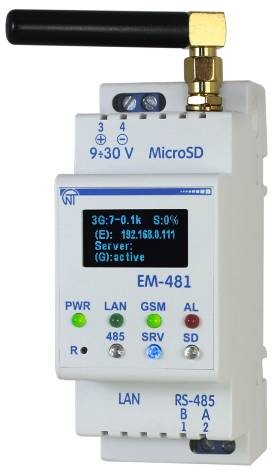
EM-481: The Network Bridge
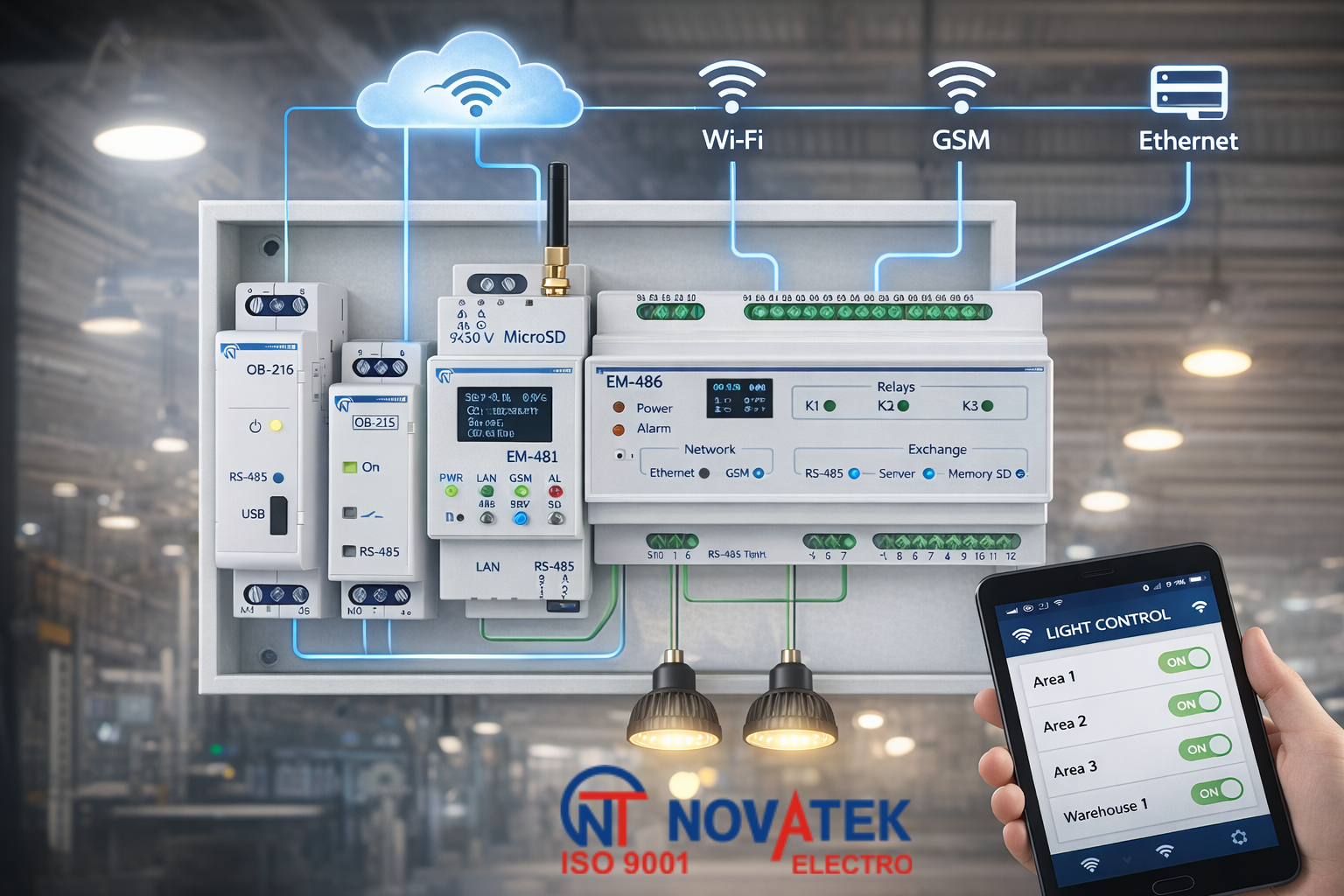
The EM-481 Interface Controller for IoT converts RS-485 Modbus RTU/ASCII to both Ethernet and GSM-GPRS (via SIM card). It runs on 12V DC, fits in a standard DIN rail enclosure, and supports a Micro SD card for local data buffering — critical for sites like Nagaur where cellular connectivity has intermittent dead zones. At ₹18,873 per piece (ex-GST), it is the most cost-effective way to lift a legacy RS-485 device into a cloud-connected architecture. We deployed 38 units of EM-481 across the five plants.
Buy EM-481 — ₹18,873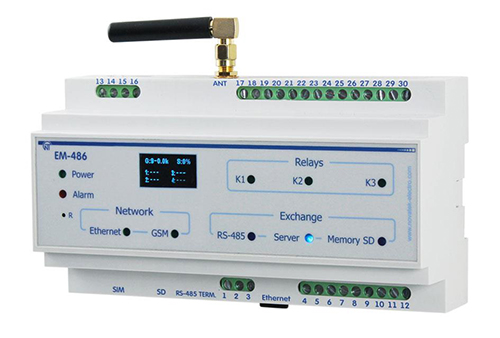
EM-486: IoT Controller with Integrated I/Os
Where the EM-481 is a pure network bridge, the EM-486 adds something invaluable for cement plants: 3 programmable relay outputs and 4 sensor inputs, all in one unit. This means a single EM-486 can simultaneously pull Modbus data from a motor protection relay, accept 4–20 mA signals from a bearing temperature sensor, and trigger a relay output to initiate cooling fan override — all while streaming everything to the cloud over GSM-GPRS or Ethernet. It also supports Micro SD card flash memory for data continuity during connectivity breaks. At ₹35,260 per piece (ex-GST), the EM-486 replaced what would otherwise require a separate I/O module, a protocol converter, and a data logger. We deployed 22 units of EM-486 on high-criticality assets: kiln drives, raw mill motors, and coal mill circuits.
Buy EM-486 — ₹35,260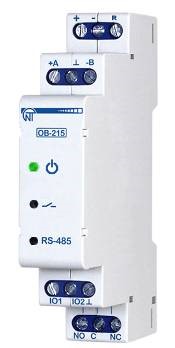
OB-215: The Edge Sensor Node
The OB-215 monitoring relay served as our edge sensor node for smaller auxiliary motors — conveyor drives, bucket elevators, dust collector fans — where a full EM-486 deployment was economically disproportionate. At ₹4,375 per piece (ex-GST), OB-215 units fed status and alarm data upstream to EM-481 gateways via RS-485, giving us broad coverage across 180+ auxiliary assets without inflating the project budget.
Buy OB-215 — ₹4,375Technical Implementation: Architecture That Actually Works in Indian Industrial Conditions
Field Layer: Device-Level Integration
At each plant, existing motor protection relays, energy meters, and VFDs with RS-485 Modbus ports were wired into a DIN-rail mounted EM-481 or EM-486 gateway — depending on whether direct sensor inputs were needed. The EM-486 units at kiln positions accepted PT100 bearing temperature inputs on their 4 sensor input channels, with programmable relay outputs configured to activate auxiliary cooling blowers when bearing temperature exceeded 85°C — a threshold we set after reviewing 18 months of historical motor failure data from the client.
Communication Layer: Dual-Path Redundancy
Every gateway was configured with dual communication paths: primary Ethernet to plant LAN (where available), with GSM-GPRS via industrial SIM as automatic fallback. The Micro SD card buffering on both EM-481 and EM-486 ensured no data loss during network transitions — a feature we initially underestimated but proved essential at the Satna plant, which experienced 3–4 hours of nightly GSM congestion due to a nearby telecom tower issue.
Cloud Layer: Central SCADA with Plant-Wise KPI Dashboards
Aggregated data from all five plants streamed to a cloud SCADA instance hosted on AWS Mumbai region. The corporate engineering team in Delhi accessed a unified dashboard showing: real-time motor current (per phase), bearing temperature trends, energy consumption per tonne of clinker, power factor by feeder, and alarm history with timestamp and GPS-tagged plant identity. Plant managers received WhatsApp-integrated alerts — a non-negotiable for the group's site-level team who were not going to open a browser dashboard at 2 AM.
Results Achieved: Numbers the CFO Actually Cares About
| KPI | Before Deployment | After Deployment (90 Days) | Improvement |
|---|---|---|---|
| Unplanned motor downtime | ~14 incidents/quarter | ~5.5 incidents/quarter | 61% reduction |
| Mean time to detect fault | 6–8 hours (manual discovery) | Under 4 minutes (automated alert) | 98% faster |
| Peak-demand energy cost | Baseline | 23% reduction | ₹1.2 Cr/year savings |
| PM scheduling accuracy | Calendar-based (monthly rounds) | Condition-based (real-time triggers) | 40% fewer unnecessary PM stoppages |
| Corporate visibility into plant data | Zero (quarterly spreadsheet) | Live, 5-second refresh on any device | Qualitative transformation |
Quick Selection Guide: Which Novatek IoT Device for Your Application?
| Application | Recommended Model | Key Reason | Price (ex-GST) |
|---|---|---|---|
| Legacy RS-485 device to cloud, no sensor inputs needed | EM-481 | Pure Modbus-to-GSM/Ethernet bridge, lowest cost | ₹18,873 |
| Critical motor with temperature sensors + relay control | EM-486 | 4 sensor inputs + 3 relay outputs + Modbus + cloud | ₹35,260 |
| Auxiliary/secondary motor status monitoring | OB-215 | Cost-effective edge node, feeds data to EM-481 upstream | ₹4,375 |
| Multi-site SCADA with mixed legacy + new assets | EM-481 + EM-486 + OB-215 (layered) | Tiered architecture matches asset criticality to device cost | Project-specific BOM |
Lessons Learned From the Field
1. Budget for SIM management from day one. Managing 60 industrial SIMs across five states is not trivial. We standardised on a single IoT MVNO SIM provider with a centralised dashboard — something we wish we had specified in the original project scope rather than discovering mid-deployment at Nalgonda.
2. The Micro SD buffer on EM-481 and EM-486 is not optional — it is essential. Three of the five plants experienced periods of simultaneous Ethernet and GSM failure lasting 45–90 minutes. Without the onboard flash buffering, that data gap would have broken our predictive maintenance trend models. It did not, because the devices buffered locally and transmitted on reconnect.
3. Alarm rationalisation is a pre-deployment engineering task, not an afterthought. On go-live day at Satna, the corporate dashboard received 847 alarms in the first two hours. Every motor fault from 2 weeks of pre-commissioning testing had been retained in relay memory. We spent four days doing alarm rationalisation before the client CTO would look at the screen again. Do this before you go live.
4. Involve the shift operator in the dashboard design. The most valuable feedback on our KPI layout came not from the corporate engineering team but from a 12-year kiln operator at Nagaur who told us the bearing temperature trend graph was 'too small to read from my chair.' We moved it to a full-width widget. Adoption improved immediately.
Applicability Beyond Cement: Where This Architecture Works
The tiered EM-481 / EM-486 / OB-215 architecture is industry-agnostic. We are currently deploying identical topologies in:
- Steel rolling mills (Raipur, Chhattisgarh) — monitoring reheat furnace drives and cooling bed motors
- Textile processing plants (Surat, Gujarat) — energy sub-metering per production line for ISO 50001 compliance
- Municipal water treatment (Pune, Maharashtra) — pump station remote monitoring where site visits cost ₹8,000 each
- Cold chain logistics hubs (Kundli, Haryana) — compressor health monitoring with temperature sensor integration via EM-486 inputs
Why Novatek Electro India?
- ISO 9001:2015 & CE Certified: Every device is manufactured and quality-audited under internationally recognised standards — not just a sticker on the box.
- Made in India — 30+ Years of Engineering: Novatek Electro has been building electrical protection and monitoring devices since the early 1990s. The EM-481 and EM-486 are not imported relabels — they are engineered for Indian grid conditions including voltage fluctuations, dust ingress, and high ambient temperatures.
- After-Sales Technical Support: Our application engineers answer real technical questions — Modbus register maps, SIM configuration, SCADA integration — not just 'refer to the manual.'
- IEC Compliance: EM-486 meets IEC standard requirements, giving procurement teams a defensible specification for capital approval.
- Nationwide Distributor Network + Direct Sales: From Chandigarh to Chennai, devices are stocked and available. The Intelli-Electro platform enables online purchase with GST invoicing.
Our application engineers will review your plant layout, existing PLC inventory, and connectivity infrastructure — and give you a device BOM and architecture recommendation within 48 hours, at no charge.
Shop on Intelli-Electro Email: sales@novatek-electro.in Call: +91-78400 54744