Why Your Hotel's Electricity Bill Is Lying to You — And How Panel-Level Demand Control Fixes It
Here is a number that should stop every facility engineer in the hospitality sector cold: in many commercial electricity tariffs across India, Maximum Demand (MD) charges can account for 30–45% of the total monthly bill — even if that peak was touched for as little as 15–30 minutes during the entire billing cycle. A hotel's HVAC compressors, kitchen equipment, laundry machines and EV chargers can all coincide during a morning check-out rush or an evening banquet, briefly spiking the kVA demand — and the discom records every bit of it.
The engineering solution is not exotic. It is demand-side management (DSM) implemented at the distribution panel level — using intelligent power controllers and overload relays that can shed non-critical loads before the MD setpoint is breached, and restore them automatically once demand drops. This article explains the physics, the circuit architecture, and the specific Novatek Electro devices — OM-310, OM-163 and RMT-101 — that form the backbone of such schemes in commercial and hospitality installations.
The Physics of Maximum Demand and Why Timing Matters
Maximum Demand is not instantaneous power. Discoms measure it as the highest average kVA (or kW, depending on tariff) over a sliding integration window — typically 15 or 30 minutes. This means a brief overload does not immediately register; but sustained excess over even 10–12 minutes of a 15-minute window will set a new MD record that you pay for all month. The protection philosophy therefore requires:
- Threshold monitoring — continuously measuring true kW or current against a set limit
- Predictive or time-weighted action — initiating load shedding before the integration window closes
- Prioritised load hierarchy — dropping non-critical loads (corridor lighting, decorative signage, supplementary AHUs, EV chargers) while keeping guest-room HVAC, fire systems and kitchens alive
- Automatic restoration — reconnecting shed loads once demand normalises, without manual intervention
At the device level, this translates to a relay that drives contactors. The relay monitors current (and in some cases voltage and power factor), compares against a user-programmed setpoint, and issues a trip or a reconnect command to the contactor coil. That is precisely what OM-310, OM-163 and RMT-101 are designed to do.
Device Deep-Dive: OM-310 — Three-Phase Demand Controller & Overcurrent-Earth Fault Relay
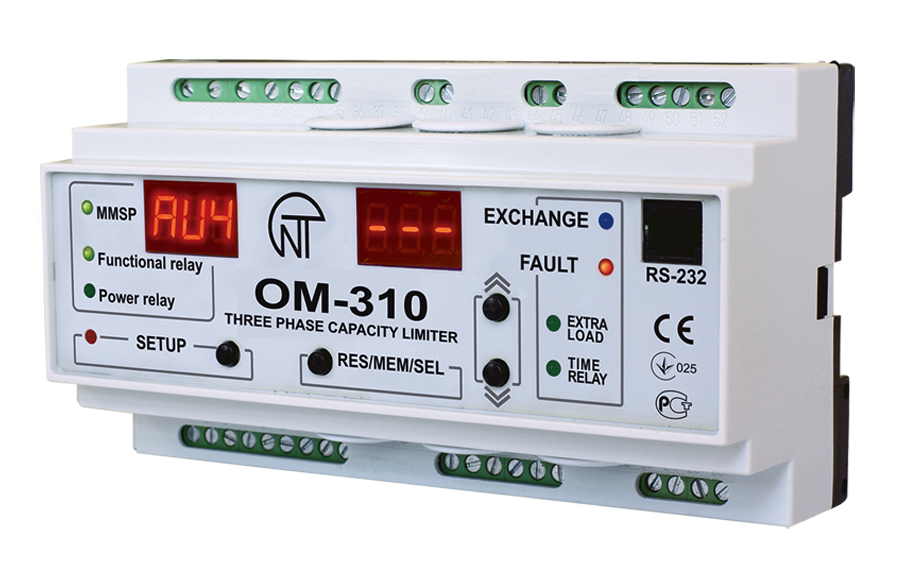
The OM-310 is the flagship demand-management device for three-phase commercial and industrial applications. It is a numeric, multi-functional relay with a dual LED display, designed to work across the standard Indian supply voltage of 380–415 V AC (3-phase, 3-pole or 4-pole) and cover a current range of 5 A – 800 A (2.5 kW – 450 kW).
What OM-310 Monitors and Controls
- Overcurrent protection with programmable trip curves
- Earth leakage (earth fault) protection
- Voltage monitoring (over/under voltage)
- Active power (kW) demand monitoring
- Complete load rejection — trips the entire load when power consumption exceeds the main threshold for a user-set time period
- Partial load rejection — sheds a secondary contactor output when consumption exceeds an intermediate threshold, preserving the primary load
- Generator protection functions
Output Architecture
The OM-310 provides two independent relay outputs: a programmable SPDT contact (1NO + 1NC) for signalling or alarm duty, and a power DPDT contact (2NO + 2NC) for direct contactor driving. Both outputs are potential-free, making integration into any panel wiring straightforward. This dual-output architecture is what enables the partial/complete load-shedding hierarchy — the DPDT trips the main load contactor while the SPDT can activate a secondary shed group or send an alert to the BMS.
Price: Rs. 15,687 per piece (ex-GST)
Buy OM-310 OnlineOM-163 — Single-Phase Power Controller & Current-Voltage Monitoring Relay
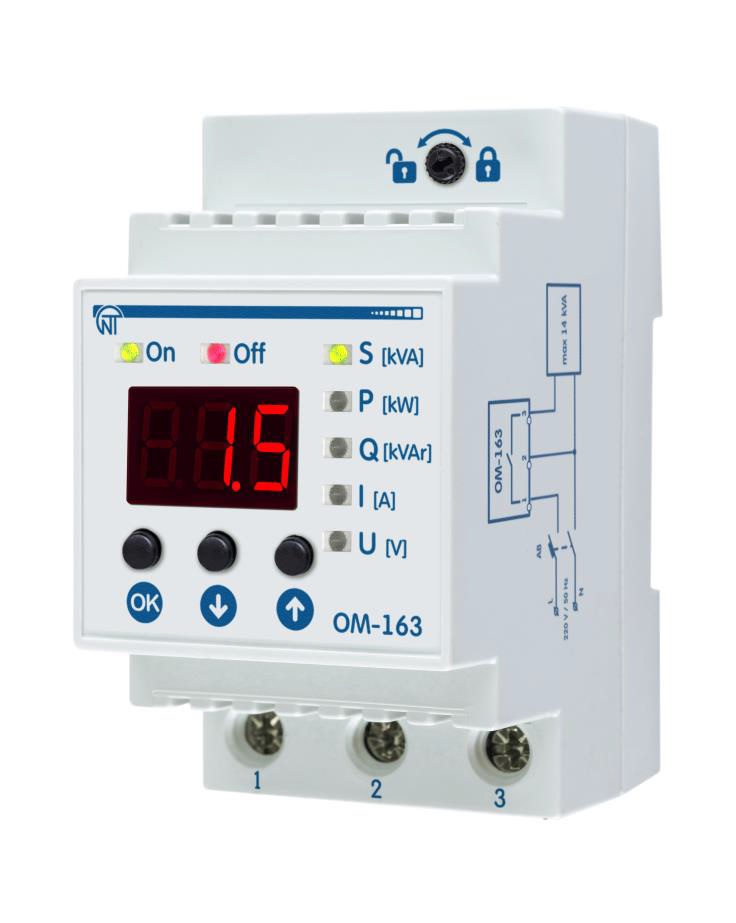
Not every load in a hotel is three-phase. Corridor lighting panels, single-phase HVAC splits, small water heaters, room-service kitchen circuits and laundry ironers are all single-phase loads. The OM-163 addresses this tier with a 2-pole, single-phase digital power controller rated at 63 A @ 250 V AC and designed for a supply voltage window of 130–300 V — wide enough to ride through the voltage sags common during peak-demand periods.
Functions in a DSM Scheme
- Power limiting (load shedding when current exceeds setpoint)
- Voltage monitoring (over and under voltage)
- Integrated energy metering function — useful for sub-metering individual floors or F&B zones
- Overcurrent relay function with programmable threshold
The three-digit display gives real-time readout of current, voltage or energy depending on configuration. Because the OM-163 has a built-in energy meter function, it doubles as a sub-metering device — allowing facilities managers to allocate energy costs across hotel departments (rooms, banquets, kitchen, laundry) without a separate energy meter installation.
Price: Rs. 3,500 per piece (ex-GST)
Buy OM-163 OnlineRMT-101 — Single-Phase Digital Overcurrent Relay with Built-In CT
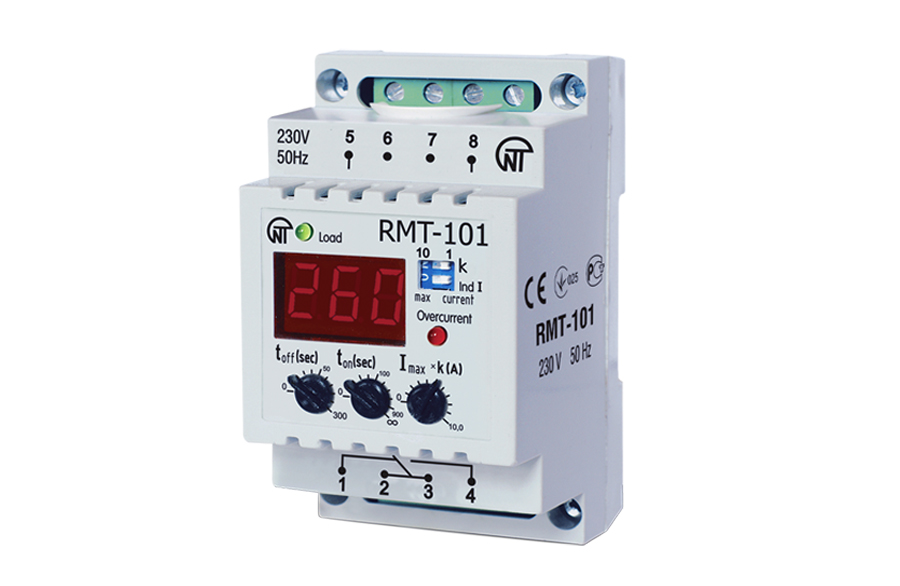
The RMT-101 is the workhouse device for individual circuit-level overcurrent protection and load rejection. Rated for 220–240 V AC, 2-pole, 0–100 A settable range, it features a built-in current transformer (CT) — eliminating the separate CT and wiring that add cost and panel space in traditional installations. The contact is a potential-free SPDT (1NO + 1NC) latching type.
Latching Contact — Why It Matters in Hotels
The latching coil type means the relay holds its tripped or reset state without continuous coil energisation. In a hotel context this is important: if a kitchen circuit trips on overload at 2 a.m., the latching contact keeps the downstream contactor open until a deliberate reset action. This prevents phantom auto-restarts of cooking equipment in an unattended kitchen — a safety consideration that thermal bimetallic overloads do not address as cleanly.
The RMT-101 is rated to 450 V nominal insulation voltage, 2.5 kV impulse withstand, Pollution Degree II, Overvoltage Category II, IP40 device / IP10 terminal block — appropriate for standard switchboard environments.
Price: Rs. 5,475 per piece (ex-GST)
Buy RMT-101 OnlineModel Comparison Table
| Parameter | OM-310 | OM-163 | RMT-101 |
|---|---|---|---|
| Phase Configuration | 3-Phase (3P / 4P) | Single Phase (2P) | Single Phase (2P) |
| Supply Voltage | 380–415 V AC | 130–300 V AC | 220–240 V AC |
| Current Range | 5 A – 800 A | Up to 63 A @ 250V | 0–100 A (settable) |
| Power Range | 2.5 kW – 450 kW | Up to ~15.75 kW | Up to ~24 kW |
| Display | Dual LED (numeric) | 3-digit digital | Digital |
| Relay Output | SPDT (1NO+1NC) + DPDT (2NO+2NC) | Programmable output | SPDT (1NO+1NC) latching |
| Output Type | Potential-free | Potential-free | Potential-free |
| Key Functions | Demand ctrl, overcurrent, earth fault, voltage mon., generator protection | Power limiting, voltage mon., energy metering, overcurrent | Overcurrent / load rejection, built-in CT |
| CT Required | External CT (per installation) | Internal / application dependent | Built-in CT |
| Partial Load Shedding | Yes (2-tier) | Single threshold | Single threshold |
| Earth Fault Protection | Yes | No | No |
| Generator Protection | Yes | No | No |
| Insulation Voltage | — | — | 450 V |
| Impulse Withstand | — | — | 2.5 kV |
| IP Rating (device) | — | — | IP40 |
| Price (ex-GST) | Rs. 15,687 | Rs. 3,500 | Rs. 5,475 |
All prices effective 01.04.2026. GST @ 18% applicable extra.
Quick Selection Guide: Hospitality Applications
| Application / Load Type | Recommended Model | Key Reason | Price (ex-GST) |
|---|---|---|---|
| Main hotel incomer demand control (3-phase, >50 kW) | OM-310 | 2-tier load shedding, earth fault, demand monitoring up to 450 kW | Rs. 15,687 |
| Generator changeover protection panel | OM-310 | Generator protection function + overcurrent + earth fault | Rs. 15,687 |
| Floor-level SDB — single-phase sub-panel (<63 A) | OM-163 | Power limiting + sub-metering + voltage monitoring in one device | Rs. 3,500 |
| Laundry / kitchen equipment (single-phase, <100 A) | RMT-101 | Built-in CT, latching contact, 0–100 A settable — no separate CT required | Rs. 5,475 |
| Corridor lighting / decorative load shedding (single-phase) | RMT-101 or OM-163 | RMT-101 for pure overcurrent; OM-163 where energy monitoring also needed | Rs. 3,500 – Rs. 5,475 |
| Banquet hall HVAC + lighting combined panel (3-phase) | OM-310 | Handles mixed high-power 3-phase loads with partial shedding hierarchy | Rs. 15,687 |
How the Demand-Control Circuit Works — Step by Step
Basic Contactor-Driving Circuit
The relay output (potential-free DPDT on OM-310, SPDT on RMT-101/OM-163) is wired in series with the contactor coil supply. In normal operation the NO contact is closed, energising the contactor and connecting the load. When the relay detects a threshold breach, the contact opens, de-energising the coil and dropping the load. For the RMT-101 latching type, a separate reset pulse — either manual pushbutton or a timed auto-reset signal from a PLC/timer relay — is required to re-energise.
Two-Tier Shedding with OM-310
The OM-310's dual-output architecture enables a practical two-tier hierarchy:
- Tier 1 (Programmable SPDT): When demand crosses the intermediate threshold (e.g., 85% of MD limit), the SPDT energises a secondary contactor controlling non-critical loads — corridor lighting, ornamental fountains, supplementary ventilation.
- Tier 2 (Power DPDT): If demand continues to rise and exceeds the primary threshold for the user-set time, the DPDT trips the primary load group — typically supplementary AHUs, EV chargers or banquet lighting — preserving guest-room HVAC and kitchen supply.
Power Factor Interaction
In hotels with large inductive loads (motors, compressors, transformers), poor power factor directly inflates apparent power (kVA) and thus MD charges. While OM-310 and OM-163 monitor kW demand, the voltage monitoring function helps detect supply degradation associated with reactive loading. For comprehensive power factor correction, the demand controller should be used in conjunction with a dedicated APFC panel — the relay's alarm output can signal the APFC controller to switch capacitor banks faster during load surges.
Wiring Best Practices for Hotel Panel Installations
- CT sizing (OM-310): Select the external CT ratio such that the secondary current falls within the relay's 5 A input range at full load. Oversized CTs reduce resolution at low loads where demand monitoring accuracy matters most.
- Control cable segregation: Run relay control wiring (coil circuits, potential-free contacts) in separate conduit or trunking from power cables. Induced voltages on long cable runs can cause false pickup on sensitive digital relays.
- Contactor coil voltage matching: Confirm that contactor coil voltage matches the control supply. The relay output is potential-free — it does not supply voltage; it only switches the external control supply through the load contact.
- Latching relay reset wiring (RMT-101): Always wire a clearly labelled reset pushbutton accessible to maintenance staff. A latching relay that trips at 2 a.m. must not require panel-builder intervention to restore service.
- Earthing the relay chassis: Despite IP40 rating, always connect the relay chassis earth terminal to the panel earth busbar. This is mandatory under IS 3043 and ensures correct earth fault detection reference for the OM-310.
- Voltage monitoring wiring (OM-163): The 130–300 V range accommodates wide supply swings, but ensure the voltage sensing tap is taken from the same phase that the load contactor feeds — not a different phase or a different MCB, which would make the voltage reading irrelevant to the protected load.
Troubleshooting Common Installation Issues
Issue 1: Relay Trips Immediately on Energisation
Most commonly caused by the setpoint being programmed in secondary CT amps rather than primary load amps, or vice versa. Verify the CT ratio entered matches the physical CT installed. Also check that the load is not in a locked-rotor condition (motor starting surge) — increase the trip-delay time setting to ride through starting inrush.
Issue 2: No Trip Despite Clear Overload
Check CT polarity and wiring continuity first. A reversed CT secondary will present a near-zero differential signal to the relay. On RMT-101 with built-in CT, confirm that all conductors of the circuit pass through the CT window — a missed neutral in a single-phase circuit effectively halves the measured current.
Issue 3: OM-163 Shows Erratic Voltage Readings
The 130–300 V window is intentionally wide, but loose connections at the voltage sensing terminals create resistive voltage drops that corrupt the reading. Re-torque all terminals to the specified value and check for discolouration indicating thermal damage from a prior loose connection.
Issue 4: RMT-101 Latching Relay Does Not Reset
The latching coil requires a distinct reset pulse — verify that the reset pushbutton wiring is correct (momentary NO contact across the reset input, not wired in parallel with the trip input). Also confirm supply voltage at the relay terminals is within 220–240 V; a sagged supply during a fault event may not provide enough coil hold energy.
Demand controllers like OM-310 and OM-163 primarily address the demand component of the electricity bill, not the energy (kWh) component. If a 15-minute peak is flattened by shedding a 20 kW corridor lighting load for 8 minutes, the total energy consumed over the day barely changes — but the MD recorded by the discom drops, potentially moving the hotel into a lower demand slab. This is billing optimisation through load-timing management, not energy reduction per se. Both strategies matter — but they require different interventions and should not be conflated in the panel design brief.
Why Novatek Electro?
- ISO 9001:2015 Certified Manufacturing: Every OM-310, OM-163 and RMT-101 is manufactured under a certified quality management system — traceability, calibration records and process controls are not optional extras but standard practice.
- CE Certified Products: CE marking confirms conformity with European safety and EMC directives, providing independent validation of design integrity beyond Indian market requirements.
- Made in India, Delhi: Manufactured in Delhi, with localised supply chains, rupee-denominated pricing and availability through a national distributor network — no import lead times, no forex exposure.
- 30+ Years of Protection Device Expertise: Novatek Electro has been designing and manufacturing electrical protection relays for over three decades, with a product portfolio spanning motor protection, voltage monitoring, power controllers and demand management.
- Panel-Builder and OEM Support: Technical documentation, connection diagrams, dimension drawings and application notes are available for every model, supporting panel-builders and OEMs in integrating devices efficiently without re-engineering from scratch.
Frequently Asked Questions
Novatek Electro India — ISO 9001:2015 & CE Certified Manufacturer, Delhi
Buy Online: intelli-electro.com
Email: sales@novatek-electro.in
Phone / WhatsApp: +91-7840054744
Technical datasheets, connection diagrams and application notes available on request. Bulk pricing available for panel-builders and OEMs.