When the Sanctioned Demand Meter Is Your Biggest Operational Risk
Walk into the main LT panel room of any mid-sized textile manufacturing unit — a composite mill running ring frames, sizing machines, rapier looms and dyeing vessels — and you will find two things competing for the maintenance engineer's attention: the condition of the motors and the maximum demand reading on the energy meter. In many textile facilities operating on HT or LT tariff slabs, the maximum demand charge can account for 30–40% of the total monthly electricity bill. Exceed your sanctioned demand even once in a billing cycle, and the penalty is levied on the actual peak, not the average. That single spike can erase the cost savings from weeks of disciplined operation.
This is not a procurement problem. It is a panel-engineering problem — and it is solved at the distribution board level, with the right combination of power controllers, overload relays and contactor-driving automation. Novatek Electro's OM-310, OM-163 and RMT-101 are the devices that panel-builders and electrical contractors routinely specify for exactly this function in textile manufacturing environments.
The Textile Industry's Power Quality & Protection Landscape
Textile manufacturing is one of India's most electrically intensive industries. A single composite mill may run anywhere from 500 kW to several MW of connected load — spinning frames, weaving machines, stenters, compressors, effluent treatment pumps, lighting and HVAC — all drawing from the same LT bus. The power quality challenges are layered:
- Maximum Demand Overshoot: Simultaneous motor starts during shift changeover or after a power restoration event can push demand well past the sanctioned limit within minutes.
- Poor Power Factor: Large induction motor loads — ring frame drives, loom motors, compressor sets — present lagging power factor, increasing reactive kVA demand charges.
- Unbalanced Loading: Three-phase supply feeding single-phase ancillary loads (lighting, small tools) creates phase imbalance that accelerates motor winding degradation.
- Overload Conditions: Yarn breaks on ring frames, cloth jams on rapier looms, and clogged filter presses in effluent treatment all create sustained overcurrent events that unprotected contactors cannot respond to quickly enough.
- Earth Leakage in Wet Processes: Dyeing baths, chemical dosing stations and washing ranges operate in permanently wet environments where earth fault current is a fire and personnel safety risk.
Against this backdrop, the demand for panel-level intelligence — devices that can measure, respond and switch without SCADA intervention — is acute.
Product Overview: OM-310, OM-163 and RMT-101
OM-310 — Demand Controller, Overcurrent & Earth Fault Relay
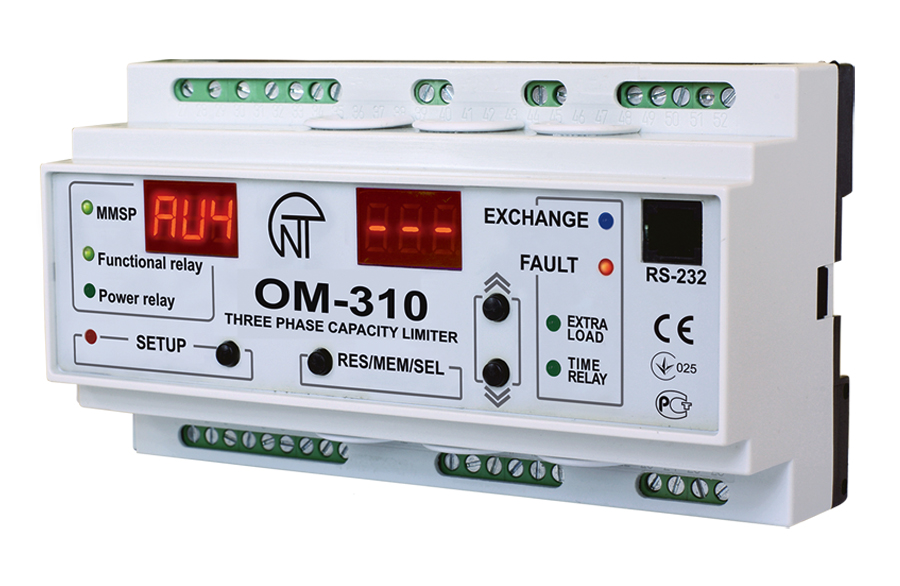
The OM-310 is a numeric, multi-functional protection relay combining demand control, overcurrent protection and earth fault detection in a single DIN-rail-mountable enclosure. It accepts three-phase and four-pole configurations, operates across 380–415 V AC, and covers a current range of 5 A to 800 A (equivalent to 2.5 kW to 450 kW of connected load). The dual LED display gives real-time visibility of load current and demand parameters directly at the panel face — a feature that field electricians appreciate during shift rounds.
In a textile panel context, the OM-310 is configured to monitor total drawn current against a pre-set demand threshold. When the threshold is approached, it drives a contactor output to shed the lowest-priority load in the sequence — typically an auxiliary compressor, a humidification fan or a lighting feeder — before the maximum demand reading peaks. This automated load-shedding sequence happens at the relay level, with no PLC or SCADA dependency, which is critical for mid-scale mills that have not yet invested in distributed control infrastructure.
Price: Rs.15,687 per piece (ex-GST)
Buy OM-310 OnlineOM-163 — Single-Phase Power Controller, Voltage Monitor & Energy Meter
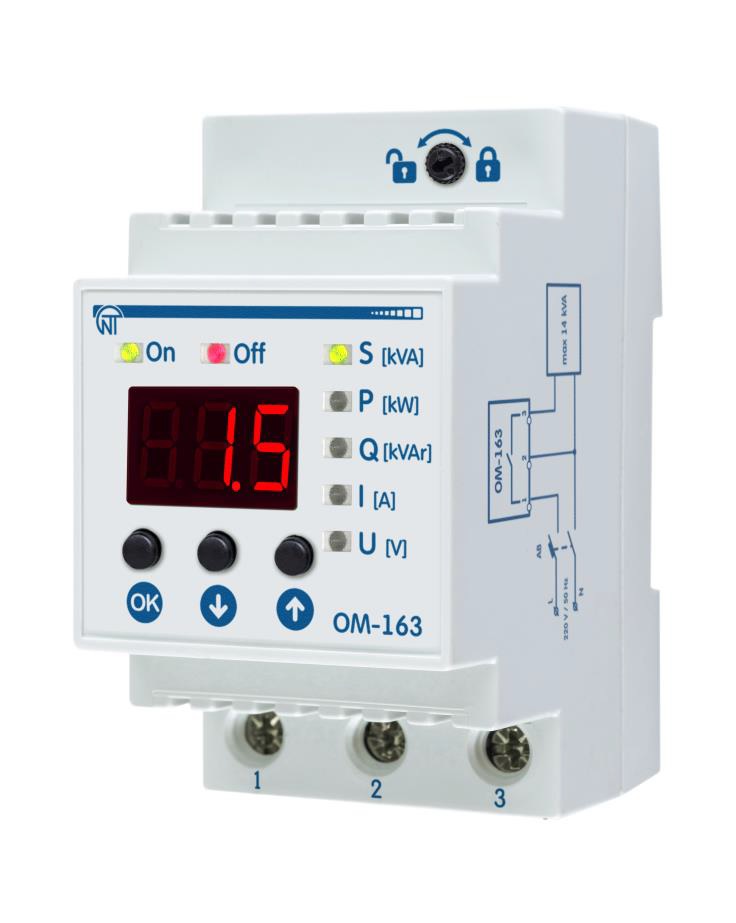
The OM-163 is a two-pole, single-phase power controller and monitoring relay operating at 130–300 V AC, rated up to 63 A at 250 V AC. It combines power limiting (load control), voltage monitoring, energy metering and overcurrent relay functions into a compact digital unit with a 3-digit display. At Rs.3,500 per piece (ex-GST), it is among the most cost-effective ways to add demand-side intelligence to single-phase ancillary circuits.
In textile manufacturing, the OM-163 is well suited for single-phase feeder circuits serving humidification systems, chemical dosing pumps, small fans, lighting sub-circuits and laboratory instrumentation — loads that are non-critical to production continuity but that collectively contribute meaningfully to peak demand. By pre-setting a current or power limit, the OM-163 automatically disconnects or restricts the load when the set threshold is crossed, preventing these peripheral circuits from contributing to a demand overshoot event.
Price: Rs.3,500 per piece (ex-GST)
Buy OM-163 OnlineRMT-101 — Contactor-Driving Timer Relay for Load Sequencing
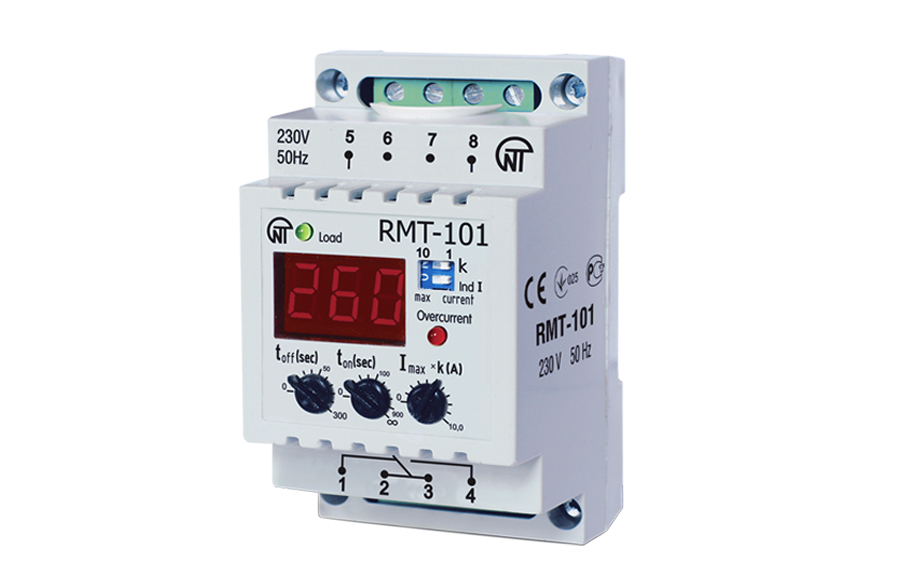
The RMT-101 is a digital timer relay designed to drive contactor coils in time-sequenced load-switching schemes. At Rs.5,475 per piece (ex-GST), it provides the time-delay and sequencing logic that complements the demand-measurement function of the OM-310 and OM-163 in a coordinated load-management panel.
In practical textile panel designs, the RMT-101 is used to introduce a time delay between the OM-310's demand-trip signal and the contactor energisation — preventing simultaneous re-energisation of multiple loads after a demand event, which would itself cause a current spike. It is also deployed for star-delta starting sequencing on larger loom-drive motors, and for timed re-connection of shed loads once the demand window passes.
Price: Rs.5,475 per piece (ex-GST)
Buy RMT-101 OnlineMapping Products to Textile Applications
For Main Incomer Panels in Spinning and Weaving Sections
The OM-310, deployed at the main incomer of a spinning or weaving section panel, monitors aggregate current draw across all three phases against the sanctioned demand threshold. When draw approaches the limit — typically during morning start-up when all ring frames or rapier looms are brought online simultaneously — the relay's contactor output trips the lowest-priority feeder (auxiliary ventilation, corridor lighting) until the transient peak subsides. This keeps the incomer's maximum demand reading within the billing threshold without any manual intervention.
For Humidification and HVAC Sub-Panels
Textile weaving sheds require precise humidity control (typically 70–80% RH) for yarn quality. Humidification systems — banks of centrifugal atomisers or ultrasonic humidifiers — are significant single-phase loads. OM-163 units installed on individual humidification feeders act as power limiters: when the total demand signal from the OM-310 at the main panel triggers a load-shed command, the OM-163 responds by disconnecting or limiting humidification loads in a pre-determined sequence. Because the OM-163 also monitors voltage at 130–300 V, it simultaneously protects the humidifier motors from low-voltage damage during grid sag events.
For Dyeing and Chemical Processing Panels
Jigger dyeing machines, winch dyeing vessels and padding mangles draw heavy single and three-phase loads during heating cycles. The OM-310's earth fault protection function is particularly relevant here — wet process areas present persistent earth leakage risk from corroded cable insulation and water ingress. The relay's combined overcurrent and earth fault monitoring ensures that a developing insulation fault in a dyeing vessel's heating element is detected and the contactor tripped before it escalates to a cable fire or personnel hazard.
For Compressor and Utility Service Panels
Compressed air is critical to shuttle looms and pneumatic yarn tensioning systems. However, the compressor set is also one of the highest-demand loads in the plant and an obvious candidate for demand-side shedding when the main incomer OM-310 signals an overload condition. The RMT-101 introduces a configurable time delay before the compressor contactor reconnects after a shed event — preventing the locked-rotor current spike of a compressor restart from immediately recreating the demand overshoot condition that triggered the shed in the first place.
For Effluent Treatment Plant (ETP) Sub-Panels
ETP pump panels in textile facilities typically run aeration blowers, sludge transfer pumps and filter press drives — all of which are non-critical to immediate production. The OM-310's overcurrent protection (5 A–800 A range) covers even the largest aeration blower motor, while its demand control output can be wired to shed ETP blowers during peak demand windows and reconnect them during off-peak periods — a simple, panel-level energy management scheme that requires no additional automation hardware.
Quick Selection Guide
| Application Type | Recommended Model | Key Function | Price (ex-GST) |
|---|---|---|---|
| Main incomer demand control, 3-phase panels up to 450 kW | OM-310 | Demand limit, overcurrent, earth fault, load shed output | Rs.15,687 |
| Single-phase ancillary feeders — humidification, lighting, small pumps | OM-163 | Power limiting, voltage monitoring, energy metering, overcurrent | Rs.3,500 |
| Load sequencing, time-delayed contactor re-energisation | RMT-101 | Timer relay, contactor driver, sequencing logic | Rs.5,475 |
| ETP and utility panels with mixed load shed and overload protection | OM-310 + RMT-101 | Demand control with sequenced reconnection | Rs.21,162 (pair) |
| Dyeing and wet process panels — earth fault priority | OM-310 | Earth leakage detection + overcurrent, 3/4-pole | Rs.15,687 |
Relevant IS/IEC Standards for Textile Panel Demand Management
Panel-builders and electrical contractors specifying these devices should be aware of the following applicable standards:
- IS/IEC 60947-4-1: Low-voltage switchgear and controlgear — electromechanical contactors and motor starters. Governs contactor ratings and coordination with overload relays.
- IS/IEC 60947-5-1: Control circuit devices and switching elements — relevant to the contactor-driving output circuits of OM-310 and RMT-101.
- IS 13947 (Parts 1–4): Indian standard equivalent of IEC 60947 series for LV switchgear — applicable to panel assemblies in textile facilities.
- IEC 61000-4-2 / IEC 61000-4-4: EMC immunity standards — relevant in textile environments with inverter drives generating high-frequency switching noise.
- IS 15884 / IEC 62053-21: Electricity metering equipment — accuracy class for energy measurement functions used in OM-163's energy metering mode.
- CEA Regulations 2010 (Amendment 2019): Central Electricity Authority regulations governing metering, demand recording and power factor penalty/incentive structures applicable to HT and LT industrial consumers in India.
- BEE Energy Conservation Building Code (ECBC): While primarily aimed at buildings, ECBC principles for demand-side management apply to textile facility utility areas and lighting panels.
When specifying the OM-310 for demand control at the incomer level, always verify the CT ratio of the existing metering CTs before wiring the OM-310's current input. The OM-310 covers 5 A–800 A directly; for installations above this range or where summation CTs are used, confirm input scaling with Novatek Electro's technical team. The RMT-101's time-delay setting must be co-ordinated with the compressor or motor's thermal time constant to ensure the motor has adequately de-accelerated before re-energisation.
Why Novatek Electro?
- ISO 9001:2015 Certified Manufacturer: Every OM-310, OM-163 and RMT-101 is manufactured under a documented quality management system — not assembled from unverified sub-components.
- CE Certified Products: CE marking confirms conformity with EU electromagnetic compatibility and low-voltage directives — a benchmark that panel-builders exporting panels to international OEM customers increasingly require.
- Made in India: Designed and manufactured in Delhi. No import lead-time uncertainty, no foreign exchange exposure on replacement units, and full local technical support.
- 30+ Years of Field Experience: Novatek Electro products have been specified across industrial, agricultural, municipal and commercial panel applications throughout India for over three decades.
- After-Sales and Application Support: Direct access to application engineers for CT sizing queries, panel integration questions and product selection — not a chatbot, not a brochure-forward response.
Frequently Asked Questions
Our application engineers are available to help panel-builders, electrical contractors and facility engineers with CT sizing, setpoint recommendations and panel integration guidance.
Shop Now at Intelli-Electro Email: sales@novatek-electro.in
Call us: +91-7840054744 | Novatek Electro India Private Limited, Delhi — ISO 9001:2015 & CE Certified Manufacturer