When the Grid Misbehaves, Your Telecom Tower Cannot Afford to Wait
Picture a remote defense communication relay station — a hardened telecom tower feeding encrypted voice and data to forward operating units. The local grid delivers a three-phase supply, but phase R is sagging to 168 V at peak agricultural pump load, phase Y is nominal, and phase B is intermittently dropping out. A conventional single-phase tap from phase R will cause the rectifier bank to collapse, the battery string to discharge, and the link to go dark — exactly when it is needed most.
This is not a hypothetical. Grid voltage imbalance and phase loss are the two most common power-quality disturbances in rural and semi-urban India, where a significant proportion of defense communication infrastructure, border surveillance towers, and aerospace tracking stations are located. The engineering answer is an automatic phase selector — a microprocessor-based device that continuously monitors all three incoming phases and routes the single-phase load to whichever phase is healthiest, in real time, without operator intervention.
Novatek Electro India Private Limited — ISO 9001:2015 and CE certified, Delhi-based manufacturer with over 30 years in electrical protection — offers three field-proven models for this exact duty: the PEF-301, PEF-319, and PEF-320. This article is an engineer-to-engineer guide on how to select, install, and get the most from these devices.
Why Automatic Phase Selectors Exist — The Engineering Problem
A three-phase four-wire (3L+N) distribution system is designed for balanced loading. In practice, single-phase loads — telecom rectifiers, UPS front-ends, hospital imaging equipment, ATM power supplies, edge-compute nodes — create chronic imbalance. Utilities respond by throttling or shedding individual phases, leaving some phases healthy while others are undervoltage, overvoltage, or absent entirely.
The traditional response — a manual changeover switch, a technician, a site visit — is incompatible with unmanned installations. An automatic phase selector solves this by:
- Continuously sampling voltage on all three phases (L1, L2, L3)
- Comparing each phase against user-configurable upper and lower voltage thresholds
- Selecting the phase that is within limits (and, where configurable, the user-preferred priority phase)
- Switching the single-phase output load to that phase via internal relay contacts or external magnetic contactors
- Repeating the evaluation cycle automatically whenever grid conditions change
For a defense telecom tower or an aerospace ground-station UPS, this means the rectifier sees a clean, within-limits voltage regardless of which phase the grid is currently degrading — fully autonomously, with zero human intervention.
Features to Demand in an Automatic Phase Selector
1. Adjustable Voltage Thresholds
Fixed trip points suit no one. A device that lets field engineers set both the upper (overvoltage) and lower (undervoltage) limits — via front-panel potentiometers or digital settings — adapts to the actual grid profile at each site, from coastal grids with frequent voltage swells to high-altitude stations with chronic undervoltage.
2. Phase Priority Configuration
When multiple phases are simultaneously healthy, the device should return to a user-designated priority phase. This matters for load-balancing across the three-phase feeder and for predictable behavior during commissioning and testing.
3. Direct-Load vs. Contactor-Controlled Switching
Small loads (rectifier control circuits, ATM power supplies) can be switched directly through the device's internal relay contacts. Larger loads — full telecom tower rectifier banks, hospital genset control buses — require the phase selector to drive external single-phase magnetic contactors. The device must provide the appropriate relay output for both architectures.
4. Protection Coverage
The device must detect and respond to undervoltage, overvoltage, and phase loss on each phase independently — not just aggregate conditions.
5. Robust Contact Form
Three SPDT (Single Pole Double Throw) relay outputs — one per phase — allow clean NO/NC switching logic for contactor coil control without external auxiliary relays.
Meet the Models: PEF-301, PEF-319, PEF-320
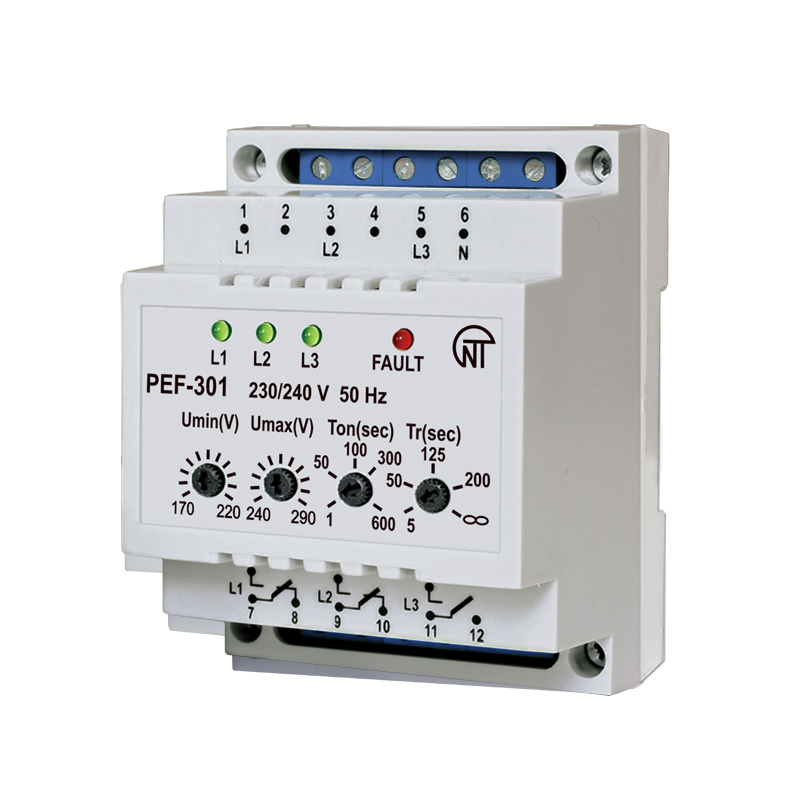
PEF-301 — The Workhorse for Standard Industrial Panels
The PEF-301 is designed for three-phase four-wire mains (220–240 V AC, 50 Hz). It carries up to 16 A direct on its internal contacts and can control magnetic contactors for any higher load. Contact form is 3 × SPDT relays. Switching criteria: undervoltage, overvoltage, phase loss. Priced at Rs. 3,440 per piece (ex-GST), it is the logical choice for panel-builders who need reliable phase selection without priority-phase logic.
Buy PEF-301 Online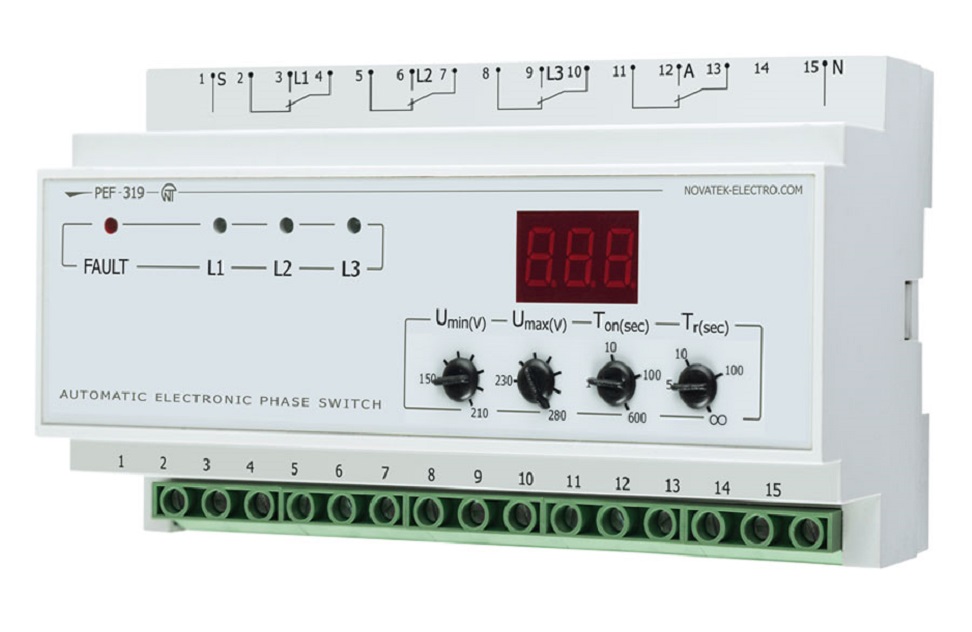
PEF-319 — High-Current Direct Switching for Heavy Single-Phase Loads
The PEF-319 is purpose-built for installations where the load can be up to 30 A (6.6 kW) direct — eliminating the need for an external contactor in many telecom and UPS front-end applications. Above 30 A, it drives external single-phase magnetic contactors. Maximum and minimum voltage limits are set via front-panel potentiometers. Contact form: 3 × SPDT relays. Protection: undervoltage, overvoltage, phase loss. At Rs. 5,625 per piece (ex-GST), the PEF-319 commands a premium justified by its higher direct-switching current rating — a real installed-cost saving when you eliminate a contactor and its enclosure.
Buy PEF-319 Online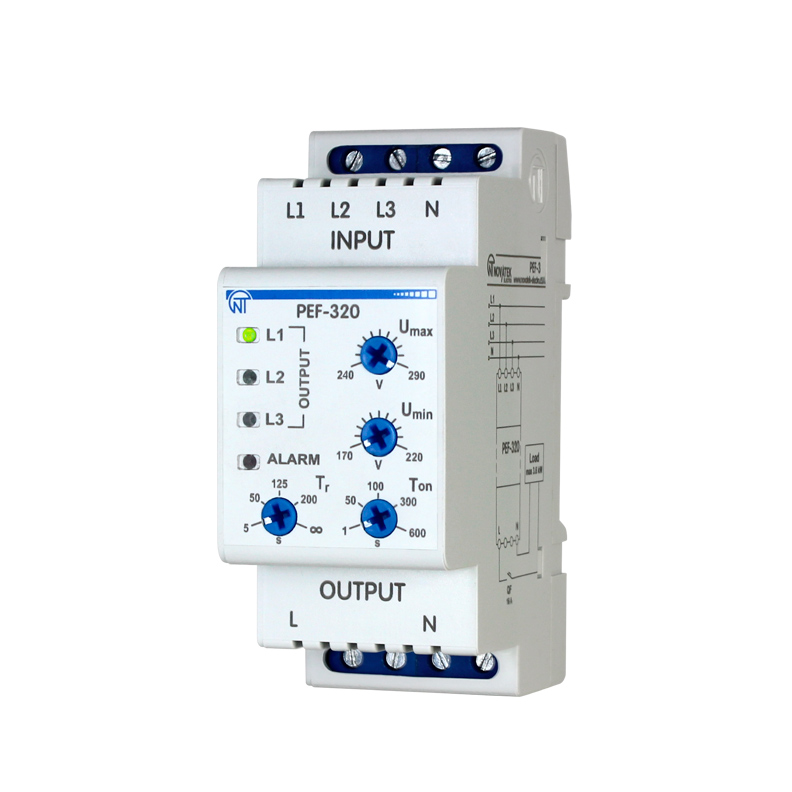
PEF-320 — Priority-Phase Logic for Structured Power Distribution
The PEF-320 adds one critical capability over the PEF-301: configurable priority phase. When the preferred phase recovers to within limits, the device returns to it automatically, ensuring predictable long-term load distribution across the feeder. Direct switching to 16 A, contactor control for larger loads. Contact form: 3 × SPDT relays. Protection: undervoltage, overvoltage, phase loss, priority phase. Priced at Rs. 3,150 per piece (ex-GST) — the lowest in the range — making it the best value for structured installations where phase assignment matters.
Buy PEF-320 OnlineModel Comparison Table
| Parameter | PEF-301 | PEF-319 | PEF-320 |
|---|---|---|---|
| Voltage Input | 220–240 V AC | 220–240 V AC | 220–240 V AC |
| Supply Type | 3-phase 4-wire + N | 3-phase 4-wire + N | 3-phase 4-wire + N |
| Frequency | 50 Hz | 50 Hz | 50 Hz |
| Direct Load Current | 16 A | 30 A (6.6 kW) | 16 A |
| Contactor Control | Yes (any load) | Yes (above 30 A) | Yes (any load) |
| Contact Form | 3 × SPDT Relays | 3 × SPDT Relays | 3 × SPDT Relays |
| Undervoltage Protection | Yes | Yes (adjustable) | Yes |
| Overvoltage Protection | Yes | Yes (adjustable) | Yes |
| Phase Loss Protection | Yes | Yes | Yes |
| Priority Phase Selection | No | No | Yes |
| Voltage Threshold Setting | Fixed / Internal | Front-panel potentiometers | Fixed / Internal |
| Price (ex-GST) | Rs. 3,440 | Rs. 5,625 | Rs. 3,150 |
| Price (incl. 18% GST) | Rs. 4,059 | Rs. 6,638 | Rs. 3,717 |
All prices as per Novatek Electro Price List 2026-27 effective 01.04.2026. GST @ 18% applicable extra. Prices subject to change — confirm with distributor at time of order.
Application-Based Selection Guide
| If Your Installation Requires… | Choose | Price (ex-GST) |
|---|---|---|
| Telecom tower rectifier up to 16 A, no priority-phase requirement, lowest panel cost | PEF-301 | Rs. 3,440 |
| Telecom tower or UPS front-end with direct load up to 30 A — contactor-free architecture, field-adjustable voltage thresholds | PEF-319 | Rs. 5,625 |
| Edge data centre or ATM with structured phase assignment — priority-phase return logic, 16 A direct, lowest unit price | PEF-320 | Rs. 3,150 |
| Hospital genset control panel feeding single-phase medical loads, contactor-controlled, no priority needed | PEF-301 | Rs. 3,440 |
| Defense forward-area communication node requiring automatic phase recovery to a designated phase after grid restoration | PEF-320 | Rs. 3,150 |
| Aerospace ground-station UPS front-end, load between 16 A and 30 A, field-configurable voltage window | PEF-319 | Rs. 5,625 |
Common Selection Mistakes — and How to Avoid Them
Mistake 1: Treating All Three Models as Identical
The PEF-301 and PEF-320 share a 16 A direct-load rating, but only the PEF-320 has priority-phase logic. Specifying PEF-301 for an installation that requires automatic return to a designated phase will produce unpredictable phase assignments after every grid event. Read the logic column carefully.
Mistake 2: Undersizing the Direct Contact Rating
Engineers sometimes size the phase selector for the steady-state load current and forget inrush. A telecom rectifier with a 14 A steady-state draw may present 25–28 A inrush at startup. In this scenario, the PEF-319 (30 A rated) is the safer direct-connect choice; the PEF-301 and PEF-320 (16 A rated) should drive a contactor.
Mistake 3: Ignoring Neutral Continuity
All three models require a solid neutral (N) connection from the four-wire supply. Phase selectors route the live (phase) conductor to the load; the neutral is common throughout. Floating or high-impedance neutrals — common in older distribution infrastructure — will produce erratic operation. Always verify neutral integrity at the installation point.
Mistake 4: Setting Voltage Thresholds Too Tight on PEF-319
The PEF-319 offers front-panel potentiometer adjustment of upper and lower voltage limits. Engineers new to the device sometimes set the window so narrow (e.g., ±3% of 230 V) that all three phases are simultaneously rejected during a grid sag — leaving the load de-energized. A practical starting point for most Indian grids is a lower limit of 180 V and an upper limit of 260 V, tightened only after characterizing the local grid profile with a power analyzer over at least 72 hours.
Mistake 5: Omitting Phase Selector from Single-Phase UPS Input
Many UPS installations are fed from whichever phase the panel-builder happened to terminate. On a degraded grid, that phase may be the worst of the three. Placing a PEF-301, PEF-319, or PEF-320 upstream of the UPS input terminal ensures the UPS always charges its battery from the healthiest available phase — extending autonomy during subsequent outages.
Installation Tips from the Field
- Mount vertically in the panel for convective cooling of the relay contacts — especially important in enclosed outdoor telecom enclosures where ambient temperatures can reach 55°C.
- Use ferrule-terminated wiring on all phase input terminals. Loose strands on a 30 A circuit cause hot joints that degrade both the terminal block and the device's measurement accuracy.
- Label the three phase inputs clearly (L1/R, L2/Y, L3/B) at the device. During commissioning, verify switching behavior by deliberately reducing one phase using a variac — never by opening a live bus without isolation.
- When driving magnetic contactors from the SPDT outputs, verify that the contactor coil burden is within the relay contact rating. Use interposing relays if coil currents exceed the specified contact capacity.
- Commission the priority-phase feature (PEF-320) by confirming that after a simulated fault and recovery on the priority phase, the device returns to that phase within the expected delay — not to whichever phase happened to recover first.
- Record the potentiometer settings (PEF-319) in the panel's as-built documentation. Settings are site-specific and must be reproduced if the device is replaced.
Why Novatek Electro?
- ISO 9001:2015 Certified Manufacturing: Every device is produced under a documented quality management system — not assembled from unverified sub-components.
- CE Marked: Products meet European safety and EMC directives, reflecting engineering discipline that goes beyond the minimum required for the Indian domestic market.
- Made in India, Delhi: Local manufacturing means shorter lead times, stocked spares, and technical support without time-zone friction.
- 30+ Years of Application Experience: Novatek Electro's protection relay portfolio spans voltage relays, phase sequence relays, time relays, and phase selectors — an integrated ecosystem, not a single-product catalogue.
- Panel-Builder and OEM Ecosystem: Products are available through a trained distributor and OEM network across India, with pre-sales technical support for specification queries.
The PEF-301, PEF-319, and PEF-320 are in stock and available for immediate despatch through our authorized online store. For bulk orders, panel-builder accounts, or technical pre-sales consultation:
Shop PEF Series Online Email: sales@novatek-electro.in Call: +91-7840054744