When the Grid Misbehaves, Your Telecom Tower Cannot Afford to Wait
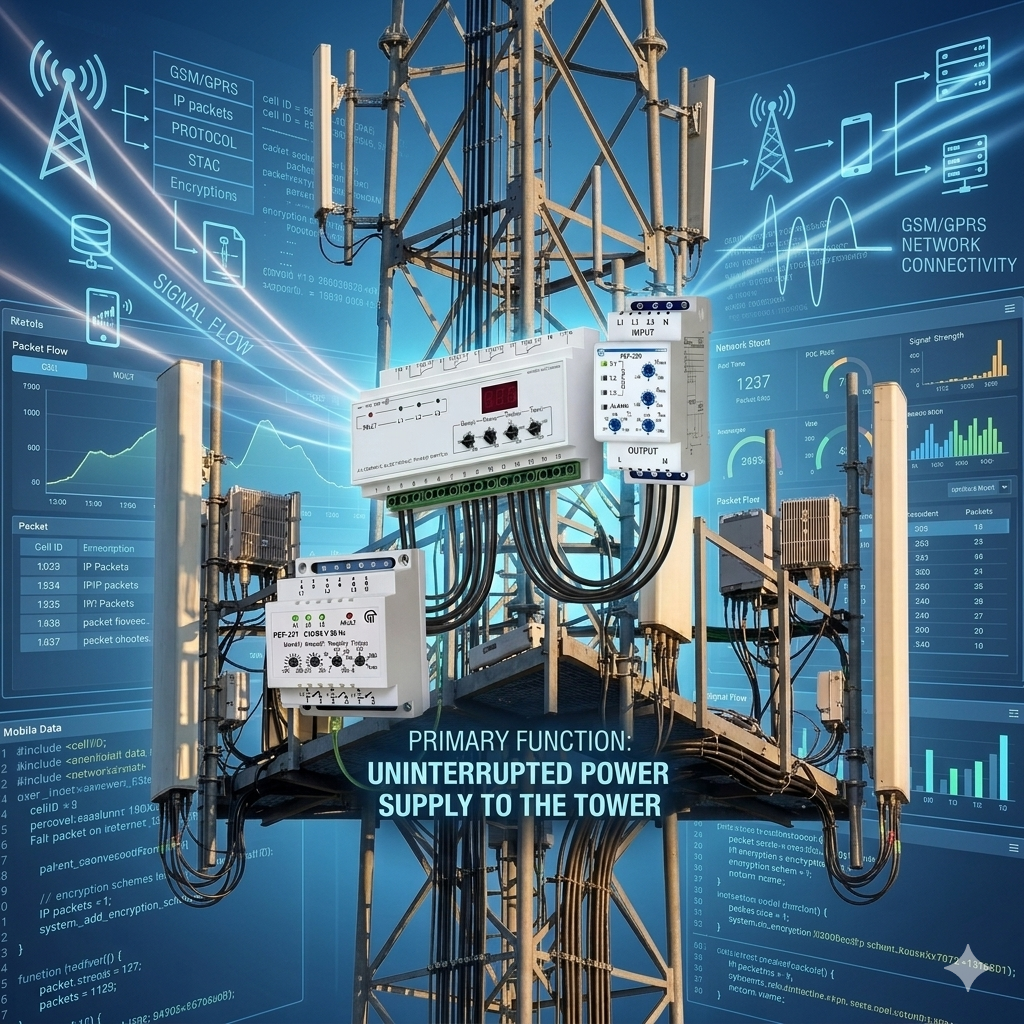
Picture a remote defense communication relay station — a hardened telecom tower feeding encrypted voice and data to forward operating units. The local utility delivers a three-phase supply, but phase R sags to 170 V due to a downstream transformer overload, phase Y is intermittently lost because of a broken overhead conductor, and only phase B is holding steady at 228 V. The tower's rectifier is single-phase fed. It has no intelligence to know which phase is healthy. It locks onto whatever phase it was wired to at commissioning — and when that phase fails, the tower goes dark.
This is not a hypothetical. It is the daily reality across thousands of telecom towers, edge data nodes, UPS front-ends, hospital generator control panels, and ATM kiosks deployed on India's grid — a grid that, despite significant investment, still delivers notoriously uneven three-phase quality at the last mile. The engineering problem is specific: a single-phase critical load connected to one fixed phase of a three-phase supply has no fallback when that phase degrades. The load trips, the mission fails, and no amount of downstream UPS capacity compensates for the fact that the UPS itself stopped charging because its rectifier input phase collapsed.
The solution is an Automatic Phase Selector — a microprocessor-based device that continuously monitors all three incoming phases for voltage quality and instantaneously switches the single-phase output to the healthiest available phase, without manual intervention and without a power interruption that exceeds the device's programmed switching time.
Novatek Electro India Private Limited — ISO 9001:2015 and CE certified, Delhi-based manufacturer with over 30 years of experience in electrical protection — offers three models purpose-built for this function: the PEF-301, PEF-319, and PEF-320.
Why Does Phase Quality Degrade? The Engineering Root Cause
India's distribution network operates at 11 kV/433 V (LT side) with four-wire three-phase topology. Several well-documented phenomena cause individual phase degradation at the consumer terminals:
- Load unbalance: Agricultural pump sets, residential loads, and small commercial consumers are distributed unevenly across phases, causing neutral current and per-phase voltage variation — sometimes 20–30 V differential between phases at the same metering point.
- Voltage sags and swells: Motor starting transients, capacitor bank switching, and arc furnace operations on shared feeders inject voltage disturbances that can last from milliseconds to several seconds.
- Phase loss: Single-phase faults, blown HRC fuses on LT feeders, or broken conductors on overhead lines cause complete phase absence — the most catastrophic condition for single-phase loads.
- Neutral displacement: In the absence of a solid neutral, three-phase unbalance causes neutral point shift, driving some phases above 260 V (over-voltage) while others collapse below 180 V (under-voltage).
A standard three-phase voltage relay can detect these conditions and trip a contactor — but it offers no intelligence to automatically route the load to a surviving healthy phase. That is the precise gap that automatic phase selectors fill.
The PEF-301, PEF-319 & PEF-320: How They Work
All three models share the same fundamental operating logic: continuously sample all three phases of the incoming 3-phase 4-wire (380 V + N) supply, evaluate each phase against user-configurable voltage thresholds, and route the single-phase 220/230/240 V output to the optimum phase. Each model uses 3 × SPDT relay outputs to control either direct switching (for loads within rating) or external magnetic contactors (for larger loads).
The switching criteria covers the three most common failure modes: under-voltage, over-voltage, and phase loss. The PEF-320 adds a fourth criterion: priority phase selection — allowing operators to designate a preferred phase (typically the most stable feeder) and return to it automatically once it recovers within limits.
Model-by-Model Technical Breakdown
| Parameter | PEF-301 | PEF-319 | PEF-320 |
|---|---|---|---|
| Voltage Type | AC | AC | AC |
| Operating Voltage | 220 – 240 V | 220 – 240 V | 220 – 240 V |
| Input Logic | 3-phase in, best phase out | 3-phase in, best phase out | 3-phase in, best phase out |
| Maximum Current Rating | Via contactor | 30 A direct / contactor for >6.6 kW | 16 A maximum |
| Output Contact Form | 3 × SPDT Relays | 3 × SPDT Relays | 3 × SPDT Relays |
| Protection Functions | Under-voltage, Over-voltage, Phase loss | Under-voltage, Over-voltage, Phase loss | Under-voltage, Over-voltage, Phase loss, Priority phase |
| Voltage Threshold Setting | User configurable | User adjustable (potentiometers on front panel) | User configurable |
| Frequency | 50 Hz | 50 Hz | 50 Hz |
| Price (ex-GST) | ₹3,440 | ₹5,625 | ₹3,150 |
All prices as per Novatek Electro Price List 2026-27, effective 01.04.2026. GST @ 18% applicable extra.
PEF-319 — The Industrial Workhorse for High-Current Loads
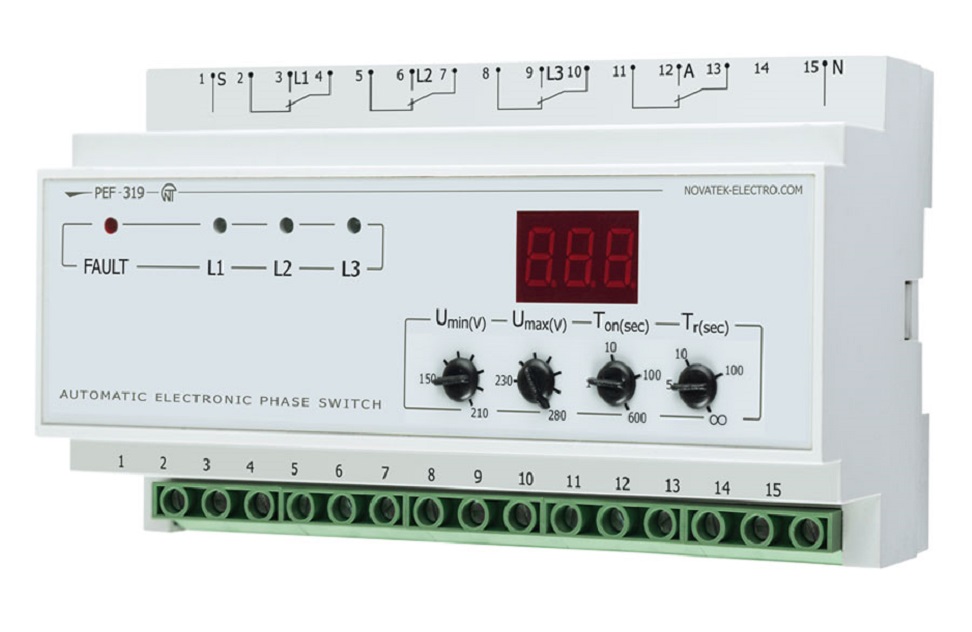
The PEF-319 is designed for both industrial and domestic single-phase 220/230/240 V, 50 Hz loads supplied from a three-phase four-wire (3×380 V + N) mains. Its standout feature is dual switching architecture: for loads up to 6.6 kW (30 A), the PEF-319 can energise the load directly. For loads exceeding this threshold, it controls the single-phase coils of external magnetic contactors — making it suitable for large UPS rectifier inputs, genset automatic mains failure (AMF) panels, and heavy rectifier banks in telecom power systems. Maximum and minimum voltage limits are set by the user via potentiometers accessible on the front panel — a critical feature in field deployments where the acceptable voltage window may differ from the IS 1646 nominal ±6% and needs to be tightened or relaxed based on load sensitivity.
At ₹5,625 per unit (ex-GST), the PEF-319 represents the highest-specification option in this range.
Buy PEF-319 OnlinePEF-320 — Priority Phase Logic for Managed Power Environments
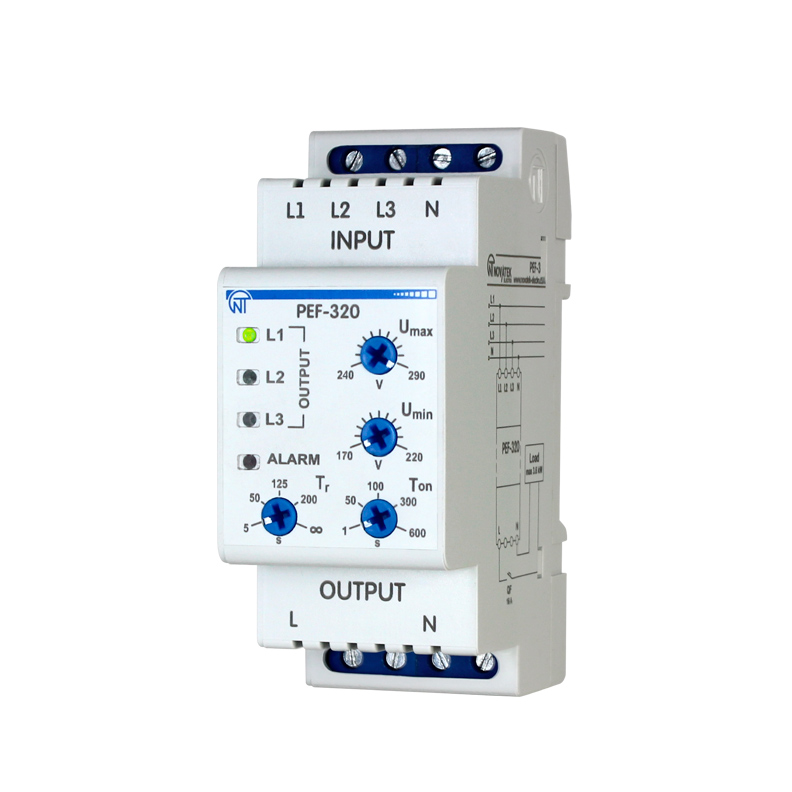
The PEF-320 is rated at 16 A maximum and adds the critically important priority phase function. In managed power environments — such as a defense edge data node where one phase is fed from a dedicated stable feeder and two phases from a shared utility feeder — the PEF-320 can be configured to always prefer the designated priority phase when it is within acceptable voltage limits, and switch away only when that phase degrades beyond the threshold. It auto-returns to the priority phase once it recovers. This prevents unnecessary switching cycles and reduces wear on downstream contactors.
At ₹3,150 per unit (ex-GST), the PEF-320 offers the best price-to-feature ratio for panel builders specifying ATM kiosks, small UPS systems, and compact edge nodes.
Buy PEF-320 OnlinePEF-301 — Versatile Contactor-Controlled Phase Selector
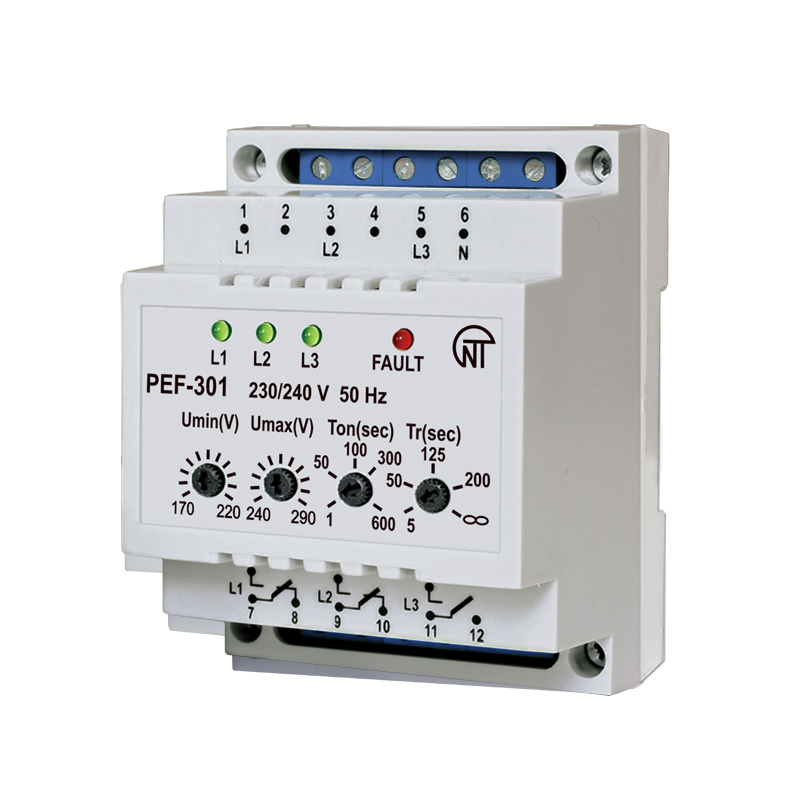
The PEF-301 operates via external contactor control, covering under-voltage, over-voltage, and phase loss protection functions. At ₹3,440 per unit (ex-GST), it fits naturally into existing panel designs where the panel builder already specifies a contactor for the main load switching duty and simply needs an intelligent phase-selection brain to drive it. Its 3 × SPDT relay outputs interface cleanly with standard contactor coil voltages used across Indian industrial panel practice.
Buy PEF-301 OnlineApplication Categories: Where Automatic Phase Selectors Are Deployed
The following application categories represent environments where single-phase critical loads exist on three-phase supplies, and where phase degradation or loss creates mission-critical risk:
- Telecom tower power systems: Tower rectifiers, battery chargers, and base transceiver station (BTS) power plants are single-phase fed. Phase loss causes rectifier shutdown, draining battery backup and eventually causing tower blackout. Phase selectors placed at the tower power distribution unit (PDU) input maintain rectifier energisation from whichever phase is healthy.
- Defense communication nodes and edge data centres: Forward operating base communication equipment, encrypted radio relay stations, and tactical edge servers require uninterrupted power. These sites often receive grid power from rural LT feeders with notoriously poor phase balance.
- UPS front-end rectifiers: An offline or line-interactive UPS feeding hospital ventilators, surgical equipment, or ICU monitoring systems is only as reliable as its own mains input. A phase selector ahead of the UPS input ensures the rectifier always charges from the best available phase.
- Hospital genset control and AMF panels: Genset AMF panels with single-phase sensing circuits benefit from phase selectors to ensure the mains sensing is always referencing a live phase — preventing nuisance AMF starts triggered by a false phase loss on the monitored phase while other phases remain healthy.
- ATM kiosks and banking infrastructure: ATMs are single-phase loads. A phase selector at the distribution board serving an ATM cluster ensures continuous availability even when the primary phase on the LT feeder fails.
- Cold chain and pharmaceutical storage: Temperature-controlled storage for vaccines and pharmaceuticals requires uninterrupted compressor power. Phase selectors protect the single-phase compressor control circuits in facilities served by three-phase supplies.
- Aerospace ground support equipment: Hangar lighting panels, navigation aid power supplies, and runway lighting controllers operating as single-phase loads from three-phase airfield power distribution systems benefit from automatic phase selection to prevent ground operations disruption.
Quick Selection Guide
| Application | Recommended Model | Key Reason | Price (ex-GST) |
|---|---|---|---|
| Telecom tower rectifier / large UPS input (>6.6 kW) | PEF-319 | Direct 30 A switching or contactor control for heavy loads; adjustable voltage thresholds | ₹5,625 |
| ATM kiosk, small UPS, edge server (≤16 A) | PEF-320 | Priority phase logic; auto-return to preferred phase; most economical | ₹3,150 |
| Panel-builder contactor-controlled applications | PEF-301 | External contactor control; clean SPDT relay outputs; mid-range price | ₹3,440 |
| Hospital AMF panel / genset sensing circuit | PEF-319 or PEF-301 | Contactor control flexibility; reliable phase-loss detection prevents nuisance starts | ₹3,440 – ₹5,625 |
| Defense edge node with dedicated stable feeder | PEF-320 | Priority phase returns automatically to stable feeder phase after recovery | ₹3,150 |
Why Novatek Electro?
- ISO 9001:2015 Certified Manufacturer: Quality management systems govern design, production, and testing — ensuring every unit shipped meets documented specifications.
- CE Certified Products: PEF-series devices carry CE marking, confirming conformity to European safety and EMC directives — relevant for defense and aerospace procurement specifications that require internationally recognised certifications.
- Made in India — Delhi-Based Manufacturing: Domestic manufacturing ensures supply chain resilience, shorter lead times, and direct manufacturer support without import delays.
- 30+ Years of Product Engineering: Over three decades of designing electrical protection devices for Indian grid conditions — including the specific challenges of unbalanced LT feeders, rural grid instability, and high-ambient-temperature panel environments.
- Comprehensive After-Sales Support: Technical documentation, application engineering guidance, and distributor/OEM support network across India. Direct contact available for project-specific queries.
The PEF-301, PEF-319, and PEF-320 are available for immediate despatch through our authorised online store. For bulk procurement, OEM pricing, or project-specific application support, contact our technical sales team directly.
Online Store: intelli-electro.com
Email: sales@novatek-electro.in
Phone: +91-78400 54744
Shop PEF Series Now