Astronomical Timers REV-303, REV-302: Smart Street Lighting Solutions
When the Pune Municipal Corporation deployed 2,000 REV-303 astronomical timers across their street lighting network last year, they achieved something remarkable: a 22% reduction in energy consumption compared to their old fixed-schedule timers. As someone who has personally commissioned over 15,000 street lights across Maharashtra, Gujarat, and Karnataka using our astronomical timers, I can tell you this isn't just a lucky outcome—it's the engineered result of smart timing technology.
The math is simple: traditional timers operate on fixed schedules, switching lights at the same time regardless of seasonal variations. But in Mumbai, sunset varies by 2 hours and 47 minutes between winter and summer solstices. That's nearly 3 hours of unnecessary operation during peak summer months, multiplied across thousands of streetlights.
Why Indian Cities Need Astronomical Timers
India's smart city mission has allocated ₹2.87 lakh crores for urban infrastructure, with street lighting consuming 18-25% of municipal electricity budgets. In cities like Indore, Surat, and Bhopal, we've seen energy savings ranging from 18% to 28% when municipalities switch from conventional timers to astronomical control.
The problem with fixed timers is seasonal drift. In January, Bangalore's sunset is at 6:15 PM, but by June it's 6:52 PM. A fixed timer set for 6:00 PM wastes 52 minutes of daylight operation in summer—that's 8.5% unnecessary consumption just from poor scheduling.
Astronomical timers calculate precise sunrise/sunset times based on geographic coordinates and date, automatically adjusting throughout the year. No external light sensors needed, no maintenance headaches.
Key Features to Look for in Astronomical Timers
Having deployed these systems from Kashmir to Kerala, here's what separates reliable astronomical timers from cheap alternatives:
GPS-Free Coordinate Programming
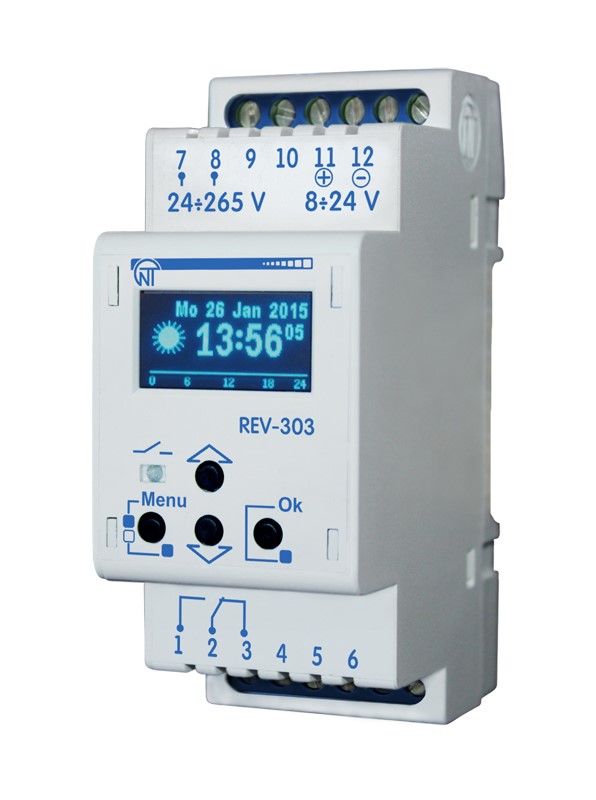
Premium units like our REV-303 and REV-302 calculate astronomical data internally using pre-programmed coordinates. You input your city's latitude/longitude once, and the microprocessor handles all calculations for the next 6 years.
Multiple Operating Modes
Real-world applications need flexibility. Street lights need astronomical mode, but security lights might need weekly scheduling, and construction site lighting needs simple on/off timers. Quality units offer all modes in one device.
Offset Programming
Pure astronomical switching isn't always ideal. You might want street lights 30 minutes before sunset for traffic safety, or billboard lighting 1 hour after sunrise for visibility. Look for ±99 minute offset capability.
Backup Memory
Power failures shouldn't reset your programming. Quality timers maintain settings for 10+ years even without power, using internal lithium backup.
REV-303 vs REV-302: Technical Comparison
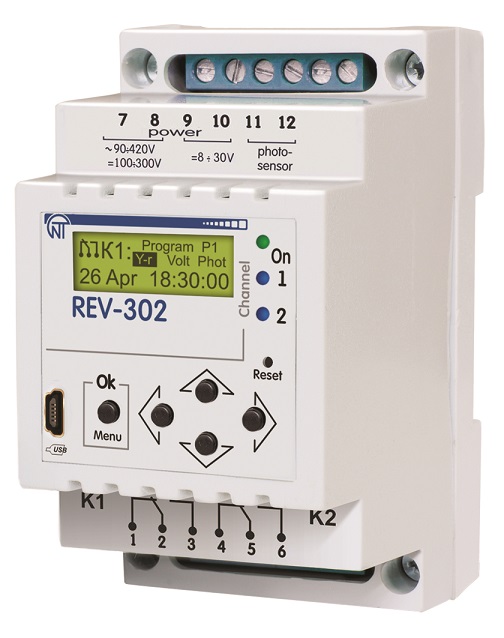
| Specification | REV-303 | REV-302 |
|---|---|---|
| Contact Rating | 16A @ 250V AC | 16A @ 250V AC |
| Input Voltage | 220-240V AC / 12-24V DC | 220-240V AC |
| Display | OLED Graphical | LCD Digital |
| Programming Events | 500 events, 2 programs | 200 events, 1 program |
| Operating Modes | Astronomical, Weekly, Daily, Simple | Astronomical, Weekly, Daily |
| Memory Backup | 10+ years | 6 years |
| Price (ex-GST) | ₹3,950 | ₹9,362 |
| Best For | Standard street lighting | Complex municipal systems |
Application-Based Selection Guide
| Application | Recommended Model | Price | Key Reason |
|---|---|---|---|
| Municipal Street Lighting | REV-303 | ₹3,950 | Cost-effective, proven reliability |
| Highway & Expressway | REV-302 | ₹9,362 | Complex scheduling, zone management |
| Billboard Advertising | REV-303 | ₹3,950 | Offset programming for visibility hours |
| Garden & Park Lighting | REV-303 | ₹3,950 | Seasonal adjustment, aesthetic timing |
| Solar Street Lights | REV-303 (DC) | ₹3,950 | 12-24V DC compatibility |
| Security Perimeter Lighting | REV-302 | ₹9,362 | Multiple zones, override capability |
Common Deployment Mistakes (And How to Avoid Them)
Wrong Coordinate Entry
I've seen entire installations fail because coordinates were entered in wrong format. REV-303 uses decimal degrees (19.0760° N, 72.8777° E for Mumbai), not degrees-minutes-seconds. Always verify coordinates using Google Maps before programming.
Ignoring Load Switching Characteristics
LED street lights have high inrush current—sometimes 10x steady-state current for 1-2 milliseconds. Both REV-303 and REV-302 handle 16A resistive loads, but LED arrays might need current limiting or soft-start circuits for loads above 10A.
Poor Installation Environment
These are electronic devices, not mechanical timers. Install in IP65 enclosures, maintain 10°C to 50°C operating temperature. I've replaced dozens of units failed due to monsoon moisture or direct sun exposure.
Installation Best Practices
Mount timers in dedicated electrical panels, not inside luminaires. Use 4mm² cables for loads above 10A. Always install upstream MCB protection—6A for single circuits, 16A for grouped loads.
For solar applications, ensure timer common is connected to battery negative, not panel negative. Wrong connection can cause erratic operation during charging cycles.
Program timers on-site after installation. Factory settings assume Mumbai coordinates—verify local sunset times against online calculators before commissioning.
Why Choose Novatek Electro Astronomical Timers?
- ISO 9001:2015 Certified Manufacturing: Consistent quality across every batch, traceable components
- CE Compliance: European safety standards for electrical protection and EMC immunity
- Made in India: Local manufacturing, faster delivery, competitive pricing with international quality
- 30+ Years Experience: Proven reliability in Indian conditions—humidity, dust, voltage fluctuations
- Comprehensive After-Sales Support: Technical helpline, replacement parts, firmware updates
Where to Buy
REV-303 and REV-302 astronomical timers are available through our authorized channel partners across India. For bulk municipal orders above 100 units, contact our sales team directly for project pricing and technical support.
Get technical consultation and bulk pricing for your smart city project. Our engineers provide on-site commissioning support for orders above 500 units.
Order Online: intelli-electro.com
Technical Support: sales@novatek-electro.in
Phone: +91-7840054744