Why Your Street Lights Are Still Burning at 10 AM — And How to Fix It
Walk through any industrial township, highway corridor, or commercial campus in India after sunrise and you will almost certainly find it: sodium-vapour or LED street lights blazing away, hours after the sun has climbed above the horizon. The cause is almost always the same — a fixed-time mechanical timer that was set once during commissioning and never touched again. Seasonal shift in sunrise and sunset times can be as much as 90 minutes across a calendar year at Indian latitudes, yet most lighting panels are still switching on the same fixed schedule from January to December. The result is wasted energy, shortened lamp life, and a maintenance headache that compounds every quarter.
The engineering answer is an astronomical timer — a microprocessor device that calculates actual sunrise and sunset times from entered geographic coordinates and a real-time clock, then switches loads accordingly, every single day, automatically. Novatek Electro India's REV-303 and REV-302 are exactly that. This article explains the underlying technology, how to select the right model, how to wire it correctly, and how to avoid the five most common installation mistakes on solar and street lighting projects.
The Physics Behind Astronomical Switching
Why Fixed Timers Fail in India
India spans roughly 8° N to 37° N latitude and 68° E to 97° E longitude — a spread that produces significant variation in both sunrise/sunset times and their seasonal drift. At 28° N (northern plains), the difference between the shortest and longest day is nearly 4 hours 40 minutes. A fixed timer cannot account for this. Every week of drift represents roughly 3–5 minutes of over-burn or under-burn at the lamp, and across a network of hundreds of luminaires, that adds up to measurable energy waste and premature lamp degradation.
How the Astronomical Algorithm Works
An astronomical timer stores the NOAA (National Oceanic and Atmospheric Administration) solar algorithm internally. When you enter your installation's latitude and longitude during commissioning, the microprocessor uses the equation of time and solar declination to calculate the exact local sunrise and sunset for every day of the 6-year onboard calendar. The output relay switches at a user-configurable offset — for example, switch ON at sunset minus 10 minutes, switch OFF at sunrise plus 5 minutes — capturing civil twilight without relying on external photocell sensors that can fail due to dust, bird droppings, or shadowing from nearby structures.
This is the core advantage over photocell-based switching: no external sensor, no drift over time, no false triggers from passing vehicles or lightning flashes. The calculation is deterministic and repeatable.
REV-303 and REV-302 — Technical Deep Dive
REV-303: The Workhorse for Street and Solar Lighting Panels
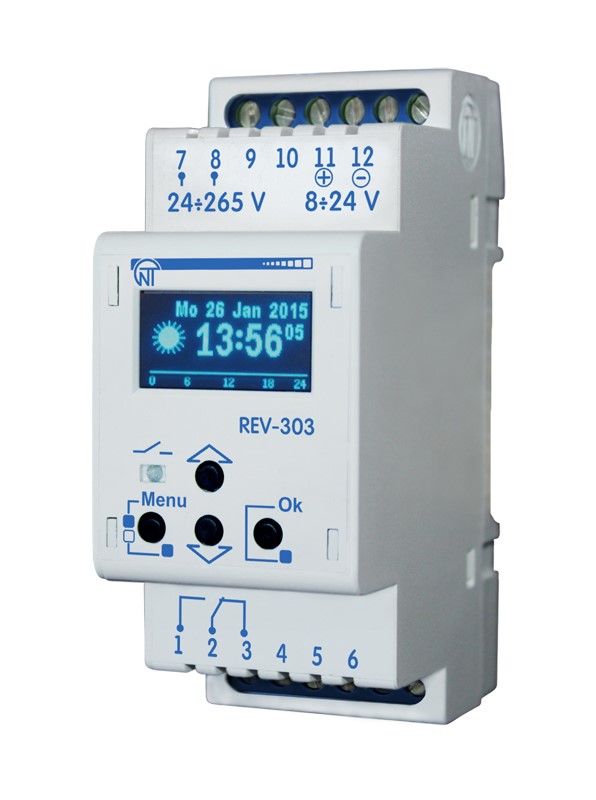
The REV-303 is a microprocessor-based, DIN-rail mounted astronomical and multifunctional programmable timer with an OLED graphical display. It supports four operational modes: Astronomical, Weekly, Daily, and Simple. The astronomical mode is the headline feature — enter your site coordinates once, and the device handles seasonal drift for the entire calendar lifetime without further intervention.
Key electrical ratings: supply voltage 220–240 V AC or 12–24 V DC (making it compatible with both grid-connected and solar battery-backed panels), output relay rated at 16 A / 3.5 kW @ 250 V AC via an SPDT (1NO + 1NC) contact. Event capacity is 500 events spread across 2 selectable preset programs — allowing, for example, one program for summer schedules and a second for winter or monsoon dimming strategies, switchable at the front panel in seconds. The 6-year onboard calendar eliminates the need for manual re-entry after power interruptions. Price: ₹3,950 per piece (ex-GST; GST @ 18% extra).
Buy REV-303 OnlineREV-302: Advanced Programmability for Complex Lighting Architectures
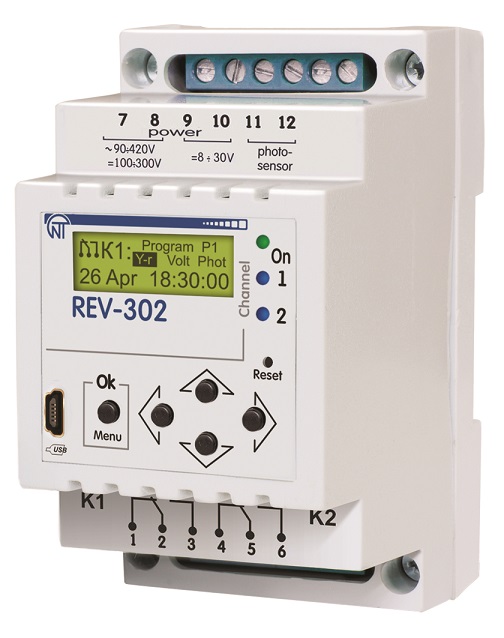
The REV-302 is the higher-specification model in this family, designed for applications where more complex scheduling logic is required — multi-zone billboard lighting, large solar farm perimeter security, or campus lighting networks with holiday override requirements. It shares the astronomical core with the REV-303 but adds extended programmability, making it suitable for panel builders and system integrators who need granular control over multiple switching events, holiday schedules, and program logic. Price: ₹9,362 per piece (ex-GST; GST @ 18% extra).
 Buy REV-302 Online
Model Comparison Table
| Parameter | REV-303 | REV-302 |
|---|---|---|
| Display | OLED Graphical | Digital Programmable |
| Supply Voltage | 220–240 V AC / 12–24 V DC | 220–240 V AC / 12–24 V DC |
| Output Contact | SPDT (1NO + 1NC) | SPDT (1NO + 1NC) |
| Output Rating | 16 A / 3.5 kW @ 250 V AC | 16 A / 3.5 kW @ 250 V AC |
| Operational Modes | Astronomical, Weekly, Daily, Simple | Astronomical + Extended Programmable |
| Programs / Events | 500 events / 2 preset programs | Extended multi-program |
| Calendar Life | 6 years | 6 years |
| Holiday Scheduling | Yes (programmable) | Yes (extended) |
| Coordinate-Based Sunrise/Sunset | Yes | Yes |
| Mounting | DIN Rail | DIN Rail |
| Certification | CE, ISO 9001:2015 | CE, ISO 9001:2015 |
| Price (ex-GST) | ₹3,950 | ₹9,362 |
Quick Selection Guide by Application
| Application | Recommended Model | Key Reason | Price (ex-GST) |
|---|---|---|---|
| Municipal street lighting | REV-303 | Astronomical mode + 6-yr calendar, low cost per panel | ₹3,950 |
| Solar farm perimeter security lighting | REV-303 | 12–24 V DC supply compatible with battery systems | ₹3,950 |
| Billboard / facade lighting | REV-302 | Complex multi-event scheduling, holiday override | ₹9,362 |
| Garden and landscape lighting | REV-303 | Simple astronomical dusk-to-dawn, weekly override | ₹3,950 |
| Campus / industrial security lighting | REV-302 | Multiple zones, extended program logic, holiday schedules | ₹9,362 |
| Off-grid solar lighting systems | REV-303 | DC supply compatibility, sensor-free operation | ₹3,950 |
Wiring Best Practices
1. Coordinate Entry Accuracy
Always enter latitude and longitude to at least two decimal places. A 0.5° error in latitude can shift calculated sunrise/sunset by 2–3 minutes, which compounds to 15+ minutes over a season. Use a verified GPS reference for the panel installation site, not the nearest city centroid.
2. Supply Voltage Selection
The REV-303 accepts 220–240 V AC or 12–24 V DC on its supply terminals. For solar battery-backed installations, connect the timer supply to the battery bus (nominal 12 V or 24 V DC) so the timer keeps running during grid outages. Do not connect the supply terminals to the load circuit — this is the most common wiring error on first installations.
3. Load Current and Contactor Sizing
The onboard relay is rated 16 A / 3.5 kW at 250 V AC. For direct switching of LED street light circuits within this rating, the internal relay is sufficient. For circuits exceeding 16 A (multiple luminaire strings, high-wattage HID fittings), wire the timer output to the coil of a DIN-rail contactor, not directly to the load. Use the NO contact for normally-off loads (lights off during daytime) and verify contact polarity before energising.
4. Time Zone and DST
India operates on IST (UTC+5:30) with no daylight saving time. Set the timer's time zone offset to +5:30. Errors here will shift all astronomical calculations by the equivalent offset error. After initial setup, verify the calculated sunrise and sunset times on the display against a published almanac for your latitude before handing over to the client.
5. Panel Enclosure and Ambient Temperature
Mount the timer inside an IP54 or better enclosure when installed outdoors. The OLED display of the REV-303 can be read through the enclosure door glass. Avoid mounting immediately adjacent to high-heat components such as contactors or MCBs — maintain at least 20 mm clearance on the DIN rail to avoid thermal de-rating of the relay contacts.
Troubleshooting Common Installation Issues
Timer Not Switching at Expected Time
First verify the real-time clock is correctly set — including date, not just time. A wrong date will produce a correct-looking display but wrong solar calculation. Second, confirm the latitude sign: southern hemisphere sites use negative latitude; Indian sites are always positive. Third, check that the mode selector is on 'Astronomical' and not on 'Simple' or 'Daily', which ignore coordinate data.
Output Relay Chattering at Switching Events
This typically indicates an inductive load (contactor coil or transformer) connected directly to the relay without a snubber circuit. Fit a RC snubber (typically 0.1 µF / 100 Ω) or a varistor across the load terminals to suppress the back-EMF transient. This is a standard protection measure for any relay output driving inductive loads.
Timer Loses Time After Power Interruption
The REV-303 uses an internal battery-backed RTC. If the device is brand new or has been in storage for over 12 months without power, the backup cell may be depleted. Apply supply power for 24 hours to fully charge the backup cell, then reset time and date. Subsequent power interruptions of normal duration (hours to days) will not cause time loss.
Why Choose Novatek Electro India?
- ISO 9001:2015 Certified Manufacturing: Every unit is produced under a quality management system covering design, production, testing and after-sales — not just a badge on the box.
- CE Certified Products: Both REV-303 and REV-302 carry CE marking, confirming compliance with EU Low Voltage Directive and EMC Directive — a standard increasingly specified in Indian government and export-facing projects.
- Made in India: Designed and manufactured at our facility in Delhi, with local component sourcing and full in-house testing, supporting the Atmanirbhar Bharat initiative.
- 30+ Years of Protection Device Expertise: Novatek Electro has been designing microprocessor-based protection and control devices since the early 1990s — the astronomical timer range is not a new experiment but an evolution of proven relay technology.
- Panel-Builder and Contractor Support: Technical datasheets, connection diagrams, and application notes are available for every product. Our team supports panel builders, system integrators and electrical contractors with pre-sales selection guidance and post-sales technical assistance.
The REV-303 at ₹3,950 (ex-GST) and REV-302 at ₹9,362 (ex-GST) are available for immediate dispatch across India. Whether you are a panel builder specifying timers for a municipal street lighting tender, an EPC contractor designing a solar farm auxiliary system, or a facility manager retrofitting an existing lighting panel — Novatek Electro has the right astronomical timer for your application.
Shop REV-303 & REV-302 Online Email: sales@novatek-electro.in Call: +91-78400 54744
Engineering FAQs
Novatek Electro India Pvt. Ltd. — ISO 9001:2015 & CE Certified | Delhi, India
🌐 intelli-electro.com — Buy REV-303 & REV-302
📧 sales@novatek-electro.in
📞 +91-78400 54744